

Making Workplace Communication Memorable Through Dual-Channel Learning
Key takeaways:
- People remember information better when they see and hear it simultaneously.
- Relying on only reading or listening makes it easy to forget key points.
- Real-time visuals paired with narration strengthen memory and understanding.
- Designing content with visual vs auditory memory in mind leads to better communication and retention.
According to Ebbinghaus’s Forgetting Curve, most people forget 70% of new information within 24 hours. This is not a theoretical insight or an academic footnote. It shows up clearly in workplace communication, where employees are expected to absorb policies, instructions, updates, and training content and then act on them correctly, often with little reinforcement.
When messages fail to stick, the issue is rarely a lack of effort or attention on the employee side, and it is not simply a matter of volume. More often, the problem lies in how information is presented and how the human brain processes and stores it.

Memory relies on two primary channels: visual and auditory. When communication depends too heavily on one channel while neglecting the other, retention drops and understanding weakens. Recognizing how visual vs auditory memory works together is essential for designing messages that move beyond delivery and actually stay with the audience.
This blog explains why combining visuals and narration improves retention, and why whiteboard videos are especially effective.
“They Heard It, But They Didn’t Get It.”
Organizations run into this problem all the time: the message was delivered, maybe even repeated, but it didn’t stick. Most often, this happens after a critical update has been shared. The details were explained clearly. Follow-ups were sent to reinforce the message.
And yet… people still miss key instructions, overlook important changes, or fail to act as expected.
It’s easy to blame this on a lack of attention or motivation. But more often, the real issue lies in how the information was processed and how it was remembered.
People retain information more effectively when they see and hear it together, not when it’s delivered through a single channel. In many cases, the communication breakdown stems from two common problems tied to visual vs auditory memory:
1. The Message Relies on One Memory Channel
Most workplace communication is delivered in a single format. For example, emails are text-only. Meetings may involve listening without visuals. In both cases, only one memory pathway, visual or auditory, is activated.
Even if employees appear to understand in the moment, memory fades quickly without reinforcement. When only one channel is engaged, retention drops.

2. Communication Isn’t Anchored in a Memorable Way
Workplace content is often shared as a list of changes or procedural updates instead of an engaging, coherent message. Employees are told what is happening, but not shown how it fits together or why it matters.
When communication feels abstract instead of anchored in a clear narrative, it’s harder to follow, and even harder to remember.
The Science Behind Retention (and What Most Training Misses)
Our brains rely on two primary pathways to process and store information: visual memory and auditory memory. Visual memory is triggered by what we see such as images, diagrams, and motion. Auditory memory is activated by what we hear, such as spoken words, tone, and rhythm.
Each channel can store information on its own. But when both are activated simultaneously, retention increases dramatically.
This is the foundation of Dual Coding Theory, a well-established concept in cognitive science. The principle is simple: when the brain encodes information through both visual and auditory memory, it builds stronger mental connections. The result? Your audience is far more likely to understand, retain, and apply what you’ve communicated.
At TruScribe, we design with this in mind. Our proprietary approach expertly synchronizes narration with visuals. The illustration unfolds in real time with the voiceover, activating both memory channels together. It’s intentional, strategic, and far more effective than traditional animation or static visuals.
Get Your Message to Stick (and Stay)
Explaining a process or policy is only the first step. The next is ensuring your audience actually remembers it. That’s where designing with visual vs auditory memory in mind makes a measurable difference.
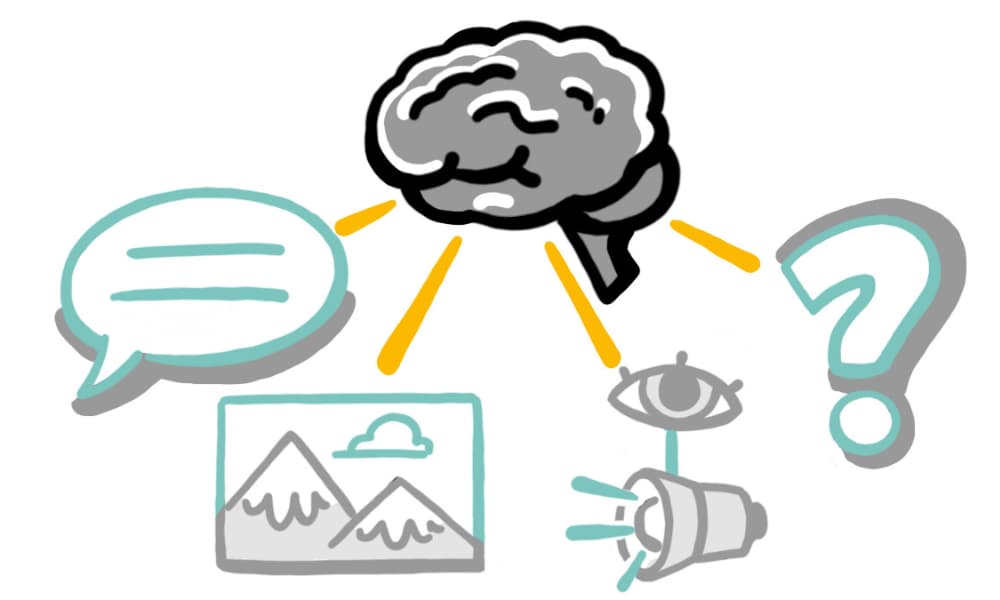
Use the following dual-memory messaging checklist when planning your whiteboard explainer videos, training sessions, or internal communications. It will help ensure your message lands.
1. Narration (auditory memory support)
Your narration is the voice your audience will remember. With clear, structured speech, you ensure that auditory memory locks in the key points. Ask yourself:
- Does your narration have a clear story arc (problem → solution → next step)?
- Are sentences short, active, and free of jargon?
- Are key points repeated or summarized to reinforce learning?
- Is the tone aligned to the emotional intent (e.g., calm, enthusiastic, professional)?
2. Visuals (visual memory support)
What people see sticks as much as what they hear. Compelling visuals guide attention, simplify complex ideas, and make abstract concepts concrete. Check:
- Are visuals drawn in real time to match narration flow?
- Do illustrations highlight key ideas — not distract from them?
- Is white space used effectively to prevent cognitive overload?
- Are metaphors or symbols used to make abstract ideas concrete?
3. Alignment between sight and sound
Your visuals and narration work best when they happen together. Synchronization ensures the brain links what it sees with what it hears. Here’s what you should pay attention to:
- Does the image appear just as the narration mentions it (synchronized)?
- Are redundant words removed from visuals to reduce overload?
- Does each scene support one key concept at a time?
- Is the pacing slow enough for processing, but fast enough to maintain interest?
4. Retention support
Even with strong narration and visuals, messages need structure to be remembered. Reinforcement and clear transitions help ideas stick and stay. Confirm the following:
- Is the video structured with clear chapter breaks or transitions?
- Are there visual summaries or recaps of core ideas?
- Are CTAs or final takeaways reinforced visually and verbally?
- Could a viewer describe the message back to you in their own words?
The proof is in the results
Whether you’re sharing important updates, teaching a new concept, or helping people understand a process, retention is essential. When messages are designed to engage both visual and auditory memory, the difference is clear: people understand more, remember longer, and act with greater confidence.
The TruScribe approach, Scribology, ensures that every line drawn and every word spoken is designed to make information stick. By aligning visuals with narration in a purposeful, science-backed way, we help audiences retain what matters. Whether the goal is to educate, explain, or inspire action, our clients consistently see stronger understanding, fewer follow-up questions, and clearer communication outcomes across a wide range of use cases.
Design for How the Brain Works
If you want your message to be remembered, start by designing with the brain in mind. The Dual Memory Messaging Checklist included in this guide is a practical tool to help you align visuals and narration, using both visual and auditory memory to your advantage.
Whether you’re sharing ideas with the public, educating a group, or simply trying to explain something clearly, this checklist will help you create messages that truly stick.
Need help bringing it all together? We’re here for that too.
Reach out to us to explore how a visual strategy, grounded in cognitive science, can help you communicate with greater clarity and impact.