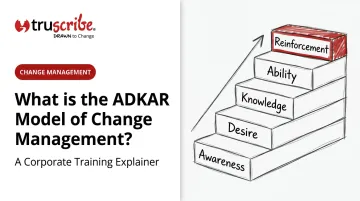
The ADKAR model exists precisely to address that gap. Developed by Jeff Hiatt at Prosci, it reframes organizational change as something that only succeeds when every affected individual successfully makes a personal transition. No matter how well-crafted the project plan, the change only lands if the people involved move through each stage of adoption.
This article covers the five ADKAR stages in detail, how to implement the model, its genuine benefits and limitations, and how it compares to other common frameworks — giving you a practical foundation for applying it in your organization.
Key Takeaways
- ADKAR stands for Awareness, Desire, Knowledge, Ability, and Reinforcement — five sequential stages every individual must pass through for change to stick
- The stages are intentionally sequential; skipping or rushing any one stage creates a "barrier point" that stalls the entire effort
- Desire is the hardest stage — it cannot be mandated, only influenced
- Prosci research shows 88% of teams with excellent change management met objectives — versus just 13% with poor change management
- ADKAR works at the individual level and pairs well with enterprise-wide frameworks like Kotter's 8-Step
What Is the ADKAR Model of Change Management?
ADKAR is a goal-oriented, outcome-focused change management framework created by Jeff Hiatt, who founded Prosci in 1994 after studying why organizational changes succeeded or failed. A former Bell Labs engineer and program manager, Hiatt developed the model in 1996, first published it in 1999, and expanded it into a full book in 2006. The research base spans more than 700 organizations.
Organizational change only works when each affected individual completes their personal transition. An enterprise-level initiative is, at its foundation, a collection of individual human decisions — and ADKAR gives leaders a structured way to measure and manage each one.
Three Phases of the Change Journey
Prosci maps the five ADKAR elements onto three organizational states:
| Phase | ADKAR Elements | Focus |
|---|---|---|
| Current State (preparing for change) | Awareness, Desire | Why change is needed; building willingness |
| Transition State (adapting to change) | Knowledge, Ability | How to change; building capability |
| Future State (sustaining change) | Reinforcement | Preventing reversion; embedding the new normal |
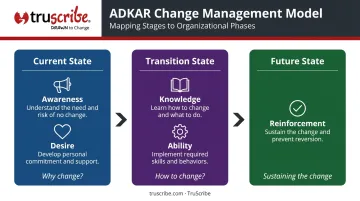
This three-phase view helps change leaders pinpoint exactly where each person — or group — stands, rather than treating the entire workforce as a single audience with identical needs. That precision is what separates ADKAR from broader, less diagnostic frameworks.
Key reasons practitioners rely on this structure:
- Individual focus: Change is measured person by person, not just at the initiative level
- Diagnostic clarity: Leaders can identify which phase is stalling and intervene directly
- Sequential logic: Each element builds on the last, so gaps become visible before they become failures
The 5 Building Blocks of the ADKAR Model
Awareness
Awareness is the foundation. Employees need to understand not just that a change is happening, but why — the business drivers, the risks of staying the same, and what the future state looks like. Without this, resistance is nearly guaranteed.
Prosci's research, drawing on more than 10,800 responses across 38 industries and 101 countries, found that 58% of employees prefer personal-impact communications from their immediate supervisor. Organizational rationale and strategic context land better from senior leaders.
Building Awareness effectively:
- Use multiple communication channels — no single announcement is enough
- Match the messenger to the message (supervisors for personal impact, executives for strategic rationale)
- Make the "why" compelling, not just informational
- Address the risks of inaction, not only the benefits of change
Desire
Desire is the hardest stage because it cannot be mandated. Telling someone they must support a change is not the same as them genuinely wanting to. Passive compliance and active buy-in produce very different behaviors — and only one of them sustains a change long-term.
Strategies for building Desire:
- Connect the change to personal benefits ("What's in it for me?")
- Involve employees early so they feel ownership, not just obligation
- Identify change champions who can influence peers authentically
- Proactively address fears about job security, workload, or role changes
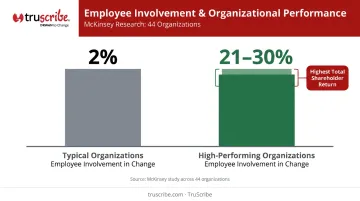
McKinsey's analysis of 44 organizations found that companies involving 21–30% of employees in transformation milestones achieved the highest total shareholder return — compared to the typical rate of just 2% employee involvement. The data makes the cost of low engagement concrete.
Knowledge
Knowledge is where organizations equip employees with what they need to know — new processes, tools, behaviors, and expectations. The most common mistake is jumping straight to training before establishing Awareness and Desire first. Prosci is explicit: training delivered before those foundations are in place isn't just ineffective — it can actively frustrate employees who aren't yet ready to receive it.
Building Knowledge effectively:
- Develop role-specific training rather than one-size-fits-all programs
- Use multiple learning formats: workshops, written documentation, video
- Set clear performance expectations so employees know exactly what success looks like
Format is a practical consideration here, not just a stylistic one. Employees absorbing unfamiliar processes under pressure retain information better when training uses sequential, visually structured delivery — the kind that directs attention rather than demanding it. Organizations choosing communication tools for change rollouts should prioritize formats built around how people actually process new information, not just what's easiest to produce.
Ability
There's an important distinction between Knowledge and Ability: knowing how to do something is not the same as being able to do it consistently under real conditions. A person can sit through every training session and still struggle when faced with the actual work.
Ability is built through practice, coaching, and hands-on application — not information transfer alone.
Methods for building Ability:
- Provide safe practice environments — sandbox scenarios, simulations, pilot programs
- Identify and close skill gaps through targeted coaching and feedback
- Remove organizational barriers: outdated tools, conflicting priorities, insufficient time
- Offer ongoing feedback rather than one-time assessments
Prosci defines Ability as the point where change actually occurs through demonstrated behaviors. It's not a milestone you check off — it's a state you maintain.
Reinforcement
Without Reinforcement, even well-executed changes fade. Humans naturally drift back toward familiar habits, especially when the new way is harder or when leadership attention moves on to the next initiative.
Prosci's research on sustainment found that 81% of participants who planned reinforcement or sustainment activities met or exceeded their objectives, compared to 15% who did not. That gap is substantial.
Reinforcement strategies:
- Recognize and reward early adopters visibly
- Monitor adoption metrics — don't assume momentum
- Address relapses with additional support, not blame
- Embed the change into policies, performance evaluations, and culture so it becomes the new standard
How to Implement the ADKAR Model in Your Organization
Start With a Readiness Assessment
Before applying ADKAR, identify where your employees and groups currently stand. Which stage are most of them at? Which teams are farthest behind? A readiness assessment maps the landscape before you build the plan — it prevents wasting training resources on employees who haven't reached Desire yet, or communication budgets on groups that are already at Ability.
Sequence and Pace Your Interventions
ADKAR is sequential by design. Each stage must be sufficiently achieved before the next one can take hold. But different employees move at different rates — and some will regress. An employee who was absent during initial communications may need to revisit Awareness long after others have moved to Knowledge.
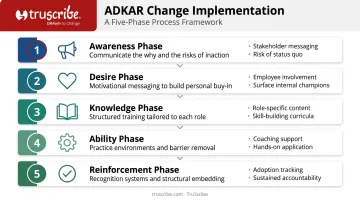
Map your communications and training to ADKAR stages:
- Awareness phase — Focus early communications on the why: business drivers, risks of inaction, what the future looks like
- Desire phase — Shift to motivational messaging; involve employees, surface champions, address fears directly
- Knowledge phase — Deliver structured training and documentation; use role-specific content and multiple formats
- Ability phase — Create practice opportunities; provide coaching, feedback loops, and barrier removal
- Reinforcement phase — Implement recognition systems, track adoption metrics, and embed the change structurally
Identify and Resolve Barrier Points
Sequencing interventions correctly is only half the challenge — knowing where individuals are stuck is the other half. ADKAR's diagnostic power makes this practical. When someone is struggling with a change, the model helps pinpoint exactly which stage is blocking progress. On Prosci's assessment scale, the first element scored 3 or lower (out of 5) is the barrier point.
Because the stages are sequential, fixing a later-stage symptom won't help if an earlier stage is incomplete. Two examples illustrate why this matters:
- An employee who appears resistant may simply lack Awareness — not motivation
- Someone who seems capable in training may be blocked by an Ability barrier: no time to practice, outdated tools, or conflicting priorities
Specific diagnosis leads to specific intervention.
Benefits and Limitations of the ADKAR Model
Benefits of ADKAR
ADKAR's strengths explain why it's one of the most widely adopted change management frameworks in use today.
- Each stage produces a measurable outcome, making progress concrete rather than conceptual
- Addresses individual barriers rather than treating the workforce as a single, uniform group
- Helps leaders pinpoint exactly where a change effort is stalling — and why
- Backed by practitioner data — Prosci's research across more than 2,600 practitioners shows a sevenfold difference in outcomes between excellent and poor change management application
ADKAR also helps organizations avoid the most common failure patterns: skipping communication (Awareness), underestimating emotional resistance (Desire), overloading training before readiness is established (Knowledge), or declaring success before new behaviors are embedded (Reinforcement).
That said, ADKAR has real boundaries — and knowing them upfront prevents misapplication.
Limitations of ADKAR
The model is not designed to solve every change challenge:
- Individual-level scope — the model diagnoses individual outcomes, not enterprise strategy, governance, or organizational design; for large-scale structural transformations, it needs to be paired with frameworks that address those dimensions
- Resource-intensive — implementing ADKAR properly requires consistent leadership attention at every stage, not just during launch
- Doesn't address structural or political dynamics — power structures, culture clashes in mergers, and systemic organizational barriers require additional tools
- Limited empirical grounding — a 2025 review in the Journal of Organizational Change Management noted limited scientific scrutiny of popular change frameworks, including ADKAR; the model is a useful diagnostic structure, but not a guaranteed formula
ADKAR vs. Other Change Management Models
No single framework works for every situation. Here's how ADKAR relates to the most common alternatives:
| Framework | Primary Focus | Best For |
|---|---|---|
| ADKAR | Individual adoption outcomes | Diagnosing and supporting personal change transitions |
| Kotter's 8-Step | Enterprise-level leadership and transformation | Building organizational momentum from the top down |
| ITIL | IT service management and delivery | Managing how IT services are governed and improved |
| Lewin's 3-Stage | High-level organizational sequence | Simpler transitions needing a broad-strokes structure |
| Kübler-Ross Change Curve | Emotional responses during change | Understanding grief and acceptance as a lens on reactions |
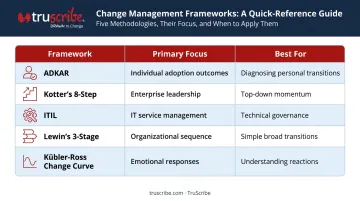
ADKAR and Kotter's 8-Step are frequently used together. Prosci explicitly describes the two as complementary: Kotter guides the organizational strategy — building urgency, forming a coalition, institutionalizing the change — while ADKAR ensures individuals are actually making the transition. One without the other leaves an adoption gap, where employees don't shift behavior even when the organizational strategy is sound.
ADKAR and ITIL serve different purposes. ITIL governs how IT services are delivered and managed; it's a technical operations framework. ADKAR is a people-change methodology. In IT implementation projects, the two often appear side by side: ITIL guides the technical rollout, ADKAR supports human adoption of the new system.
The remaining two frameworks operate at a higher level of abstraction:
- Lewin's 3-Stage model (Unfreeze, Change, Refreeze) offers a broad organizational sequence — useful for straightforward transitions that don't require stage-by-stage diagnostic detail.
- Kübler-Ross Change Curve maps emotional responses (denial, anger, bargaining, depression, acceptance) but doesn't give practitioners the actionable structure ADKAR provides.
Frequently Asked Questions
What is the ADKAR model and how do you use it?
ADKAR is a five-stage change management framework developed by Jeff Hiatt at Prosci: Awareness, Desire, Knowledge, Ability, and Reinforcement. Organizations use it by assessing where each individual stands across the five stages, then applying targeted interventions to move people through each one before progressing to the next.
What is the difference between ITIL and ADKAR?
ITIL is a framework for managing IT service delivery and operations — a technical governance structure. ADKAR is a people-change methodology focused on individual adoption. They serve different purposes and often appear together in IT change projects: ITIL for the technical side, ADKAR for the human side.
Is the ADKAR model sequential, or can you skip stages?
The stages are sequential by design — each builds on the previous. However, the process isn't strictly linear in practice. Individuals can regress to earlier stages, and change leaders should revisit any stage where a barrier exists rather than forcing progression forward prematurely.
What are the main limitations of the ADKAR model?
ADKAR is best suited for individual-level adoption challenges. As a standalone tool, it may fall short for large-scale strategic or structural transformations. It also requires consistent leadership investment at every stage and does not address organizational power dynamics or design issues.
Who created the ADKAR model and when?
Jeff Hiatt, founder of Prosci, developed the model in 1996 after researching change patterns across more than 700 organizations. It was first published in 1999 and expanded into a full book in 2006.
Which stage of ADKAR is the most difficult to achieve?
Desire is widely considered the hardest stage because it requires a genuine personal decision — it cannot be imposed or mandated. Even well-resourced, clearly communicated change initiatives can stall here if employees don't see personal value in the transition.