Introduction
Most employees aren't ignoring company communications — they're drowning in them. Long policy PDFs, dense email chains, and text-heavy announcements compete for attention that workers simply don't have. Video cuts through that noise in a way text-based formats structurally cannot.
Internal communications videos span everything from onboarding and compliance training to leadership updates and crisis response — all created for employee audiences, where alignment is the goal and clarity is non-negotiable.
This post covers 12 of the most impactful internal video types with real-world examples. If you're in HR, L&D, or internal comms, use it as a practical guide for building a video strategy that drives understanding and action.
Key Takeaways
- Peer-reviewed multimedia learning research shows that pairing narration with relevant visuals significantly improves comprehension and recall compared to text alone
- Organizations with strong onboarding programs are up to 103% more likely to improve new-hire retention
- Employees who are well recognized are 45% less likely to leave within two years
- Format matters: animated, whiteboard, and live-action videos each serve different internal comms goals
- Clarity and relevance drive viewer impact — even low-budget videos outperform polished ones when the message fits the audience
Why Internal Communications Videos Work
The Cognitive Case
The brain processes visual and auditory information simultaneously. When narration is paired with relevant imagery, comprehension and recall improve measurably compared to reading text alone. This is the core insight behind Paivio's dual-coding theory and Mayer's multimedia learning framework — both of which have been validated in peer-reviewed research.
Video also solves a practical problem: it can be paused, replayed, and accessed on-demand. For organizations with shift workers, deskless employees, or multilingual teams, that asynchronous flexibility is essential.
The Business Case
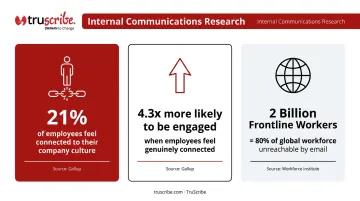
According to Gallup, only 21% of U.S. employees strongly agree they feel connected to their organization's culture. Employees who do feel connected are 4.3 times as likely to be engaged and 47% less likely to be looking for another job.
Internal video — particularly culture, recognition, and leadership content — is one of the most scalable tools for closing that gap.
Microsoft's Work Trend Index identifies roughly 2 billion frontline workers representing 80% of the global workforce. Many have limited or no access to email, making mobile-optimized video — distributed through apps or digital signage — one of the few formats that reliably reaches them.
Key figures driving the case for internal video:
- 21% of U.S. employees feel strongly connected to their organization's culture (Gallup)
- Connected employees are 4.3x more likely to be engaged and 47% less likely to job-hunt
- 2 billion frontline workers — 80% of the global workforce — often can't be reached by email
12 Best Internal Communications Video Examples and Ideas
These 12 video types represent the most impactful and widely adopted formats in corporate internal communications today, spanning everything from day-one onboarding to company-wide crisis response.
1. Onboarding Welcome Videos
Onboarding videos reduce information overload for new hires by delivering culture, values, and process information in an engaging, repeatable format. Brandon Hall Group reports that organizations with structured onboarding are up to 103% more likely to see improvements in new-hire retention and engagement — and those that use technology-enabled onboarding are 33% more likely to improve time to proficiency.
What makes onboarding videos effective isn't production value — it's storytelling, visual clarity, and a human tone. Organizations like Amedisys and Walmart have worked with TruScribe to produce culture and orientation videos that communicate core values visually rather than through policy manuals. Walmart's "100 Pennies" video, for example, used hand-drawn whiteboard animation to convey company principles across a massive, diverse workforce in a format that employees could actually absorb and remember.
What to include:
- A genuine welcome from a leader (not a script-read)
- Clear communication of company values and cultural expectations
- Practical orientation content — who to call, where to find things
- A visual format that employees can revisit on-demand
2. Leadership and CEO Update Videos
Short, authentic video updates from executives do something company-wide email blasts can't: they convey tone, personality, and real human presence. Gallup found that when employees strongly agree their leaders communicate clearly, inspire confidence, and support change, 95% fully trust those leaders. That number matters because 29% of employees currently report they don't receive clear, honest, or consistent communication from leadership — a gap video can help close.
Fresenius CEO Michael Sen published a video on his first day in office outlining the "fundamental changes" needed for the company's future — a direct, visible leadership communication that set a tone from day one. It worked: brief, conversational, and directly connecting strategic direction to what employees could expect next.
What makes these work:
- Under 3 minutes in length
- Conversational tone, not corporate script
- Direct connection between company direction and what it means for employees
3. Training and Compliance Videos
Training videos have the highest structural ROI of any internal video type. They replace instructor-led sessions that are difficult to scale, expensive to repeat, and inconsistent across locations. ATD reports that organizations spent an average of $1,283 per employee on workplace learning in 2023 — video training protects that investment by making content reusable and accessible.
The compliance stakes are concrete. TD Bank agreed to pay a combined $1.8 billion in penalties in 2024 related to failures in its anti-money-laundering compliance program — a clear example of what inadequate compliance systems can cost.
Animated and whiteboard-style formats perform particularly well for compliance and process training. TruScribe's Scribology method uses sequential drawing to reveal regulatory information step by step — matching the brain's natural processing rhythm and reducing cognitive overload. The approach has produced 2.3x higher retention than traditional video formats, which matters when employees need to recall and apply what they've watched.
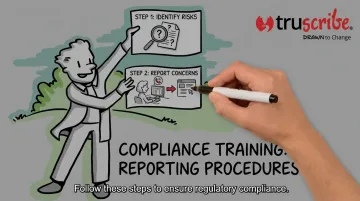
A TruScribe-produced information security training video for Eli Lilly (via MediaPRO) earned a Summit Award — a concrete external validation of whiteboard animation's effectiveness in compliance contexts.
4. Explainer Videos
Internal explainer videos focus on one thing: giving employees clarity fast. They're typically short, focused, and built around a single concept — a policy change, a new IT system, a benefits update, a process shift.
Animated formats consistently outperform talking-head videos for dense or conceptual content. When a message requires employees to understand an abstract idea (how their 401(k) matching works, what the new expense approval process looks like, why the company is reorganizing), animation can sequence that information in a way that live-action footage simply can't.
Best use cases for explainer videos:
- Benefits enrollment windows or changes
- New software rollouts
- Policy updates with regulatory implications
- Process changes affecting daily workflows
Keep them under 3 minutes. One video, one message — the moment you add a second objective, the clarity disappears.
5. Change Management Videos
Change management is one of the hardest internal comms challenges because resistance usually stems from one thing: employees don't understand the why behind the change. McKinsey found that where organizations failed to engage line managers and frontline employees, only 3% reported transformation success.
Prosci research adds that 58% of employees prefer to hear about a change's personal impact from their immediate supervisor. That means change videos need to be designed for cascading communication — built so managers can share them with their teams, not just broadcast from the top.
Video helps by allowing leadership to communicate context, emotion, and clarity simultaneously — something a memo or slide deck can't do.
TruScribe produced a culture transformation video for Navistar specifically designed to help employees understand and internalize a major organizational shift. The whiteboard format built the case for change step by step, using narrative rather than directive — a distinction employees feel immediately.
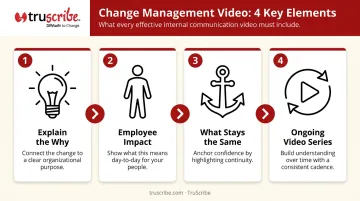
Effective change management video elements:
- A clear explanation of why the change is happening
- What it means specifically for employees
- What stays the same (often overlooked and anxiety-reducing)
- A consistent series of videos throughout the rollout — not just one announcement
6. Company Culture Videos
Culture videos are not just a recruitment tool. Internally, they reinforce shared values, recognize team behaviors, and give employees a sense of belonging — especially critical in hybrid or remote environments where culture can feel abstract.
Gallup data shows that employees who feel genuinely connected to their organization's culture are 4.3 times as likely to be engaged and significantly less likely to be job searching. Culture videos that feature real employees, authentic voices, and diverse representation tend to land far better than scripted corporate narratives.
The most effective internal culture videos mirror the company's actual personality — warts and all. HubSpot's publicly documented Culture Code, for example, is built around transparency and candor, and their internal communications reflect that same directness.
7. Employee Recognition Videos
Recognition is one of the most cost-efficient drivers of retention available to HR teams. Gallup and Workhuman's longitudinal research found that employees who were well recognized were 45% less likely to have left their organization two years later.
Recognition videos — spotlights, milestone celebrations, team achievement highlights — make that recognition visible and shareable across the organization. The key is authenticity: a leadership "thank you" paired with the employee's own voice telling their story lands differently than a generic award announcement.
What makes recognition videos feel genuine:
- Specific language about what the employee did and why it mattered
- The employee's own words, not just a manager's summary
- Broad distribution so the recognition reaches the full team
8. Internal Announcement Videos
Announcement videos — for policy updates, product launches, org changes, or event promotions — outperform text-based announcements because they convey tone and context that email cannot. A written message about a benefits change can feel bureaucratic; the same message delivered on video, with a clear explanation and a calm tone, feels human.
Practical format guidelines:
- Keep announcements under 90 seconds
- State the key information in the first 20 seconds
- End with a specific call-to-action (click here, complete this form, attend this session)
- Distribute through the channels employees actually use — not just email
9. Event Recap Videos
Town halls, sales conferences, and training summits represent a significant organizational investment. Event recap videos extend the ROI of that investment by making the content accessible to employees who couldn't attend live, or who want to revisit specific moments.
A 2–3 minute highlight reel with strong narration, speaker clips, and key announcement moments drives higher rewatch rates than a full-length recording. Most employees won't watch a two-hour town hall replay. They will watch a focused, well-edited summary.
10. Employee Wellness Videos
Wellness video content — mental health resources, ergonomic guidance, stress management tips — signals that the organization genuinely values employee wellbeing. Deloitte's UK analysis estimates an average return of approximately £5 for every £1 employers invest in employee mental health, though the evidence base suggests ROI depends heavily on program quality and implementation.
The most effective approach is a consistent format — a short monthly or bi-weekly video series — that normalizes wellness as part of the regular internal communications cadence rather than treating it as a one-off campaign that disappears after enrollment season.
11. Crisis Communication Videos
Speed, clarity, and a calm authoritative tone are the three non-negotiables in crisis communications. When employees are anxious or uncertain, ambiguity makes things worse. Video allows leadership to address multiple dimensions of a crisis simultaneously — what happened, what the organization is doing, and what employees should do next.
Animated explainer-style formats work particularly well for procedural steps — evacuation routes, remote access protocols, safety procedures — because they can sequence instructions visually without depending on a filming location or live presenter. TruScribe's Scribology method, with its step-by-step visual sequencing and minimalist design, is well-suited to this kind of high-stakes procedural communication.
12. Recruitment and Employer Brand Videos
Employer brand videos serve an internal function that's often overlooked. Yes, they attract candidates — but they also remind current employees why the organization is a great place to work, and they reinforce cultural identity across teams.
The most effective employer brand videos feature real employees speaking candidly about their experiences — unscripted, specific, personal. That authenticity increases internal pride and alignment, which matters most during rapid growth or organizational change when cultural cohesion is hardest to maintain.
Which Video Format Works Best for Your Use Case
Not all video formats serve all purposes. Here's a practical breakdown:
| Format | Best For | Why It Works |
|---|---|---|
| Live-action | Leadership messages, employee spotlights, culture videos | Authentic, human, builds personal connection |
| Screen recording | Software training, IT troubleshooting, process walkthroughs | Shows exactly what employees will see on screen |
| Whiteboard/animation | Compliance, onboarding, change management, explainers | Simplifies complex or abstract content; directs attention sequentially |
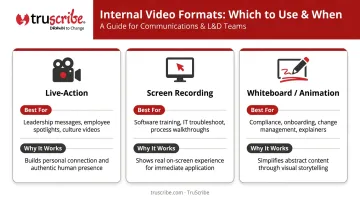
The core decision factor is message complexity. The more abstract, procedural, or regulatory the content, the stronger the case for animation.
That's where whiteboard animation earns its place. It uses the dual-coding principle, combining hand-drawn visuals with narration, to improve retention for content that would otherwise be dense and forgettable. TruScribe's Scribology methodology is built around this: sequential drawing, minimalist design, and timed information reveals that match the brain's natural processing rhythm. The approach produces 2.3x higher retention than traditional video formats, a real differentiator when compliance accuracy or organizational alignment is on the line.
Match format to audience:
- Deskless or frontline workers: keep videos short, mobile-optimized, and captioned
- Knowledge workers: use longer, chapter-based modules with embedded assessments
- Multilingual teams: add localized voiceover and on-screen captions
Tips for Creating Effective Internal Communications Videos
Keep It Focused
One video, one message. Trying to cover multiple topics in a single video dilutes your message and loses viewers fast. Define your goal, your audience, and the single action you want employees to take. Then build the video around that.
Plan Before You Produce
Before production begins, outline your key message, desired employee action, and format choice before production begins. Changes at the scripting stage cost far less than changes during production.
A simple pre-production checklist: core message in one sentence, target audience, desired action, and video format.
Prioritize Accessibility and Distribution
- Add captions and closed captions — required for ADA compliance and practical for noisy environments like warehouse floors or retail spaces
- Offer transcripts for employees who prefer or need text
- Distribute through channels employees actually use: email, intranet, mobile apps, or digital signage
- Consider localization for multilingual workforces — TruScribe offers script translation, multilingual voiceover, and captioning in other languages as part of its production services
Conclusion
Internal communications video is no longer optional for organizations that want to engage, inform, and retain their workforce. The 12 types covered here — from onboarding and compliance to recognition and crisis response — provide a complete toolkit for any internal comms professional ready to move beyond email overload.
The format you choose matters. For leadership messages and culture content, live-action delivers authenticity. For training, compliance, change management, and complex explainers, animated whiteboard video delivers the retention and clarity that text-based formats can't match.
That's where TruScribe comes in. Using the proprietary Scribology method — built on neuroscience and cognitive science — TruScribe helps organizations produce onboarding videos new hires actually remember, compliance training employees can apply, and change management content that reduces resistance. With 5,000+ videos delivered for more than 1,000 B2B organizations, including Microsoft, Walmart, Medtronic, and Fidelity, the work speaks for itself. Contact TruScribe to start with a free video strategy review.
Frequently Asked Questions
What is an internal communications video?
Internal communications videos are any video content created specifically for employee audiences — covering training, announcements, culture, leadership updates, recognition, and more. Unlike external marketing videos, the priority here is employee alignment and comprehension, not brand awareness or lead generation.
How long should an internal communications video be?
Most announcement, culture, and recognition videos perform best under 2 minutes. Training and explainer content can extend to 3–5 minutes when the content requires it. Shorter formats consistently drive higher completion rates — length discipline is the single biggest factor in whether employees watch to the end.
What type of video is best for employee training and compliance?
Animated and whiteboard-style videos are consistently the strongest format for training and compliance. They simplify complex or abstract information and support higher retention than live-action formats — a meaningful advantage for regulatory, procedural, or technical content.
How do I measure the success of an internal communications video?
Key metrics to track include video completion rate, click-through rate (for email-embedded videos), employee survey feedback on message clarity, and knowledge retention assessments for training content. Completion rate is usually the fastest signal of whether the format and length are working.
Can internal communications videos work for remote or deskless employees?
Video is one of the most effective formats for reaching remote and deskless workers, as long as videos are mobile-optimized, captioned, and distributed through channels employees already use. Apps, digital signage, and SMS links tend to outperform email for these audiences.
What is the difference between an explainer video and a training video?
Explainer videos focus on building understanding of a single concept, process, or change — typically short and single-topic. Training videos are structured to build a specific skill or knowledge base and may include multiple modules, assessments, or branching scenarios. Both serve distinct and valuable internal comms purposes.