Introduction
Most organizational change initiatives don't fail because the strategy was wrong. They fail because leaders underestimate how emotionally disruptive change is for the people living through it.
McKinsey's survey of 1,034 executives found fewer than one-third of transformations both improved and sustained performance. The same research identified frontline and manager engagement as a defining factor — where those groups weren't engaged, only 3% of respondents reported a successful transformation.
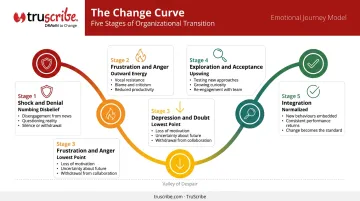
The Change Curve — adapted from Dr. Elisabeth Kübler-Ross's 1969 grief model — explains why. It maps the predictable emotional journey employees travel when faced with significant organizational change: from shock and denial through frustration and doubt, and eventually toward exploration and integration.
Knowing the model matters. Knowing how to coach people through each stage is what actually moves the needle. This guide covers:
- The emotional stages employees move through during change
- Specific coaching approaches for each stage
- The variables that determine whether coaching takes hold
- The common mistakes that cause change initiatives to stall
Key Takeaways
- The Change Curve maps an emotional journey from shock and denial through a low-energy valley and up toward exploration and integration
- Coaching must shift at each stage — what works during denial actively backfires during exploration
- Diagnose where each person sits on the curve before deciding how to support them — pace varies widely
- Employees most often get stuck due to communication gaps, unclear expectations, or missing resources — not resistance or attitude
Understanding the Change Curve and Why Coaching Is the Critical Link
The Change Curve's organizational lineage is more gradual than most people realize. A 2025 peer-reviewed intellectual history traces its development through Walter Menninger's 1975 work with Peace Corps volunteers, Levy and Merry's Organizational Transformation (1986), and Scott and Jaffe's workplace application (1988) — it was a gradual synthesis of ideas from multiple academics and practitioners, not the invention of any single firm.
Kübler-Ross's original five stages — denial, anger, bargaining, depression, acceptance — were adapted for workplace settings because the emotional mechanics of loss apply equally to unwanted organizational change. Understanding this origin matters. It helps coaches approach resistant employees with genuine empathy rather than frustration.
The Gap Between Model and Action
The Change Curve is a descriptive tool. It tells you where someone is emotionally. It does not tell you what to do next.
Coaching is the active intervention that bridges observation to action. Without it, employees don't automatically move forward — they stall, particularly in the early resistance stages, sometimes indefinitely.
Organizations that invest heavily in new systems without equally supporting their people rarely see the productivity gains they expected. The pattern shows up in predictable ways:
- Employees comply on paper but revert to old behaviors within weeks
- Adoption metrics look fine while morale and output quietly decline
- The change initiative "succeeds" by leadership measures but never sticks at the individual level
Organizational change doesn't take hold until individuals complete their own personal transitions. The rest of this guide covers exactly how coaching accelerates that process — stage by stage.
The Stages of the Change Curve: What Employees Experience
Different versions of the model use between four and seven stage labels. Prosci's five-stage framework and Scott and Jaffe's four-phase workplace model are the most documented. Both follow the same underlying U-shaped pattern: initial resistance, a valley of low energy, then a gradual upswing toward engagement.
One critical caveat: people can revisit earlier stages and rarely move in a perfectly linear path. Treating the curve as a fixed schedule is a mistake.
Here is what each stage looks like in practice — and what coaches and managers need to watch for.
| Stage | Emotional State | Observable Signals |
|---|---|---|
| Shock and Denial | Numbing disbelief | Low engagement, surface compliance, avoidance |
| Frustration and Anger | Outward emotional energy | Vocal objections, blame, questioning decisions |
| Depression and Doubt | Overwhelmed, unprepared | Disengagement, reduced output, withdrawal |
| Exploration and Acceptance | Cautious optimism | Curiosity, proactive questions, tentative change |
| Integration | New behaviors normalized | Consistent application, reduced friction, self-direction |
Shock and Denial
The first response to change is often a numbing disbelief — "this won't really affect me" or "things will go back to normal." This is not obstinance. It's a psychological protective response that prevents the brain from being overwhelmed by unwelcome information.
Observable signals:
- Low engagement and surface-level compliance
- Avoidance of specifics about the change
- Minimizing the scope or impact of what's coming
Frustration and Anger
Once the reality of change settles in, emotional energy turns outward — toward leadership, the process, or circumstances. This stage is difficult to manage but is actually a positive indicator. Anger means denial has broken. The person is now genuinely processing the change.
Observable signals:
- Vocal objections and blame-directed conversations
- Direct questioning of decisions or leadership rationale
- Increased emotional intensity in team interactions
Depression and Doubt
The lowest point on the curve. Employees have accepted the change is real but feel unprepared or overwhelmed. Critically, most employees at this stage already have the skills they need — they just lack the confidence to apply them in the new context.
Observable signals:
- Disengagement and noticeably reduced output
- Withdrawal from collaboration or team communication
- Expressions of self-doubt about their ability to adapt
Exploration and Acceptance
The upswing begins. Employees start experimenting with new behaviors, asking practical questions, and cautiously testing what the change means for their day-to-day work. This stage requires careful support — people can slide back into doubt if early experiments go poorly or go unacknowledged.
Observable signals:
- Increased curiosity and willingness to ask practical questions
- Tentative behavioral changes and small experiments
- More forward-looking language in conversations
Integration
New behaviors become routine and the change is fully embedded. This is not the moment to withdraw support. Without deliberate reinforcement, old habits return — particularly when employees face stress or time pressure.
Observable signals:
- Consistent application of new behaviors without prompting
- Reduced friction and fewer workarounds
- Self-directed problem-solving within the new framework
How to Coach Employees Through Each Stage
Coaching style, tone, and support must shift as an individual moves through the curve. Offering solutions to someone still in denial, for instance, typically accelerates resistance rather than reducing it.
Coaching Through Shock and Denial
The primary coaching action here is consistent, clear communication — not persuasion.
Employees in denial need frequent, factual, empathetic messaging about why the change is happening and what it means for them specifically. Resist the urge to force buy-in. The goal is to make information accessible, repeated, and non-threatening.
Practical approaches:
- Explain the "why" in concrete, role-specific terms — not corporate-speak
- Repeat key messages across multiple channels and formats
- Keep interactions low-pressure and informational, not evaluative
Scale is a real constraint here. Not every employee will get a one-on-one manager conversation, especially in large or distributed organizations. Consistent visual communication tools help bridge that gap — delivering the same rationale, in the same tone, to every employee regardless of location. TruScribe's whiteboard animation videos are built for exactly this context, using the Scribology methodology to reduce cognitive load and build understanding step by step. That matters when employees are emotionally overwhelmed and working memory is already stretched thin.
Coaching Through Frustration and Anger
At this stage, a coach's most important tool is active listening — without defensiveness.
Create space for employees to voice concerns, validate the emotional response as normal, and resist the instinct to immediately rebut objections. A 2022 systematic review of 79 organizational change studies found that listening to employee objections may reduce change complexity and motivate employees forward. People who feel unheard become more entrenched — not less.
Once concerns are surfaced, the next step is connecting the change to individual relevance. Demonstrating what this change means for this specific person's role, workload, or career opportunities shifts the emotional register from "this is happening to me" toward "I can see where I fit in this."
Practical approaches:
- Ask open questions and listen to the answers
- Avoid defending leadership decisions during the listening phase
- Follow up with role-specific clarity after the venting has space to settle
Coaching Through Depression and Doubt
By this stage, employees aren't lacking information — they're lacking confidence. The coaching response shifts from communication to capability-building.
Practical support looks like:
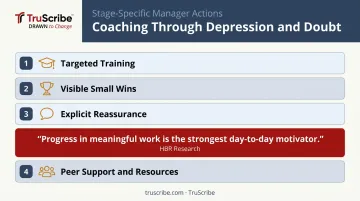
- Targeted training on specific new skills or processes
- Smaller experiments with visible, achievable wins
- Explicit reassurance that struggle is expected during transition
- Access to resources and peer support
HBR's diary research found that progress in meaningful work is the strongest day-to-day motivator of creative productivity among knowledge workers. Visible early wins — even minor ones — are disproportionately powerful at the low-energy phase of the curve. Celebrate them explicitly. Don't assume employees notice their own progress.
Coaching Through Exploration and Acceptance
Employees at this stage are ready to engage — but they need room to move.
Structured opportunities to test new behaviors in low-risk ways work well here. Prescriptive coaching backfires — it signals distrust and slows the ownership-building that drives genuine adoption.
Practical approaches:
- Involve employees in shaping how the change is implemented in their specific workflow
- Ask questions that build ownership rather than providing answers
- Run brainstorming sessions that draw on their emerging knowledge of the new environment
- Treat experimentation as progress, not deviation
Coaching Through Integration
The final coaching action is reinforcement and reflection.
Prosci reports that 81% of projects with sustainment planning met their objectives, compared to just 15% without it. That gap is not accidental. Integration looks like success, which is exactly why coaches step back too soon.
Practical approaches:
- Recognize behavioral change explicitly, not just results
- Ask employees what they've learned about themselves through the transition
- Embed new practices into performance expectations and team norms
- Watch for regression when new pressures arrive — this is when old habits resurface
Key Variables That Determine Whether Change Curve Coaching Works
Coaching outcomes are not determined by goodwill alone. Several controllable variables significantly affect how quickly and successfully employees move through the curve.
Timing of Coaching Interventions
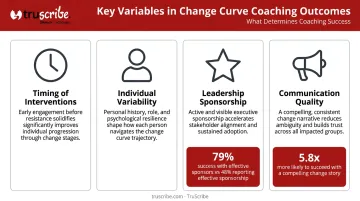
Coaching applied too early — before an employee has accepted the change is real — tends to miss. So does coaching applied too late, after someone has stagnated in the doubt stage for weeks without support. Stage-matched coaching outperforms both.
Diagnosing where someone actually is before deciding how to coach them is what makes the difference. Look for behavioral signals, not assumptions based on how long ago the change was announced.
Individual Variability in Change Response
Personality, past experience with change, and role-specific impact all affect how an individual moves through the curve. Research by Oreg (2005) studying 177 employees confirmed that personality and context are meaningfully associated with attitudes toward large-scale organizational change.
Some people race through denial in hours. Others need weeks. Treating the Change Curve as a universal clock leads directly to over-supporting some employees while leaving others behind. Assess each person individually.
Leadership Alignment and Visible Sponsorship
An employee's willingness to move through the curve is heavily influenced by how leaders behave. Prosci's benchmarking consistently identifies active sponsorship as the top contributor to change success — projects with extremely effective sponsors met their objectives 79% of the time. Only 48% of practitioners reported having effective sponsorship.
A coach cannot carry the weight of change adoption if senior leaders are reluctant, inconsistent in their messaging, or absent from the process. Leaders need to actively model the change they're asking employees to make — not just endorse it from a distance.
Quality and Consistency of Communication
McKinsey found that transformations were 5.8 times more likely to succeed when CEOs communicated a compelling change story. Communication gaps — particularly ambiguity about the change's purpose, its impact on specific roles, and what the future state looks like — are a primary driver of employees getting stuck in the early curve stages.
Coaches should advocate for:
- Clear, specific messaging about role-level impact
- Consistent delivery across multiple channels
- Repeated communication — one announcement rarely sticks
- Honest acknowledgment of what is and isn't yet known
Common Coaching Mistakes That Stall Change Adoption
Three mistakes derail change adoption more reliably than any others:
Rushing past the resistance stages. Managers motivated by urgency flood employees with information, escalate pressure, or declare "we don't have time for this." This deepens resistance rather than dissolving it. People who feel unheard become more entrenched — time spent genuinely supporting resistance stages is invested time, not lost time.
Coaching everyone as if they're at the same stage. When leaders communicate as though the whole team is at the same point on the curve, they over-support employees who've already reached exploration (making them feel patronized) while under-supporting those still in denial. Individual diagnosis is the discipline that makes everything else work.
Withdrawing support at integration. Because integration looks like success, coaches step back too soon. It's the stage most vulnerable to backsliding, especially when new pressures arise. Structured reinforcement — explicit recognition, performance feedback, and embedding new behaviors into team norms — converts temporary compliance into durable change.
Frequently Asked Questions
What is the change management curve?
The Change Curve is a model adapted from Dr. Elisabeth Kübler-Ross's five stages of grief, applied to organizational change. It maps the predictable emotional and behavioral journey employees move through during significant transitions, helping leaders anticipate reactions and plan targeted support rather than treating resistance as a personal failing.
What are the 4 stages of the change management curve?
Different frameworks present between four and seven stages, but Scott and Jaffe's widely referenced workplace version groups them as: denial, resistance (encompassing anger/frustration), exploration, and commitment. The underlying U-shaped pattern — resistance, a low point, then recovery — is consistent across all versions.
What are the 5 C's of change management?
No single authoritative definition of "the 5 C's" exists. Published practitioner lists use conflicting elements, and Prosci's official framework is its Five Tenets of Change Management, not a 5 C's model. Any version you encounter reflects one practitioner's preference, not a standardized methodology.
What is the difference between ADKAR and the change management curve?
The Change Curve is descriptive: it maps the emotional experience of change. ADKAR (Awareness, Desire, Knowledge, Ability, Reinforcement) is prescriptive, defining the specific outcomes an individual must achieve to successfully adopt a change. Prosci explicitly presents them as complementary — the Change Curve explains why and when to intervene; ADKAR specifies what to build.
How long does it take to move through the Change Curve?
Timing varies based on the scale of change, individual personality, leadership quality, and coaching effectiveness. Prosci explicitly warns against treating the curve as a predictable schedule. Without active support, people can remain stuck at early stages indefinitely.
What should a manager do if an employee gets stuck?
A stuck employee typically signals one of three gaps: insufficient information, inadequate emotional support, or missing skills and resources. Diagnose which gap is present before choosing a response — defaulting to pressure or information dumps regardless of root cause usually makes things worse.