

Introduction
Companies spend an average of $1,054 per employee on direct learning and development each year — and much of it produces little measurable change. Employees sit through modules, click past knowledge checks, and return to their desks having retained almost nothing useful.
The frustrating part? The problem isn't eLearning as a concept. It's how most programs are built.
Lecture-style formats, information overload, no reinforcement, and zero personalization combine to create training that checks boxes without changing behavior. L&D teams end up measuring completion rates and calling it success — while actual performance gaps persist.
This article identifies the five most common reasons corporate eLearning fails and pairs each one with a structural fix. These are root-cause solutions — not platform swaps or cosmetic redesigns — that work regardless of organization size.
Key Takeaways
- Five failures sink most corporate eLearning programs: low engagement, poor retention, cognitive overload, missing personalization, and weak measurement
- Completion rates measure exposure — not comprehension, behavior change, or business impact
- Fixing eLearning requires redesigning content strategy, not just switching tools or adding hours
- Visual storytelling and active participation formats consistently outperform passive, text-heavy delivery
- Kirkpatrick's Four Levels provide a practical framework for measuring what actually matters
The 5 Core Problems With Corporate eLearning Today
Most eLearning failures are not random. L&D leaders across industries run into the same patterns repeatedly. Knowing which one applies to your program is where the fix begins.
Problem 1: Low Learner Engagement
The symptom: Employees complete courses but stay passive throughout — clicking through slides, watching videos at 2x speed, or multitasking while modules auto-advance.
The cause: Content designed to satisfy a compliance requirement rather than genuinely involve the learner. Lecture-style formats with minimal interactivity give learners no reason to pay attention. When nothing requires engagement, the brain disengages.
Problem 2: Poor Knowledge Retention
The symptom: Post-training assessments pass, but on-the-job performance shows no change within days or weeks.
The cause: One-and-done delivery with no follow-up. Research on the Ebbinghaus Forgetting Curve confirms that memory declines in a predictable curve after initial learning — without spaced reinforcement, information fades fast. A single training event cannot overcome this alone.
Problem 3: Cognitive Overload from Content Design
The symptom: Learners feel overwhelmed, rush through modules, or report that courses feel too dense or too long.
The cause: Content is information-dumped rather than sequenced. No visual hierarchy, no chunking, no clear pathway through the material. The brain can't prioritize what to encode when everything competes for attention simultaneously.
Problem 4: Lack of Personalization and Relevance
The symptom: Learners disengage because the training doesn't feel connected to their actual role, challenge, or daily context.
The cause: One-size-fits-all course design that ignores the real diversity of learner roles, experience levels, and application needs. When a warehouse associate and a regional manager sit through identical onboarding content, one of them is always going to tune out.
Problem 5: No Measurement Beyond Completion Rates
The symptom: L&D teams report completion as the primary success metric. Behavioral change goes untracked.
The cause: Programs are evaluated on the wrong KPIs. According to Brandon Hall Group research, 89% of organizations track completion rates while only 8% measure business impact and 4% measure ROI. Completion records exposure — nothing more.
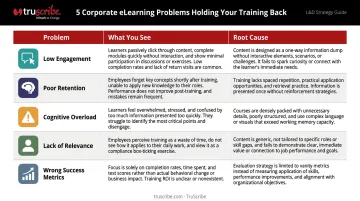
Here's how these five problems compare at a glance:
| Problem | What You See | Root Cause |
|---|---|---|
| Low engagement | Click-through behavior, multitasking | No interactivity or reason to pay attention |
| Poor retention | Assessments pass, performance doesn't change | Single-event delivery, no spaced reinforcement |
| Cognitive overload | Learners feel overwhelmed or rush | Content dumped rather than sequenced |
| Lack of relevance | Disengagement, tuning out | One-size-fits-all design ignoring role context |
| Wrong metrics | Completion reported, behavior ignored | KPIs measure exposure, not impact |
5 Powerful Fixes for Corporate eLearning
These fixes map directly to the five problems above. Each addresses a root cause, and together they form a framework for building eLearning that produces real behavior change.
Fix 1: Design for Active Participation, Not Passive Consumption
Replace click-through slides and talking-head videos with formats that require learners to actually think:
- Branching scenarios where decisions have consequences
- Problem-based challenges that mirror real job situations
- Reflection prompts that pause the module and require a response
- Short knowledge checks embedded throughout, not just at the end
The goal is deliberate friction. When learners must apply what they're learning rather than simply absorbing it, encoding improves and attention stays anchored. A module that demands nothing gets nothing in return.
Fix 2: Build Retention with Spaced Repetition and Microlearning
A single training event cannot fight forgetting on its own. The fix is distributing learning over time.
Microlearning — short, focused modules covering one concept at a time — reduces cognitive load during initial delivery and improves early encoding. A 2025 systematic review found consistently positive learning outcomes, engagement, and retention across the microlearning literature.
Spaced repetition extends the benefit over time. Structure follow-up at deliberate intervals:
- 24 hours post-training — a brief recap quiz or key concept reminder
- 7 days post-training — a short scenario or application prompt
- 30 days post-training — a performance check-in or manager observation
These touchpoints don't need to be elaborate. An email nudge, a two-question quiz, or a 90-second recap video can interrupt the forgetting curve without adding significant learner burden.
Fix 3: Apply Cognitive Load Principles to Content Structure
The way content is sequenced determines how much of it the brain can actually process. Structure training to build mental models progressively:
- Start with the core concept — one clear idea, simply stated
- Layer in complexity — only after the foundation is established
- Connect new information to what learners already know before introducing what they don't
What you remove matters just as much. Visual clutter, redundant text, over-explained slides, and competing on-screen elements all drain cognitive resources that should go toward learning. Empty space is not wasted space — it's a cognitive tool.
Signposting reinforces this: learners who know where they are in a module and what's coming next can allocate attention more efficiently than those navigating content blindly.
Fix 4: Use Visual Storytelling to Drive Engagement and Comprehension
Text-heavy training makes the brain work harder for the same result. Richard Mayer's Cognitive Theory of Multimedia Learning explains why: the brain processes verbal and visual information through separate channels, and combining relevant words with purposeful images engages both channels simultaneously. This improves comprehension without increasing cognitive load — provided the visuals are intentional rather than decorative.
Narrative structure amplifies this further. When complex information is embedded in a story with a clear arc, the brain organizes it differently than it organizes a list of facts. Narrative activates memory encoding more effectively because the brain is looking for meaning, not just data.
Whiteboard animation is one format that puts these principles to work. The continuous visual motion of drawing-in-progress keeps learner attention engaged: the brain tracks what's being revealed, building anticipation rather than drifting. Sequential drawing surfaces information one element at a time, directing focus precisely and preventing the overload that dense, pre-rendered visuals often produce.
TruScribe's Scribology methodology is built on these cognitive science principles. Every frame is designed to serve the learning objective — minimalist visuals reduce competing stimuli, while hand-drawn illustration activates deeper memory pathways than standard digital graphics.
For organizations with complex training content — compliance procedures, technical onboarding, regulatory frameworks — this approach produces measurably better results. TruScribe reports a 2.3x higher retention rate compared to traditional video, with clients including Walmart, Medtronic, Siemens, and Merck applying it specifically for high-stakes training.

Fix 5: Shift Measurement from Completion to Performance Impact
If you're measuring completion, you're measuring whether employees opened a course. That's the starting point, not the outcome.
The right metrics for eLearning effectiveness look like this:
- Behavioral change indicators — are employees doing things differently?
- Manager observation data — what does on-the-job performance show post-training?
- Pre/post knowledge assessments — what did learners actually gain?
- Performance metric shifts — did the business outcome the training targeted improve?
Kirkpatrick's Four Levels of Evaluation provide the standard framework for connecting training to outcomes:
| Level | Focus | What to Measure |
|---|---|---|
| 1. Reaction | Did learners find it relevant and engaging? | Participant surveys, post-course feedback |
| 2. Learning | Did knowledge, skills, or attitudes change? | Pre/post assessments, demonstrations |
| 3. Behavior | Are learners applying it on the job? | Manager observations, performance reviews |
| 4. Results | Did organizational outcomes improve? | Business metrics tied to training objectives |
Most organizations measure Level 1 well and stop there. Levels 3 and 4 require more effort — but they're the only levels that confirm training actually worked.
Common Mistakes to Avoid When Fixing Corporate eLearning
These patterns derail even well-planned eLearning improvements before they take hold:
- Switching LMS platforms or adding AI tools won't fix an engagement problem rooted in poor content design — the platform delivers the content, it doesn't improve it.
- Implementing microlearning without reinforcement schedules, or redesigning content without measuring outcomes, produces partial results at best. These fixes work as a system, not a menu.
- Redesigning before diagnosing wastes resources. Applying an engagement fix to a knowledge-transfer problem — or vice versa — addresses the wrong failure entirely.
- Skipping learner behavior data means missing the clearest evidence of where programs break down. Completion rates, drop-off points, quiz attempt patterns, and survey responses each tell you something specific.
Frequently Asked Questions
What is corporate eLearning?
Corporate eLearning is the use of digital platforms, videos, and interactive modules to train, upskill, or onboard employees — typically delivered through a learning management system (LMS). The focus is on job-relevant, performance-driven outcomes — not credentials or coursework.
What LMS do corporations use?
Commonly used corporate LMS platforms include Cornerstone, TalentLMS, Docebo, Workday Learning, and iSpring. The right platform depends on company size, content complexity, integration requirements, and budget — no single platform suits every organization.
How much does corporate eLearning cost to develop?
Custom eLearning development varies widely by complexity. Chapman Alliance research puts costs at roughly $10,000 to $50,000 per finished hour of content — though those figures date to 2010, so current labor rates and regional factors will shift actual numbers.
Why does corporate eLearning have low completion rates?
Low completion typically reflects disengaging content formats, training disconnected from the learner's actual role, and programs that feel obligatory rather than valuable. When employees see no clear reason to engage, they don't.
How do you measure the effectiveness of corporate eLearning?
Kirkpatrick's Four Levels — Reaction, Learning, Behavior, and Results — are the standard framework. Completion rates measure exposure only, not comprehension, behavior change, or business impact.