That later never quite arrives.
According to PMI research, ineffective communication accounts for roughly $75 million of every $1 billion at risk in project spending. The same research found that highly effective communicators completed projects on time at nearly twice the rate of their less effective counterparts — 71% vs. 37%.
A well-built communication plan is what separates those two groups.
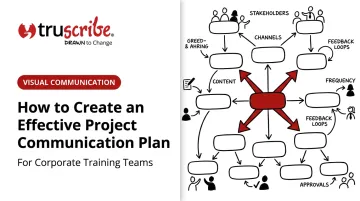
This article covers what a project communication plan is, its core components, how to build one in six steps, the variables that separate functional plans from ones that quietly fall apart, and the most common mistakes worth avoiding.
Key Takeaways
- A project communication plan defines who gets what information, through which channel, how often, and in what format — built before execution starts.
- Stakeholders at different levels need tailored messages; one version for everyone creates noise for some and gaps for others.
- Format matters as much as frequency — how you present a message determines whether it lands.
- Communication plans are living documents — review and update them at every major milestone.
What Is a Project Communication Plan and Why Does It Matter?
A project communication plan is a formal document that defines how information flows among team members, managers, and stakeholders throughout the project lifecycle. It specifies what gets communicated, to whom, when, how often, and through which channels.
The plan serves two practical purposes:
- Pre-authorization — it gives project managers standing permission to communicate without seeking repeated approvals for routine updates
- Shared expectations — it removes guesswork for everyone involved, reducing the misunderstandings that cascade into delays and budget overruns
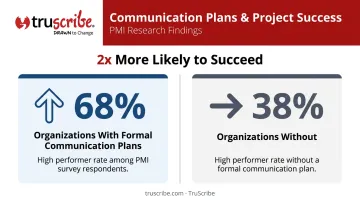
According to PMI research, organizations that used formal communication plans were high performers at nearly twice the rate of those that didn't — 68% vs. 38% at the project level.
Without a plan, communication defaults to whoever shouts loudest or sends the most emails. The result is reactive, inconsistent, and expensive.
Key Components of an Effective Project Communication Plan
Five components define every functional communication plan. Each one answers a distinct question about how information moves through a project.
| Component | What It Defines |
|---|---|
| Audience | Who receives the communication and at what level of detail |
| Message / Description | What information is being communicated and why |
| Channel | How the information is delivered |
| Frequency | How often communication occurs |
| Owner | Who is responsible for sending and following up |
Audience
Not every stakeholder needs the same message. Executives need high-level impact summaries. Core team members need task-level detail. External partners may only need milestone or compliance-relevant updates.
The same project event — a scope change, for example — requires three different messages: one for the sponsor, one for the delivery team, and potentially one for the client. Grouping all stakeholders into a single audience is where most communication plans start to break down.
Channel
Channel selection should be deliberate, not defaulted to whatever's most familiar. A few practical rules:
- Asynchronous channels (email, recorded updates, shared documents) work for distributed teams and non-urgent information
- Synchronous channels (live meetings, video calls) suit high-stakes decisions and conflict resolution
- Messaging tools fit quick, low-context updates within the core team
Routing everything through email is a default, not a strategy — and it's one that buries time-sensitive information in crowded inboxes.
Frequency
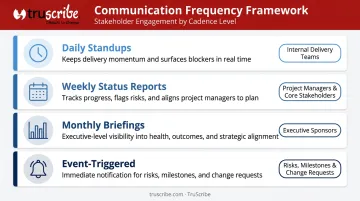
Frequency sets the communication rhythm. A workable default structure:
- Daily standups for internal delivery teams
- Weekly status reports for project managers and core stakeholders
- Monthly briefings for executive sponsors
- Event-triggered communications for risks, milestone completions, and change requests
Microsoft's 2025 Work Trend Index data found that workers receive an average of 117 emails and 153 Teams messages per weekday. Over-communication is a real cost — it creates noise that trains stakeholders to ignore updates. A tighter cadence with well-targeted messages will land better than daily volume.
Owner and Feedback Loop
Every communication type needs an assigned owner — someone responsible for drafting, sending, and following up. Without clear ownership, messages fall through the cracks during busy project phases when communication matters most.
A feedback mechanism is equally important. Quick polls, direct stakeholder check-ins, or a dedicated channel for communication questions give the project manager signal on whether the plan is working — before a missed update becomes a missed deadline.
How to Create a Project Communication Plan Step by Step
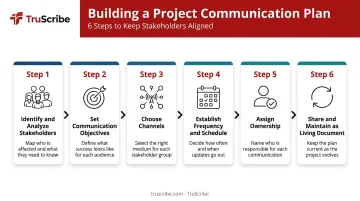
This is a six-step process that works from the ground up. Skipping the early steps creates problems in the later ones.
Step 1: Identify and Analyze Your Stakeholders
Map every party involved — sponsors, core team members, functional leads, external vendors, and end-users. Document each person's role, level of influence, information needs, and preferred communication method.
A simple stakeholder matrix works here: name, role, information need, preferred channel, and preferred frequency. This matrix becomes the backbone of everything that follows.
Step 2: Set Clear Communication Objectives
Define what the plan is trying to achieve — not just "keep everyone informed," but specific, measurable goals. For example:
- All stakeholders receive milestone updates within 24 hours of completion
- Weekly blocker alignment maintained with no gaps during execution phase
- Executive sponsors briefed monthly with summary-level status, not task-level detail
Vague goals produce vague communication. Each objective should name the audience, the information they receive, and how often — that specificity is what makes a plan actionable rather than aspirational.
Step 3: Choose Channels for Each Audience and Message Type
Match channels to audience segments and message complexity:
- Formal announcements → email or official project documentation
- Quick operational updates → team messaging tools
- Complex explanations or process walkthroughs → video or documentation platforms
- Decision-making and conflict resolution → live meetings
The channel should serve the message, not the sender's convenience.
Step 4: Establish Frequency and a Communication Schedule
Build a communication calendar that maps both recurring communications and event-triggered ones. Account for:
- Different time zones in distributed teams
- Workload peaks during key project phases
- Phase transitions — initiation, execution, and closeout have genuinely different communication demands
A weekly cadence that works during planning may be insufficient during a high-stakes execution phase.
Step 5: Assign Ownership and Define Accountability
Designate a specific owner for each communication type. Without named ownership, the most common failure mode kicks in: everyone assumes someone else sent the update.
For external-facing communications, also document:
- Who reviews the content before distribution
- Who approves it
- What the turnaround window is for that review step
Step 6: Share the Plan, Then Treat It as a Living Document
The plan must live somewhere accessible — a central project repository where all stakeholders can find it. More importantly, it needs to be actively maintained:
- Review it at each major project milestone
- Update it when scope, team membership, or stakeholder needs change
- Confirm it's still being used, not just filed
The test of a good communication plan isn't whether it was written — it's whether the team is still following it three months into execution.
Key Variables That Affect How Well Your Communication Plan Works
Two plans can follow identical steps and produce very different outcomes. These four variables explain most of that gap.
Audience Segmentation Depth
Shallow stakeholder analysis (grouping everyone into one or two categories) almost always results in over-communication with some groups and critical gaps for others. The more precisely a team understands what each stakeholder needs to know (and what they don't), the more relevant and trusted the communications become .
Message Format and Medium
Where a message is delivered matters. How it's presented matters more.
For complex project information — technical scope changes, process rollouts, onboarding new stakeholders mid-project — dense text-based formats consistently underperform. A 2020 meta-analysis of 39 experiments and 2,103 learners found a positive effect for graphics-enhanced content over text alone in comprehension tasks.
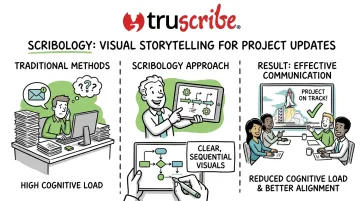
For communications that must land the first time — cross-functional rollouts, change management updates, milestone summaries for senior stakeholders — the format question deserves real attention. TruScribe's Scribology methodology applies neuroscience principles directly to this problem, using sequential drawing and minimalist design to reduce cognitive load and activate deeper memory encoding.
Across 5,000+ delivered projects, the approach delivers 2.3x higher retention than traditional video formats. For project teams whose critical updates routinely get skimmed or ignored, that gap is worth factoring into the plan.
Communication Cadence Alignment With Project Phase
Teams that use the same communication cadence across all project phases typically see one of two problems: stakeholder fatigue from constant updates during slower phases, or disengagement from infrequent contact during critical ones.
Frequency should scale with project complexity and current phase — more detail-heavy contact during execution, lighter-touch milestone communication during initiation.
Feedback and Adaptation Mechanisms
Plans without feedback loops become stale quickly. Effective feedback looks like:
- Direct stakeholder input at milestone reviews
- Quick polls on whether updates are useful
- Tracking whether communications are being read or acted on
Teams that formally evaluate their communication plan at each milestone catch misalignments before they become project risks.
Common Mistakes That Undermine Project Communication Plans
Even well-intentioned communication plans fall short when these patterns go unchecked:
Treating stakeholder analysis as a one-time activity. New people join mid-project, priorities shift, and what worked in the planning phase can become irrelevant during execution. A stakeholder map built once and never revisited will eventually route the wrong information to the wrong people.
Defaulting to a single channel for every message. Email for everything — or meeting for everything — creates information overload or missed context. A complex multi-step process buried in paragraph form is far more likely to be misunderstood than the same content in a format suited to its complexity.
Building the plan without stakeholder input — then never sharing it. Excluding key voices during planning means missing preferences, gaps, and sensitivities. Excluding stakeholders after planning means nobody uses it. The plan only works if people know it exists and know where to find it.
Frequently Asked Questions
What is an example of a project communication plan?
A typical plan takes the form of a table mapping sender, recipient, message type, channel, and frequency. For example: a project manager sends a weekly email status report to the core team every Friday, hosts a bi-weekly video call with executive sponsors, and posts daily updates in a team messaging channel for blockers and task progress.
What are the 5 C's of communication?
The 5 C's are Clear, Concise, Correct, Complete, and Courteous. Applying them to each communication type in a project plan ensures messages are understood as intended and appropriate for their audience.
What are the key components of a project communication plan?
The five core components are audience, message/description, channel, frequency, and owner. A plan missing any one component tends to break down during execution.
Who is responsible for managing a project communication plan?
The project manager typically owns the overall plan but may delegate specific communication responsibilities by stakeholder group or message type. Assigning clear ownership at that level is what prevents updates from slipping during busy project phases.
How often should a project communication plan be updated?
The plan should be reviewed at each major project milestone or phase transition, and updated whenever the stakeholder group changes, scope shifts, or feedback shows the current approach isn't working.