The problem most buyers run into: they focus on the lowest number without understanding what drives it. They budget for the cheapest option, end up with generic content that doesn't perform, and pay twice to fix it.
This guide breaks down real price ranges by production tier, the specific factors that move costs up or down, what separates a $2,000 video from a $20,000 one, and how to set a budget that matches your actual goals.
Key Takeaways
- B2B-quality explainer videos typically cost $5,000–$20,000, with DIY tools under $1,000 and premium studios exceeding $50,000
- Animation style, video length, and provider type are the three biggest cost drivers
- The first 60 seconds always costs the most — setup costs are fixed regardless of length
- Cheap videos frequently underperform and get replaced, making the "savings" illusory
- Budget for revision rounds and source file fees upfront to avoid surprise costs
How Much Does an Explainer Video Cost? Pricing Overview
Two videos of identical length can differ by $10,000 or more depending on style, team, and complexity. Buyers who focus only on the lowest quote often end up with unusable content — and pay again to redo it.
Wyzowl's 2024 survey of 242 production companies found a $5,400 median and $10,983 mean for a one-minute animated explainer, with quotes spanning $600 to $250,000. That range reflects a market with no standard pricing — the same deliverable can cost 40x more depending on who makes it and how.
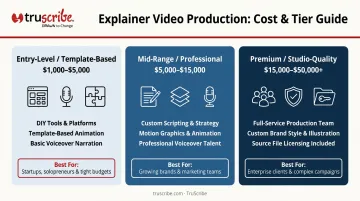
Here's how pricing breaks down across three practical tiers:
Entry-Level / Template-Based ($1,000–$5,000)
What's typically included:
- DIY software subscriptions or low-cost freelancers
- Pre-made templates with limited customization
- Basic or AI-generated voiceover
- Minimal revision rounds
Best for: Internal communications, simple concept explanations, early-stage startups that need something functional rather than branded.
The catch: Templates limit brand expression and message precision. These videos often look generic to enterprise audiences and rarely deliver strong conversion results.
Mid-Range / Professional ($5,000–$15,000)
What's typically included:
- Freelance teams or smaller agencies
- Custom scripting and storyboarding
- Original motion graphic or character design
- Professional voiceover
- 2–3 revision rounds
Best for: Growing businesses, SaaS product demos, marketing campaigns where quality matters but budget is still limited.
Premium / Studio-Quality ($15,000–$50,000+)
What's typically included:
- Full-service production studios with dedicated project managers, scriptwriters, animators, and sound designers
- Fully custom visual style aligned to brand standards
- Multiple structured revision rounds
- Source file licensing
- Strategic creative direction
Best for: Enterprise B2B companies, Fortune 500 training and onboarding programs, sales enablement campaigns where the video must perform at the highest level.
TruScribe, which has delivered 5,000+ whiteboard explainer videos for clients including Microsoft, Walmart, and NASA across 15 years, operates in this tier. At this level, studios bring scripting expertise, neuroscience-informed visual design, and structured revision processes that directly affect whether a video changes behavior — not just looks polished.
Key Factors That Affect the Cost of an Explainer Video
Explainer video pricing is shaped by creative, technical, and operational decisions. Understanding each one helps you avoid both overpaying and under-investing.
Animation Style and Complexity
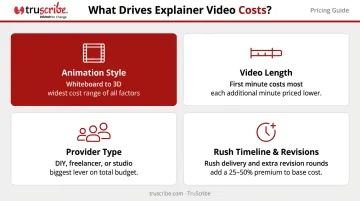
Style is the single fastest way to understand cost. According to Blue Carrot's 2025 pricing guide, the cost ladder looks like this:
| Animation Style | Approximate Cost Per Minute |
|---|---|
| Whiteboard animation | $1,000–$2,000 |
| Motion graphics | $2,500–$3,000 (60 sec) |
| 2D character animation | $2,000–$4,000 |
| 3D animation | $4,000–$10,000 |
Within any style, complexity multiplies cost. More characters, detailed scene transitions, or emotional nuance means more labor hours — and a higher invoice.
For B2B use cases, whiteboard and motion graphics deliver the strongest cost-to-clarity ratio — clear messaging without the production overhead of character animation or 3D.
Video Length
The first 60 seconds is always the most expensive. Scripting, storyboarding, and style development are fixed costs that apply regardless of length. Additional minutes are incrementally cheaper.
The math is clear: one studio's rate card shows motion graphics at $2,500–$3,000 for 60 seconds, $3,000–$3,700 for 90 seconds, and $3,700–$4,400 for 120 seconds. A second minute doesn't double the price.
For most B2B marketing use cases, shorter performs better anyway. Vidyard reports that 65% of viewers watch business videos under one minute to the end — a completion rate that drops significantly as runtime increases.
Provider Type: DIY, Freelancer, or Studio
Each route involves trade-offs:
- DIY tools — Lowest cost, template-based, generic results. Fine for internal use, rarely effective for external audiences
- Freelancers — Mid-range cost, variable quality, coordination risk when managing multiple specialists independently
- Professional studios — Higher investment, consistent quality, strategic creative guidance, and project management built in
Clients who start with DIY tools or freelancers frequently end up paying a studio to redo the work. The cost of that second pass usually exceeds what a studio engagement would have cost from the start.
Customization and Brand Alignment
Off-the-shelf templates limit both brand expression and message precision. Custom-built videos with original illustrations, tailored scripts, and brand-matched visual language cost more — but enterprise audiences recognize generic production immediately, and that recognition undermines credibility.
Rush Timelines and Revision Volume
Beyond creative and provider decisions, how you manage the project timeline affects the final number. Rush delivery typically adds a 25–50% premium to base production costs. Late-stage revisions (after animation begins) cost significantly more than early-stage script or storyboard changes. The fix: consolidate stakeholder feedback early and build a revision buffer into your initial budget.
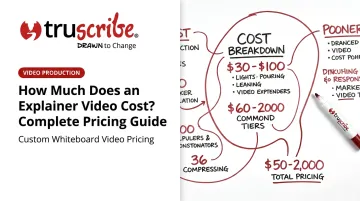
Explainer Video Cost Breakdown by Component
The quoted price for an explainer video reflects the combined labor of multiple specialists. Understanding what each component costs helps you evaluate quotes accurately and spot unexpected fees.
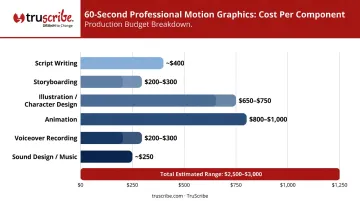
Here's a typical component breakdown for a 60-second professional motion graphics explainer:
| Component | Approximate Cost |
|---|---|
| Script writing | ~$400 |
| Storyboarding | $200–$300 |
| Illustration/character design | $650–$750 |
| Animation | $800–$1,000 |
| Voiceover recording | $200–$300 |
| Sound design/music | ~$250 |
Source: Blue Carrot 2025 production guide. Rates vary by provider type and animation style.
For voiceover specifically, the Global Voice Acting Academy's rate guide lists $350–$525 for a single explainer up to 90 seconds, providing a useful cross-check on that line item.
Add-On Costs That Frequently Surprise Buyers
Several costs sit outside the base quote and catch buyers off guard:
- Localization: $300–$600 per additional 1–2 minute version (includes translation, new voiceover, and animation corrections)
- Source file buyout: One common studio policy charges a 30% premium above base production cost — always ask about this upfront
- Rush delivery: Expect 25–50% added to base cost for expedited timelines
- Extra revisions: Beyond the included rounds, each additional revision cycle typically adds 8–12% and roughly one week
These add-ons compound quickly, so knowing the full scope before signing matters. For a studio-quality 60–90 second video, plan for 4–8 weeks from kickoff to delivery. TruScribe, for example, runs a standard 20-working-day turnaround with expedited options for tighter deadlines.
Enterprise buyers with multiple internal reviewers — legal, marketing, executive — should build a revision buffer into the budget from day one. Late-stage changes are the most expensive and the most avoidable.
Low-Cost vs. High-Cost Explainer Videos: What's the Real Difference?
A $1,500 explainer and a $15,000 explainer can look nearly identical in a thumbnail — but their real-world performance tells a different story. The gap comes down to five production dimensions:
| Dimension | Lower-Cost ($1,500–$5,000) | Higher-Cost ($10,000–$50,000+) |
|---|---|---|
| Script quality | Generic or template-driven | Strategically crafted for specific audience and goal |
| Visual originality | Stock templates, limited brand fit | Custom illustrations built from scratch |
| Animation polish | Basic motion, limited transitions | Smooth, purposeful motion with production depth |
| Voiceover quality | AI-generated or stock talent | Professional talent, properly directed and recorded |
| Project reliability | Variable — coordination risk with freelancers | Structured process, clear milestones, dedicated PM |
A high-quality explainer video earns its place across multiple channels — sales decks, website homepage, employee training, onboarding — for years. A cheaper video that needs replacing in 12 months ends up costing more, even when the upfront price looked attractive.
That total-cost-of-ownership logic is why TruScribe offers a money-back guarantee if clients don't achieve at least a 200% return on their investment. When a studio is confident enough to back its work financially, it's a reliable signal that the production process is built around outcomes, not just deliverables.
How to Estimate the Right Budget for Your Explainer Video
The right budget isn't the lowest one you can find. It's the one that matches your intended use case, audience, and expected return.
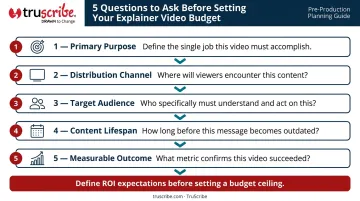
Answer these questions before setting a number:
- What is the video's primary purpose? Marketing conversion, employee training, sales enablement, and product demos each carry different quality thresholds
- Where will it be used? A landing page video needs to convert strangers; a training LMS video needs to retain employees — different jobs, different standards
- Who is the audience? External prospects have less patience for generic production than internal employees
- How long does it need to stay relevant? Content that becomes outdated in a year doesn't justify the same investment as evergreen training material
- What measurable outcome justifies the spend? Define it upfront — conversion rate lift, training completion, reduced support calls
Common Budgeting Mistakes
- Focusing on upfront price without accounting for revision costs, source file fees, and localization
- Choosing the cheapest option without validating the provider's B2B experience
- Over-specifying features that don't serve the video's actual use case
- Failing to calculate ROI expectations before setting a budget ceiling
These mistakes matter most for enterprise buyers. A single video can work across dozens of sales calls, onboard hundreds of new hires, and convert prospects at the top of your funnel — repeatedly, without additional spend. The real question isn't whether a video costs too much. It's whether its reach justifies the production investment.
Frequently Asked Questions
How much does an explainer video cost per minute?
Per-minute costs range from roughly $1,000–$2,000 for basic whiteboard animation to $4,000–$10,000+ for premium 3D or complex 2D. The first minute is always the most expensive because scripting, storyboarding, and style development are fixed costs regardless of video length.
How much does a 20-minute explainer video cost?
A 20-minute video typically runs $28,000–$38,000 at the professional level, based on roughly $1,400–$1,900 per minute for animated educational content. Videos this long are uncommon for marketing — they're more typical for training or e-learning, where per-minute rates decrease at scale.
How much does it cost to edit a 30-second explainer video?
Minor edits to an existing video cost far less than new production. However, producing a new 30-second video isn't proportionally cheaper than a 60-second one — fixed scripting and setup costs still apply. One 2025 rate card shows 30 seconds at $1,410 vs. $2,580 for 60 seconds, not a 50% reduction.
Is whiteboard animation cheaper than 2D or 3D animation?
Yes — whiteboard is generally the most cost-effective animated explainer style. Lower illustration complexity and no character rigging keeps production costs down. Done by a specialist studio, it can also be highly effective for B2B audiences who respond well to clear, sequential visual explanations.
What's the difference between hiring a freelancer and a studio for explainer video production?
Freelancers offer lower upfront cost but carry coordination risk — you're often managing multiple specialists yourself with no guarantee of consistent quality. Studios cost more but deliver project management, strategic input, and accountability from start to finish.
How can I get the best ROI from my explainer video investment?
Start by tying the video to a specific, measurable goal. From there:
- Keep it focused on one core message — concise videos consistently outperform lengthy ones
- Choose a provider with proven B2B experience in your industry
- Plan for multi-channel use (website, sales decks, onboarding, trade shows) to extend the video's value over time