Writing a commercial script looks straightforward until you're staring at a 30-second blank page. Balancing a clear message, the right emotional tone, precise timing, and a CTA that actually moves people — all within seconds — is harder than it looks. Even seasoned marketers get it wrong regularly.
This guide covers everything you need: pre-writing strategy, a step-by-step writing process, the industry-standard two-column format, a ready-to-use template, and the most common mistakes worth avoiding before you write a single word.
Key Takeaways
- Define your audience, objective, and ad length before writing — these decisions shape every line.
- Every effective commercial follows one arc: Hook → Problem → Solution → CTA → Tagline.
- A 30-second spot fits roughly 65–85 words, depending on delivery pace.
- The two-column (visual/audio) format is the production standard for video commercials.
- The biggest scriptwriting failures: trying to say too much, burying the CTA, and writing copy that reads well but sounds unnatural out loud.
What You Need Before Writing a Commercial Script
Skipping the pre-writing stage is the single most reliable way to produce an unfocused ad. The strategy decisions made here shape every word in the script.
Define Your Objective and Audience
Start with one measurable goal. One — not two, not a range. For example:
- Drive calls to a specific phone number
- Generate trial sign-ups for a software product
- Increase foot traffic during a promotional window
Then build a simple audience persona. Who are they? What frustrates them? What motivates them to act? The more precisely you can describe that person, the sharper your copy will be. A script aimed at everyone tends to reach no one.
Know Your Ad Length and Distribution Channel
Once your objective and audience are clear, format decisions follow naturally. Duration and distribution channel both shape what your script can — and can't — do:
According to Voice123, commercial word counts by duration break down as follows:
| Duration | General Range | Slow/Dramatic | Normal | Fast/Energetic |
|---|---|---|---|---|
| 15 seconds | 30–40 words | — | — | — |
| 30 seconds | 70–80 words | ~65 words | ~75 words | ~85 words |
| 60 seconds | 120–150 words | — | — | — |
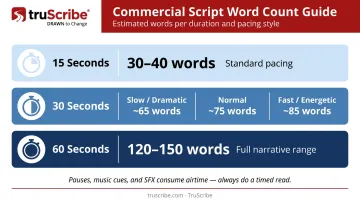
These are planning guides. Pauses, music cues, and sound effects all consume airtime, so a timed read of the full script with every beat accounted for is still necessary.
- Broadcast TV — standard 30-second spot; visuals carry part of the story
- Radio — audio only; every scene must be painted through words, voice, and sound
- Digital pre-roll — hook within 2–3 seconds; brand visible in the first 5
- Social/TikTok — 90% of ad recall is captured in the first six seconds
- Meta/social feeds — 41% of Facebook video ads are effectively meaningless without sound; captions and on-screen text are essential
How to Write a Commercial Script: Step-by-Step
Step 1: Define Your Single Core Message
Every commercial must carry one clear, memorable takeaway. Not three. Not five. One.
The pressure test: If the viewer remembers only one thing, what should it be?
Write that answer in a single sentence before touching the script. If you can't state it in one sentence, the message isn't focused enough yet.
One more distinction worth getting right: feature-focused vs. benefit-focused messaging.
- Feature: "16GB RAM"
- Benefit: "Loads twice as fast — no waiting"
Benefits always outperform features in commercial copy because they answer the viewer's actual question: What does this mean for me?
Step 2: Set the Tone and Brand Voice
Tone must be decided before writing begins — and it must stay consistent from the first second to the CTA. Common tonal directions:
- Warm — empathetic, relatable, human-centered
- Authoritative — confident, expert-driven, credible
- Playful — light, witty, unexpected
- Urgent — time-sensitive, action-oriented, direct
Choose based on what will resonate with the target audience, not what seems clever on paper. Humor is the most difficult tone to execute well and the most common to misfire. When in doubt, clarity beats cleverness.
Step 3: Choose Ad Length and Format
Match story complexity to format:
- 15 seconds — one idea, one emotion, one action. No room for anything else.
- 30 seconds — the workhorse format. Supports a complete problem-solution arc with a clear CTA.
- 60 seconds — room for deeper storytelling, character, or product demonstration. Requires disciplined pacing to avoid overstaying.
The Two-Column Format
For video commercials, the industry standard is a two-column audio/visual (A/V) script:
- Left column (Visual): Shot descriptions, camera directions, on-screen graphics, text overlays — written in present tense and all-caps
- Right column (Audio): Voiceover (V.O.), dialogue, music cues, sound effects (SFX) — non-dialogue elements in all-caps; dialogue formatted as CHARACTER NAME: "line"
Rows in both columns must align horizontally so any reader can immediately see what's happening simultaneously on screen and in audio.
This synchronization matters most in whiteboard explainer and animation-style commercials, where visuals are revealed sequentially alongside narration. TruScribe's Scribology methodology is built on exactly this principle: each narrated concept is paired with a corresponding visual reveal, timed so the drawing confirms what the narration states.
The viewer's brain processes the idea through both channels simultaneously — which produces measurably higher retention than standard animation formats.
Step 4: Build Your Story Structure
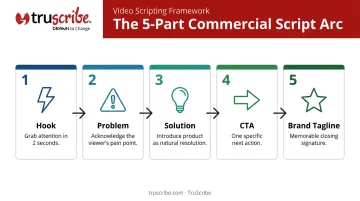
High-performing commercial scripts follow a five-part arc:
- Hook — A question, bold statement, or relatable scenario that grabs attention in the first two seconds
- Problem — Acknowledge the viewer's real pain point; build tension
- Solution — Introduce the product or service as the natural resolution
- CTA — Direct the viewer to one specific next action
- Brand Tagline — Close with a memorable signature
Decide the CTA before writing anything else. The entire narrative is building toward it. A CTA decided after the script is written will feel bolted on — and it will perform that way.
Effective vs. weak CTAs:
- ❌ "Learn more"
- ✅ "Call now for a free 15-minute consultation"
- ❌ "Visit our website"
- ✅ "Download the free guide at [URL] — offer ends Friday"
Specificity gives the viewer a clear action. Urgency gives them a reason to take it now.
Step 5: Write, Read Aloud, and Refine
Write a full draft — then read it aloud before doing anything else. This "table read" will surface awkward phrasing, unnatural pacing, and sections that run long in ways silent re-reading simply misses.
When refining for spoken delivery:
- Cut filler language and qualifiers
- Shorten sentences — spoken sentences land shorter than written ones
- Favor active verbs over passive constructions
- Apply a hard rule: every line must either advance the story or support the CTA. Lines that "sound nice" but do neither get cut.
Commercial Script Template and Format Guide
The Script Header
Every professional commercial script opens with a header block. These fields prevent version-control errors and keep production teams aligned:
| Field | Example |
|---|---|
| Client Name | Acme Corp |
| Script Title | "Summer Promo :30" |
| Writer | Jane Smith |
| Draft Version | Draft 2 |
| Submission Date | 2025-06-15 |
| Total Runtime (TRT) | :30 |
| Job ID | AC-2025-047 |
The Two-Column Body Format
Visual column (left):
- Shot descriptions in present tense, all-caps
- Camera directions: CU (close-up), MS (medium shot), WS (wide shot)
- On-screen graphics labeled GFX
- Text overlays noted as SUPER
- Shots can be numbered and timestamped
The right column handles everything the audience hears:
Audio column (right):
- Voiceover marked as V.O.
- On-screen dialogue formatted as CHARACTER NAME: "line"
- Music cues and SFX in all-caps
- Every row aligns horizontally with its corresponding visual row
With both columns mapped out, you can plug your content directly into the template below.
Sample Script Structure (Fill-in Template)
[HEADER BLOCK] Client: _______________ | Title: _______________ | Writer: _______________ Draft: ___ | Date: _______________ | TRT: ___ seconds | Job ID: _______________
| VISUAL | AUDIO |
|---|---|
| HOOK — Shot 1: [Describe opening scene or image — CU/MS/WS] | V.O.: "[Opening line — question, bold statement, or relatable scenario]" |
| PROBLEM — Shot 2: [Describe visual that represents the viewer's pain point] | V.O.: "[Acknowledge the problem; build tension]" |
| SOLUTION — Shot 3: [Introduce product/service visually — logo, product shot, or demonstration] | V.O.: "[Position the product/service as the natural resolution]" |
| BENEFIT PROOF — Shot 4: [Show outcome, result, or key benefit in action] | V.O.: "[State the primary benefit in concrete, specific terms]" |
| CTA — Shot 5: [On-screen URL, phone number, or offer graphic — SUPER: CTA TEXT] | V.O.: "[Deliver the call to action — specific, urgent, single action]" |
| TAGLINE — Closing shot: [Brand logo or signature visual] | V.O./MUSIC: "[Brand tagline]" / MUSIC OUT |
Key Variables That Affect Commercial Script Performance
Tone and Emotional Resonance
Viewers make purchasing decisions based on emotion — then justify them with logic. Kantar found that digital ads generating strong emotion are four times more likely to drive long-term brand equity than low-emotion alternatives.
The emotional arc of a script must be deliberately engineered:
- Tension (problem) activates attention
- Resolution (solution) creates memory anchors
- Relief (CTA) channels that emotion into action
This arc isn't accidental. It requires conscious construction at the outline stage.
Word Count and Pacing
Hitting word count targets is necessary but not sufficient. Pacing also requires deliberate space for:
- Natural pauses between sentences
- Music cues and SFX
- Emphasis on key words or phrases
Professional voice talent typically reads at 120–150 words per minute, with 120 WPM as a comfortable planning rate for commercial scripts. A rushed delivery kills credibility regardless of how well the words are written.
Storytelling Structure and Cognitive Retention
Scripts built around a problem-solution arc align with how the brain naturally processes and retains information. Tension introduced at the start narrows attention; resolving it creates a memory anchor that makes the message stick.
Sequential visual storytelling works on this same principle: reveal information in a deliberate order so each idea builds on the last. TruScribe's Scribology methodology applies this approach through hand-drawn whiteboard videos, with documented results of 2.3x higher retention than traditional video formats and an average 35% increase in conversion rates across 5,000+ delivered projects.
Call to Action Specificity
A vague CTA is why many high-production commercials underperform. What makes a CTA work:
- One action — not two options, not a menu of choices
- Specificity — a phone number, URL, or named offer beats "contact us"
- Urgency — a deadline or limited offer creates motivation to act now
- Alignment — the CTA should match where the viewer is in their decision journey
Common Mistakes to Avoid When Writing Commercial Scripts
Most script failures are predictable. Recognizing them before writing saves revision time.
Writing for the Eye Instead of the Ear
Commercial scripts are performed, not read. Complex sentence structures and abstract language that look fine on paper become confusing when spoken aloud. Write in natural spoken cadence — short sentences, active verbs, conversational phrasing — and test every line vocally before considering it finished.
Trying to Say Too Much
Overloading a 30-second spot with multiple messages, feature lists, and disclaimers is the single most common scriptwriting mistake. Cut anything that doesn't advance the story or support the CTA. Short-form formats make this non-negotiable — every word costs time, and clutter buries your message before it lands.
Missing or Burying the CTA
Many scripts spend 90% of their runtime building the problem and solution, then tack the CTA onto the final two seconds as an afterthought. The CTA needs structural setup throughout — the entire narrative should be building toward it. Give it enough airtime to register in real time: at minimum, a beat of silence or pause before and after so it doesn't blur into the final sentence of your pitch.
A quick checklist before you finalize any script:
- Does every line serve the story or the CTA?
- Can you read the script aloud naturally without stumbling?
- Is the CTA clearly audible — not just present — in the final version?
Frequently Asked Questions
How long should a 30-second commercial script be?
A 30-second commercial script runs approximately 65–85 words — around 65 for slower, dramatic reads and up to 85 for faster, energetic delivery. Factor in pauses, music cues, and sound effects, which consume airtime without adding to your word count.
What are the 5 elements of a script?
The five core elements are: Hook (grab attention), Problem (acknowledge the viewer's pain point), Solution (introduce the product/service), Call to Action (direct one specific next step), and Brand Tagline (close with a memorable signature). Each element plays a distinct role in guiding the viewer toward action.
What are the three C's of writing a good script?
Clear, Concise, and Compelling. Clarity ensures the message lands without confusion, conciseness respects the tight time constraint, and compelling delivery — through emotional resonance and a specific CTA — drives the viewer to act rather than simply absorb the ad.
What is a commercial script example?
A commercial script example is a sample script in 15-, 30-, or 60-second format showing how a message is structured, paced, and delivered using the visual/audio two-column format. The fill-in template covered in this guide gives you a ready-to-use starting point for any product or service.
What is the difference between a TV commercial script and a radio commercial script?
TV scripts use the two-column visual/audio format because visuals carry part of the narrative — audio doesn't need to describe everything on screen. Radio scripts rely entirely on sound, so copy must be more descriptive and sensory to build the scene without any visual support.