Introduction
You've rolled out a new training program. Employees completed it. Then, two weeks later, nobody can recall the key policies. Or you've pitched a product to a promising prospect, walked them through every feature, and still heard "we need to think about it." Or you've announced a major organizational change — and confusion spread faster than clarity.
These aren't execution failures. They're format failures.
Research by Richard Mayer across 11 controlled comparisons found that people who learn from words and pictures outperform those who learn from words alone — with a median effect size of d = 1.39 on problem-solving transfer. That's not a marginal difference.
Multimedia storytelling — combining text, visuals, audio, animation, and other formats into a deliberate narrative — is how organizations close that gap. This guide covers what it is, how to build your first piece, and which formats hold up in B2B communication.
Key Takeaways
- Multimedia storytelling works by pairing complementary formats, not piling on as many as possible
- Start with your message and audience before choosing any media
- Well-designed multimedia consistently outperforms single-format content in comprehension and recall
- Sequential visual storytelling (like whiteboard animation) is especially effective for abstract or technical topics
- A clear two-format story outperforms a cluttered five-format one every time
What Is Multimedia Storytelling?
Multimedia storytelling is the practice of conveying a narrative through a deliberate combination of media formats — text, images, audio, video, animation — where each element serves a specific purpose in advancing the story.
That last part matters. The goal is narrative function, not decoration. An infographic that doesn't add meaning isn't multimedia storytelling — it's visual noise.
How It Differs from Single-Format Communication
Traditional formats ask audiences to receive information passively through one channel. A memo, a slide deck, a written report — these work fine for simple, low-stakes messages. They struggle when the message is complex, the stakes are high, or the audience is already distracted, which describes most B2B communication.
Multimedia storytelling creates a layered experience:
- Different formats engage different cognitive pathways simultaneously
- Audiences encounter the same core idea through multiple representations, strengthening encoding
- The format itself signals importance — a well-crafted explainer video communicates that the message was worth investing in
Why B2B Organizations Need This Now
According to CMI's 2025 B2B Content Marketing Report, 76% of B2B marketers already use video, with 61% planning to increase that investment. Video adoption in internal communication is equally high — Gallagher's 2023/24 survey of 2,300 practitioners found 85% perceived video as effective for internal audiences.
Those numbers reflect a shift in baseline expectations. Audiences — whether prospects or employees — now arrive conditioned by multimedia experiences. Meeting them with a wall of text is a communication choice, and not a neutral one.
The Core Elements of a Multimedia Story
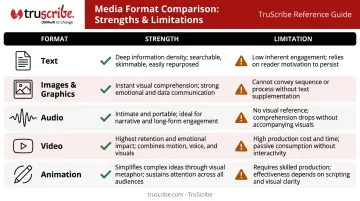
There are five foundational media types. Each does something the others can't — and knowing which format to reach for is what makes the difference between purposeful storytelling and format clutter.
| Format | What It Does Best | Key Limitation |
|---|---|---|
| Text | Structure, context, searchable detail | Passive; slow for complex concepts |
| Images & graphics | Relationships, data, emotional resonance | Static; can't show change over time |
| Audio | Immediacy, human connection, dual-channel processing | Transient; disappears as it plays |
| Video | Realistic behavior, procedure, emotional presence | High production cost; not ideal for abstract ideas |
| Animation | Hidden mechanisms, causality, abstract concepts | Novelty fades; motion without meaning adds nothing |
The Overload Boundary
More formats don't mean better storytelling. Sweller's cognitive load theory explains why: working memory is limited. When you add redundant visuals, competing on-screen text, or irrelevant audio, you consume the cognitive resources the audience needs to actually understand the message.
The coherence principle is unambiguous: cut anything that doesn't serve comprehension. A well-chosen two-format piece — narrated animation, or text with data visualization — routinely outperforms a five-format production with no clear narrative logic.
Interactivity: Optional, Not Essential
Once you have your core format combination working, interactivity becomes a meaningful upgrade — not a starting point. Embedded quizzes, scroll-driven reveals, and clickable navigation shift the audience from passive consumer to active explorer.
For long-form eLearning or complex sales content, it earns its place. For a first multimedia project, treat it as a future addition.
How to Build Your First Multimedia Story Step by Step
Step 1: Define Your Message and Audience First
Before choosing any format, answer two questions:
- What is the single most important thing my audience needs to understand or feel?
- What do they already know, and what might prevent them from engaging?
If you can't answer both in one sentence each, the story isn't ready to be built yet. Format decisions made before message clarity is achieved lead to expensive revisions and diluted impact.
Step 2: Storyboard Nonlinearly
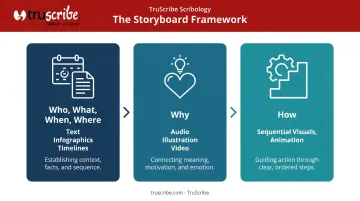
Instead of mapping a beginning-middle-end and then assigning formats, break the story into its core parts and assign the best medium to each one separately:
- Who, what, when, where — often suited to text, infographics, or timelines
- Why — frequently the emotional anchor; audio, illustration, or video carries this well
- How — step-by-step processes benefit from sequential visuals or animation
Sketch a rough visual layout and check that media elements are distributed across the piece, not front-loaded. A story where all the visuals appear in the first third and the rest is dense text has a distribution problem, not a content problem.
Step 3: Choose Media Intentionally
Two filters should govern every format decision:
- Does this medium do something the others can't for this specific part of the story?
- Does my team have the skills to execute this well, or do I need a partner?
The second question is especially important. A poorly produced video does more damage than no video. A narrated slide deck with strong visuals, built well, beats a five-format production built poorly.
Step 4: Construct the Narrative Arc
Arrange story elements into a sequence that is both logical and emotionally resonant. Pay close attention to transitions — each element should hand off to the next without jarring the audience. Audio and visuals should reinforce each other, not compete.
Every multimedia story needs a clear resolution or call to action. Tell the audience what changed, what they should do next, or what they should take away — then stop.
Step 5: Build a Media Bank for Future Projects
Capture assets during every project — recordings, photography, illustrated elements, interview clips. Archive them systematically. Teams that build this habit early find that second and third projects cost significantly less — the raw material already exists, and production time drops accordingly.
Why Multimedia Storytelling Works: The Science Behind Engagement
Dual Coding and Cognitive Load
Paivio's dual coding theory proposes that verbal and visual information are processed through interconnected but distinct systems — meaning that information encoded through both pathways has more retrieval routes than information encoded through just one. When a story pairs spoken narration with relevant visuals, the brain isn't just receiving the same message twice. It's building two interlocking representations that reinforce each other.
The architecture works only when formats are truly complementary. Ginns' meta-analysis of 43 studies found that graphics paired with spoken text outperformed graphics paired with printed text (d = 0.72). The reason: spoken narration uses the auditory channel while the visual system processes the image simultaneously. Narrating identical on-screen text forces both through the same channel — producing interference, not reinforcement.
The Attention Problem in Professional Settings
Professional audiences are navigating constant information volume. A message that doesn't engage multiple cognitive pathways within the first few seconds is deprioritized — not because people lack interest, but because competing demands are immediate.
Sequential visual storytelling addresses this directly. Research by Schneider and colleagues (2023) found that progressive drawing improved retention and transfer relative to static pictures across two experiments of 133 participants each, with effect sizes (partial η² = 0.13–0.17 for retention) that are practically meaningful for organizational communication. The mechanism isn't novelty — it's guided attention. When content unfolds sequentially, the audience's focus is directed precisely, eliminating the visual competition that text-heavy or cluttered formats create.
This principle sits at the core of TruScribe's Scribology methodology. The continuous visual motion and sequential drawing approach is designed specifically to direct viewer attention with precision — each stroke guides the eye to where comprehension needs to happen next, while minimalist design and empty space keep cognitive load low.
Emotion Is Not a Soft Metric
McGaugh's neuroscience research demonstrates that amygdala activity modulates how emotionally arousing experiences consolidate into long-term memory. Damasio's somatic marker hypothesis adds that bodily signals shape decision-making — especially when the stakes are real.
For B2B communicators, the implication is direct: emotional relevance improves memory consolidation and decision engagement. Content that connects to what genuinely matters to this audience, in this context, is more likely to be acted on.
Stories told through multiple formats generate stronger emotional resonance because they simulate a fuller sensory experience. To put that into practice:
- Pair factual content with human-voiced narration to move beyond passive reading
- Ground abstract concepts in real-world scenarios your audience recognizes
- Use narrative structure — not just information delivery — to create stakes the audience feels
Choosing the Right Format for Your Message
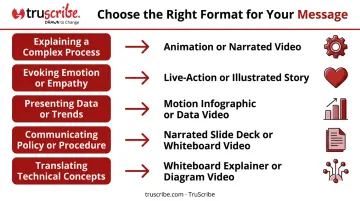
Format selection should follow message requirements, not trends or team defaults. A simple framework:
- Explaining a complex process → animation or narrated video
- Building emotional connection → live video or photography
- Presenting data clearly → infographics or data visualization
- Policy, reference, or technical detail → text with labeled visuals
- Abstract or technical B2B concepts → sequential animation with segmentation
When Animation Is the Right Choice
For abstract topics, technical explanations, compliance training, or any subject where live footage is insufficient or impractical, animation earns its place. It reaches places cameras can't: inside a mechanism, through a process, or across a concept that has no physical form to film.
Turkay's 2016 study found whiteboard animation improved immediate retention, engagement, and enjoyment compared to audio or text alone. The mechanism is sequential construction and guided attention, not the whiteboard aesthetic itself. That distinction matters: the retention benefit is replicable any time those principles are applied with discipline.
Applying those principles at scale is where methodology separates good animation from effective communication. TruScribe's Scribology approach — built on sequential drawing, precise timing, and neuroscience-backed visual design principles — has produced a 2.3x higher retention rate than traditional video and a 35% average increase in conversion rates across client engagements.
Organizations including Walmart, Microsoft, Merck, and Baker Hughes have used this framework for training programs, onboarding, change management, and sales enablement.
Start Simple, Iterate
For teams new to multimedia storytelling, the goal of a first project should be to prove the concept — not produce a flagship piece. Legitimate starting points include:
- A narrated slide deck with intentional visuals (not decorative ones)
- A short animated explainer (60–90 seconds) paired with a written summary
- A single well-produced video integrated into an existing content piece
Consistency and clarity matter more than production value. A story with a clear message and one well-chosen medium will outperform a visually spectacular story with no coherent narrative.
Frequently Asked Questions
What are the four types of storytelling?
The four main types are:
- Linear — events unfold in chronological order
- Nonlinear — events presented out of sequence
- Interactive — the audience controls how the narrative unfolds
- Visual/experiential — meaning conveyed primarily through sensory and visual modes
Multimedia storytelling often combines more than one type — for example, a linear narrative delivered through interactive, visual media.
What are five examples of multimedia?
Five common examples in B2B and media contexts: video (training, marketing), audio and podcasts (interviews, internal communications), animation (explainers, technical concepts), infographics (data communication, process overviews), and interactive data visualizations (dashboards, reports). Each excels in different communication contexts.
What is multimodal storytelling?
Multimodal storytelling uses multiple modes — linguistic, visual, auditory, gestural, spatial — to convey meaning. It's broader than multimedia storytelling: multimedia refers to delivery channels (video, audio, text), while multimodal refers to the representational choices made within those channels. A single video can be multimodal; a story using multiple delivery formats is multimedia.
How is multimedia storytelling different from traditional storytelling?
Traditional storytelling uses a single medium — spoken word, text, or image — in a linear sequence. Multimedia integrates multiple formats and can allow non-linear exploration. The core difference is cognitive: traditional formats engage one processing pathway; multimedia engages several at once, strengthening both comprehension and retention.
Do I need a large budget or technical team to get started?
No. Starting with one or two formats — a narrated explainer or a written piece with strong visuals — is a practical, effective first step. For specialized formats like animation, partnering with a studio like TruScribe is often more cost-efficient than building internal capability from scratch, especially when early projects need to demonstrate clear impact.