Introduction
Most organizational change initiatives don't fail because the change itself was wrong. They fail because leaders didn't understand who would be affected — and by how much — before the rollout began.
According to Gartner's July 2025 research, only 32% of mid-to-senior leaders said their last change initiative achieved healthy employee adoption. A separate Gartner study found fewer than half of employees actually realized the change goals their organization set. That gap between announcing a change and successfully implementing it is where most transformations break down.
A change impact assessment (CIA) closes that gap by giving leaders a structured view of who is affected, how deeply, and what support they need before rollout. This guide covers:
- What a CIA is and what it examines
- Why skipping it creates costly downstream problems
- The five key components every CIA needs
- A six-step process for conducting one
- A real-world scenario showing CIA in action
- How to communicate findings to drive adoption
Key Takeaways
- A CIA maps your current state against your future state to identify who's affected and how
- 88% of projects with excellent change management met or exceeded objectives, versus 13% with poor change management (Prosci, 2023)
- Frontline employee input is non-negotiable — leadership data alone leaves critical gaps
- CIA findings should drive your communication, training, and coaching plans — not sit in a drawer
- The CIA is a living document, not a one-time deliverable
What Is a Change Impact Assessment?
A change impact assessment is a structured process for comparing where your organization is today with where it needs to be — then identifying exactly who and what gets disrupted along the way.
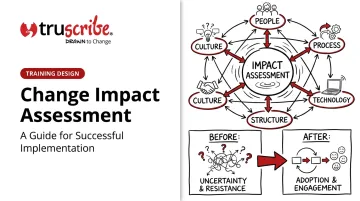
Prosci defines change impact across ten dimensions — from processes, systems, and job roles to mindsets, reporting structures, compensation, and location. A CIA isn't just a technology checklist or a training needs analysis. It examines the full picture of how work actually changes for real people across the organization.
Three Lenses for Analysis
| Analytical Lens | What It Examines |
|---|---|
| Process & Technology | Which workflows, systems, and tools change |
| Role & Behavior | Which responsibilities and critical behaviors shift |
| Cultural & Structural | Which mindsets, reporting lines, or employment terms change |
Types of CIAs
- High-level CIA — Organization-wide overview used early in planning to scope the change and prioritize resources
- Detailed CIA — Role-specific analysis of exactly how each affected group's work changes
- Business impact analysis — covers affected groups and departments
- Technology impact analysis — maps system and tool changes across users
- Behavioral/cultural analysis — examines required shifts in mindset and ways of working
The right approach depends on the size and complexity of your change. Most enterprise transformations need all three.
Why Change Impact Assessment Is Critical
Skipping a CIA creates compounding problems. Organizations that skip the process miss key stakeholder groups, underestimate training requirements, fail to anticipate resistance, and face poor adoption, project delays, and costly rework as a result.
Prosci's 2023 research, drawing on more than 2,600 practitioners, found that projects with excellent change management met or exceeded objectives 88% of the time, compared to just 13% with poor change management. Excellent programs were also nearly five times more likely to stay on schedule and 1.5 times more likely to remain on budget.
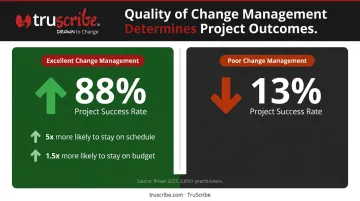
That gap between 88% and 13% is largely determined by the quality of planning that precedes execution. A CIA supplies that planning foundation, telling you which groups need intensive support and which can be handled with lighter-touch interventions so every resource allocation decision is grounded in data, not guesswork.
Core Benefits of a Well-Executed CIA
- Identifies process gaps, skill shortfalls, and resistance hotspots during planning, not mid-rollout
- Directs training, coaching, and communication investment where it will have the most impact
- Creates a shared, documented understanding of what's changing and why, aligning stakeholders before the rollout begins
- Prepares affected groups ahead of time, so adoption happens faster and with less friction
- Catches missing project deliverables or flawed design decisions before they become expensive to fix
Key Components of a Change Impact Assessment
Change Scope Identification
The first step is defining exactly what's in and out of scope. Which business units, functions, processes, roles, and systems does this change touch? Scope too broadly and you waste resources on low-impact groups; scope too narrowly and high-impact teams end up without support.
Get the boundaries documented and agreed upon before anything else.
Stakeholder Analysis
Map every individual and group affected — employees at all levels, managers, customers, and partners where relevant. The output isn't just a list; it's a severity rating for each group:
- High impact — significant role, process, or behavioral changes requiring intensive support
- Medium impact — moderate changes requiring targeted communication and some training
- Low impact — minor changes manageable through general communications
Capture not just who is affected, but in what way and to what degree.
Impact Evaluation
For each affected group, rate the severity of change across key dimensions:
- Process changes
- System changes
- Role and responsibility shifts
- New skill requirements
- Behavioral or cultural expectations
Use a standardized scoring scale — Prosci's software uses 0–5 per dimension — so assessments are comparable across groups and trackable over time. The key is publishing clear anchors: "no visible work change," "minor task adjustment," and "fundamental role redesign" mean something specific. Unexplained numbers don't.
Change Readiness Assessment
Impact magnitude and readiness are not the same thing. A high-impact group might be well-prepared, while a lower-impact group resists because of low trust or leadership gaps.
Readiness assessment examines:
- Current workload and bandwidth
- Prior change saturation (how much change this group has absorbed recently)
- Leadership sponsorship strength
- Cultural openness to change
- Existing skill levels relative to future-state requirements
Maintain separate impact and readiness scores. Both inform prioritization.
Risk and Communication Requirements
Every identified impact needs two things attached to it: an associated risk level and a determination of what support that group needs. This is where the assessment stops being diagnostic and starts driving decisions. Each impact maps to a specific intervention:
- Targeted training programs
- Leadership coaching
- Change champion networks
- Focused communication campaigns
How to Conduct a Change Impact Assessment: Step by Step
A common mistake is rushing through data collection to jump straight to the action plan. The early stages are where accuracy is built — shortchanging them creates gaps that surface as adoption failures later.
Step 1 – Define Scope and Identify Stakeholders
Document the boundaries of the change across process, systems, structure, and culture. Map all impacted groups, including roles you might underestimate. Involving HR, project leads, department heads, and frontline managers at this stage prevents major blind spots that surface later.
Step 2 – Map Current and Future States
Start by gathering existing documentation, then work forward in three stages:
- Collect workflows, org charts, job descriptions, and system architecture
- Define the desired future state in concrete, measurable terms
- Analyze the gap — what's changing, by how much, and for which groups
This gap analysis becomes the foundation for every impact rating that follows.
Step 3 – Collect Stakeholder Input
Three primary methods work well together:
- Structured interviews — depth and nuance from key individuals
- Facilitated workshops — cross-functional insight and collaborative impact mapping
- Surveys — scale and breadth across large populations
One critical point: relying solely on project sponsors or senior leaders for data is a significant pitfall. McKinsey found frontline employee and manager engagement present in 73% of successful transformations, versus only 46% of unsuccessful ones. Frontline employees consistently surface the most accurate, ground-level impact information.
Step 4 – Analyze and Prioritize Impacts
Categorize raw feedback by impact type — system, process, behavioral, role. Rate each by severity. Build an impact matrix or heat map to surface the highest-risk areas. This step converts qualitative input into ranked priorities that leaders can act on.
Step 5 – Plan Change Interventions
Use the prioritized impact data to design responses for each affected group, proportional to rated severity:
- High-impact groups — tailored training programs, dedicated change champions, executive sponsorship visibility
- Medium-impact groups — targeted communication campaigns, manager-led briefings, skills workshops
- Low-impact groups — general announcements, FAQ documents, open Q&A sessions
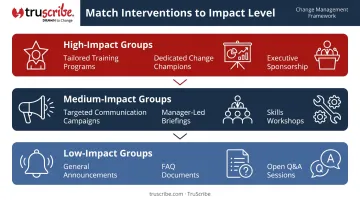
Resist the impulse to apply the same intervention to everyone. A one-size-fits-all approach wastes resources on low-impact groups while leaving high-risk ones under-supported.
Step 6 – Communicate Findings and Monitor Adoption
Present CIA findings to stakeholders and leadership using clear visuals — heat maps, impact matrices, and gap analysis summaries. These tools turn complex data into decisions leaders can act on immediately.
The CIA is not a one-time document. Treat it as a living record:
- Revisit the assessment at defined intervals throughout implementation
- Update impact ratings whenever project scope or design decisions shift
- Flag newly surfaced risks before they affect adoption timelines
Change Impact Assessment in Action: A Practical Example
Consider a large enterprise rolling out a new integrated software platform across three business units. Here's how CIA principles applied in practice.
Scoping and State Mapping
The change team defined twelve affected roles across three departments, documented current workflows, and mapped them against the future-state system design.
The gap analysis revealed two departments facing greater process disruption than the project team had assumed: one due to manual workarounds missing from official documentation, and another because the new system changed approval authority in ways that hadn't been flagged.
Data Collection
Structured workshops with department leads and one-on-one interviews with frontline users surfaced role-specific impacts. Two findings emerged that project leadership hadn't anticipated: a shift in decision-making authority for one team, and a compliance documentation requirement that fell entirely outside the original project scope. Both required targeted responses.
Intervention Design
The impact heat map drove resource allocation directly:
- High-impact roles received custom training modules, not generic platform walkthroughs
- A change champion network was established within the two most affected departments
- Leadership used the heat map to sequence communications — highest-impact groups heard first, with messages tailored to their specific role changes
The result: employees in the most disrupted roles understood what was changing before go-live, not after. That preparation, built on accurate CIA data rather than assumptions, turned a potentially chaotic rollout into a managed one where no one was caught off guard.
How TruScribe Helps Organizations Communicate Change
A thorough CIA is only as effective as the organization's ability to communicate its findings. Dense slide decks, long email updates, and static PDFs transfer information — they rarely build the understanding and emotional buy-in that drive real behavior change.
TruScribe's whiteboard animation approach addresses this directly. Their proprietary Scribology method uses neuroscience-backed, sequential hand-drawn visuals to walk employees through complex change narratives: what's changing, why it's happening, and what it means for them. The format is built around how the brain actually learns.
Why Sequential Visual Communication Works for Change
- Minimalist, purposeful design eliminates visual clutter so employees focus on what matters most
- Content revealed step by step mirrors how humans process cause-and-effect reasoning
- Hand-drawn visuals engage memory pathways differently than polished animation or slide decks, deepening retention
- Watching content drawn in real time creates active processing rather than passive viewing
Across client engagements, TruScribe videos produce an average 35% increase in engagement and conversion and 2.3x higher retention compared to traditional video formats. For change management, those numbers translate to faster adoption, fewer repeated explanations, and employees who navigate transitions with more confidence.
Organizations like Walmart, Siemens, Microsoft, and Medtronic have worked with TruScribe for employee training, culture communication, and internal messaging. Navistar engaged TruScribe specifically for a culture transformation video — a direct change management application where message retention determined whether the initiative landed or stalled.
When CIA findings need to reach employees across departments, sites, or skill levels, a well-crafted visual story is what turns analysis into action people actually take.
Frequently Asked Questions
What should a change impact assessment include?
A CIA should cover change scope definition, stakeholder identification with impact ratings, evaluation across people, process, technology, and culture dimensions, a readiness assessment, risk identification, and specific communication and training requirements for each affected group.
What are the 5 C's of change?
Different practitioners define these slightly differently. One common version uses: Case for change, Clarity, Communication, Capability, and Commitment. The CIA supports all five — building the case, clarifying scope, informing communications, identifying capability gaps, and flagging commitment risks before rollout.
When should a change impact assessment be conducted?
Start the CIA early in the planning phase — once the future state is defined but well before rollout. It should be revisited iteratively as design decisions are finalized, since new scope elements regularly surface new impacts.
What is the difference between a change impact assessment and a change management plan?
A CIA diagnoses the situation — who's affected, what's changing, how much, and what risks exist. A change management plan translates those findings into action: owners, timelines, training, communications, and success measures. Skip the CIA and the plan is built on guesswork.
Who should be involved in a change impact assessment?
Effective CIAs draw input from project managers, change leads, HR partners, department heads, subject matter experts, and frontline employees. Including people who do the actual work ensures the assessment reflects operational reality, not just leadership assumptions.
What are the most common mistakes in a change impact assessment?
The top pitfalls: relying only on leadership input (missing frontline realities), treating the CIA as a one-time document rather than a living assessment, skipping standardized scoring scales, and failing to connect impact findings to targeted communication or training actions for each affected group.