Corporate communications is the system that prevents that erosion. It's the coordinated set of strategies, messages, and channels organizations use to communicate with both internal audiences (employees, leadership) and external ones (customers, media, investors, the public). Done well, it's what keeps a company's voice coherent when speaking to thousands of people across dozens of touchpoints.
This article covers the key functions of corporate communications, its strategic goals, a step-by-step framework for building a program that works, and the best practices that separate high-performing teams from the rest.
Key Takeaways
- Corporate communications covers the full range of messaging — from internal memos and training materials to press releases and crisis response.
- Internal and external communications are distinct dimensions that must stay consistent with each other to build credibility.
- Core functions include public relations, internal communications, crisis communications, and customer/marketing communications.
- Effective strategy requires knowing your audiences, defining measurable objectives, and selecting the right channels.
- Visual communication — particularly for complex topics — significantly boosts message retention and comprehension.
What Is Corporate Communications?
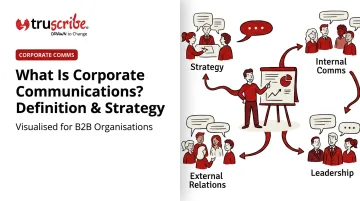
Corporate communications is the holistic practice of managing how an organization conveys its identity, values, and messages to all stakeholders — not just customers. The goal is to shape perception, build relationships, and keep every audience the organization depends on aligned — not simply to push information out.
As communication scholar Peggy Simcic Bronn defines it, corporate communication is "a management function through which all forms of internal and external communication are harmonized as effectively and efficiently as possible" to create a favorable basis for organizational relationships.
Three Branches That Work Together
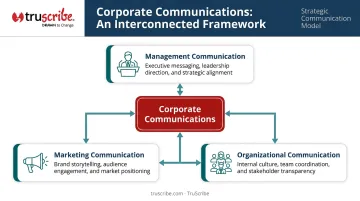
Corporate communications typically operates across three interconnected areas:
- Management communication — executive messaging, leadership visibility, and strategic narrative from the top down
- Marketing communication — brand promotion, customer outreach, and market-facing content
- Organizational communication — internal alignment, culture-building, and day-to-day employee engagement
Formats Corporate Communications Takes
Corporate communications isn't a single medium. It spans:
- Written: Reports, emails, press releases, website copy, policy documents
- Verbal: Executive meetings, media interviews, press conferences, town halls
- Visual: Infographics, explainer videos, branded materials, presentations
Choosing the right format for the right audience matters more now than it used to. As distributed and hybrid workforces have become the norm, teams that once shared a floor now span continents — making channel strategy and message clarity more consequential than ever.
Internal vs. External Corporate Communications
Internal Communications
Internal communications covers all messaging directed at employees and leadership — the content that keeps your workforce aligned with the company's mission, goals, and daily operations.
Common formats include:
- Company newsletters and intranet updates
- Employee onboarding and orientation materials
- Training programs and compliance documentation
- Executive announcements and all-staff briefings
- Team-level updates and change management content
The stakes here are higher than most leaders assume. According to McKinsey, employees who received detailed communication about workplace arrangements were nearly five times more likely to report increased productivity. Those who described communication as vague or absent were almost three times more likely to report moderate or high burnout.
External Communications
External communications targets everyone outside the organization: customers, investors, media, partners, and the general public. It includes:
- Press releases and media relations
- Marketing campaigns and social media
- Investor reports and regulatory disclosures
- Website content and thought leadership
Why Consistency Between the Two Matters
Internal and external communications must stay consistent with each other. Employees are brand ambassadors — when what a company says publicly contradicts how it communicates internally, or when employees are the last to hear major news, trust breaks down on both sides. Your workforce notices. So do your customers. A visible gap between the two messages is rarely easy to recover from.
Core Functions of a Corporate Communications Department
Public Relations and Media Management
PR manages the company's public image through press releases, media events, journalist inquiries, and coverage monitoring. PR professionals also handle corporate reputation, corporate responsibility messaging, and organizational identity. The Public Relations Society of America defines it as "a strategic communication process that builds mutually beneficial relationships between organizations and their publics."
Internal Communications
Day-to-day internal comms work spans a wide range of tasks:
- Drafting executive announcements and leadership updates
- Maintaining employee resource hubs (handbooks, benefits guides)
- Running internal newsletters and intranet content
- Facilitating training programs and compliance communications
This function overlaps significantly with HR — particularly around onboarding and culture. In hybrid environments, that overlap becomes even more important; employees can't absorb information organically when they're not in the same room.
Crisis Communications
Crisis communications covers the proactive and reactive strategies organizations use to protect their reputation during unanticipated events: product failures, cyberattacks, lawsuits, or negative press coverage.
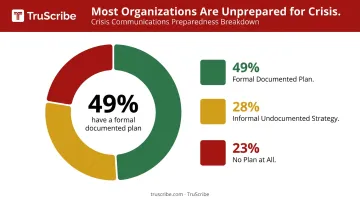
The preparedness gap here is significant. According to Capterra's 2023 survey of U.S. business leaders, only 49% had a formal, documented crisis communications plan. Another 28% relied on an informal, undocumented strategy — meaning the majority of organizations are improvising when a crisis hits.
Customer Communications and Marketing
This function bridges the communications and marketing teams to produce customer-facing content: emails, website copy, social media, brochures, and more. The most effective organizations integrate these two departments rather than silo them. When they don't, brand messaging becomes inconsistent — and customers notice, even if they can't articulate why.
Investor and Stakeholder Relations
This function manages communication with investors, board members, regulatory bodies, and strategic partners through quarterly reports, investor briefings, and compliance disclosures. How well an organization communicates here — and how consistently — shapes its credibility with the people who control access to capital and partnerships.
Key Goals of a Corporate Communications Strategy
Goal 1: Build and protect brand reputation
Reputation is built message by message, across every touchpoint. Edelman's 2024 Brand Trust Report found that fully trusting a brand produced a net +63 point effect on purchasing it, +53 on advocacy, and +55 on loyalty. Separately, 84% of consumers said they needed to share values with a brand before purchasing. Corporate communications is the function that either earns that trust or erodes it — one unclear message at a time.
Goal 2: Drive employee engagement and alignment
Communication clarity is one of the strongest predictors of workforce performance. Gallup's meta-analysis across 112,312 teams found that employees knowing what's expected of them directly predicted:
- Higher productivity and retention
- Improved safety outcomes
- Better overall wellbeing
Gallup called role clarity the most fundamental driver of engagement — meaning that vague messaging doesn't just slow teams down, it actively undermines them.
Goal 3: Enable stakeholder trust and organizational transparency
Clear, honest communication across all audiences — employees, investors, customers, partners — builds the trust that sustains growth and organizational resilience. Without it, brand equity erodes and employee engagement collapses — no matter how polished the messaging looks on the surface.
How to Build a Corporate Communications Strategy
Step 1: Audit Your Current Communication Practices
Before adding new channels or tools, assess what already exists. Survey employees and stakeholders, review current content and channels, and document where communication breaks down. This baseline prevents the common mistake of layering new processes on top of existing dysfunction.
Step 2: Define and Map Your Audiences
Stakeholder mapping identifies every internal and external audience, their communication needs, preferred channels, and relationship to the organization. Different audiences need tailored messages even when the core brand narrative is the same. What an investor needs to hear about a product launch is not what a new hire needs to hear — even if the underlying facts are identical.
Step 3: Set SMART Objectives Aligned to Business Goals
Vague goals produce vague results. Replace "improve engagement" with specific, measurable targets:
- Increase internal newsletter open rates by 20% within two quarters
- Reduce crisis response time to under four hours
- Improve employee alignment scores by 15 points on quarterly surveys
- Achieve a defined media coverage volume for a product launch
Step 4: Choose the Right Channels and Tools for Each Audience
Channel selection should follow audience behavior, not organizational convenience.
- Internal channels: Intranets, email, digital signage, training videos, all-hands meetings
- External channels: Press releases, social media, earned media, investor reports, content marketing
For complex topics — policy changes, compliance training, benefits explanations, organizational transformations — the format itself determines whether the message lands. Text-heavy emails and dense slide decks produce low engagement and retention across distributed workforces.
Visual formats address this directly. TruScribe's Scribology method — used by Walmart, Microsoft, and Siemens — combines sequential hand-drawn visuals with deliberate narrative pacing to reduce mental fatigue and improve information retention. TruScribe reports 2.3x higher retention compared to traditional video formats, which matters when a policy update or compliance mandate needs to stick, not just get delivered.
Walmart applied this approach for their "100 Pennies" cultural values video, reaching a geographically dispersed workforce with organizational principles that a text-heavy format would have struggled to land. That's the practical test for any channel choice: not what's easiest to produce, but what actually works for the audience receiving it.

Step 5: Measure, Learn, and Refine
Establish KPIs and build in regular review cycles. Useful metrics include:
- Email open rates and intranet engagement
- Employee feedback and alignment survey scores
- Media coverage volume and sentiment
- Crisis response time
- Training completion and comprehension rates
Effective corporate communications is iterative. The strategy you build today should look different in 12 months based on what the data tells you.
Best Practices for Effective Corporate Communications
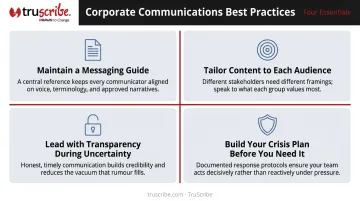
Strong corporate communications don't happen by accident. They're the result of deliberate choices about tone, timing, audience, and preparation. Four practices separate organizations that communicate well from those that struggle:
- Maintain a messaging guide. Consistent tone, vocabulary, and visual identity across all communications — internal and external — prevent confusion and reinforce brand credibility. Hold cross-functional alignment sessions regularly so every department stays on the same page.
- Tailor content to each audience. A press release and an employee onboarding video serve different purposes and should sound nothing alike. Research on personality-message fit in organizational communication shows that audience-matched messages produce significantly higher engagement — while mismatched ones can actively reduce it.
- Lead with transparency during uncertainty. Organizations that communicate openly through change maintain far more trust than those that go quiet. Employees and stakeholders can handle difficult news. What erodes trust is silence while rumors fill the gap.
- Build your crisis plan before you need it. Reactive communications created under pressure rarely hold up. Maintain a response playbook, train designated spokespersons, and run scenario exercises in advance. PwC's Global Crisis Survey found that when COVID-19 hit, more than 30% of organizations lacked a designated crisis-response team — a gap that became immediately and painfully visible.
Frequently Asked Questions
What do corporate communications professionals do?
Corporate communications professionals develop and execute messaging strategies for employees, customers, media, and investors. Their work spans PR, internal communications, crisis management, and marketing collaboration — all aimed at protecting reputation and driving organizational alignment.
What are the 7 C's of corporate communication?
The 7 C's are Clarity, Conciseness, Concreteness, Correctness, Coherence, Completeness, and Courtesy. Together, they guide communications to be effective and trustworthy across any audience or channel.
What is the difference between internal and external corporate communications?
Internal communications targets employees and leadership to drive alignment and engagement. External communications addresses customers, investors, media, and the public to manage brand reputation. Both must remain consistent with each other to maintain organizational trust.
What are the main goals of a corporate communications strategy?
Corporate communications strategy focuses on building brand reputation, driving employee engagement, and maintaining stakeholder trust — all through consistent, transparent messaging across every audience.
How do you measure the effectiveness of corporate communications?
Effectiveness combines quantitative KPIs (email open rates, intranet engagement, media coverage, survey scores) with qualitative feedback like employee sentiment and stakeholder perception. Regular reviews help refine strategy as communication needs evolve.