Introduction
Poor onboarding has a direct cost. According to BambooHR's 2023 survey of 1,565 US employees, 44% reported regret or second thoughts within their first week, and 70% decided within the first month whether the job was a good fit. Meanwhile, Gallup research found only 12% of employees strongly agreed their organization does a great job onboarding.
For HR and L&D leaders, the gap between a new hire's first impression and their long-term commitment — that 88% who aren't strongly satisfied — is exactly where onboarding video programs do their most critical work.
What follows is a practical guide: the types of onboarding videos that move the needle, real brand examples worth studying, and the practices that turn a new hire's first week into a foundation for long-term retention.
Key Takeaways
- Effective onboarding programs use a suite of video types — welcome, training, compliance, and culture — rather than a single all-purpose video.
- Video outperforms text-based onboarding by improving retention, reducing inconsistencies, and scaling across distributed teams.
- Match format to content: animation works best for process-heavy material, live-action for culture and testimonials.
- Treat onboarding video programs as ongoing investments — measure results and update content regularly.
What Are Employee Onboarding Videos and Why Do They Work?
Employee onboarding videos are short-form visual content that introduces new hires to company culture, values, policies, roles, and processes. Most organizations use several video types across the onboarding journey — not a single orientation film.
Why Video Outperforms Text-Based Onboarding
Research supports video for procedural training specifically. A peer-reviewed randomized controlled trial found that video produced significantly better practical performance outcomes than illustrated text among adult learners, with the advantage holding at one-month follow-up. That advantage is most pronounced for demonstrations, workflows, and multi-step processes — exactly the content that makes up most onboarding programs.
The contrast with printed handbooks or slide-heavy orientation sessions is stark:
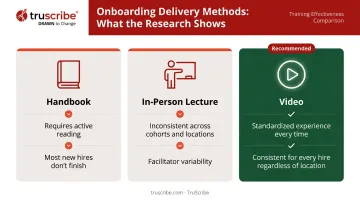
- Handbooks require active reading and provide no pacing guidance — most new hires don't finish them
- In-person lectures are inconsistent across cohorts, locations, and facilitators
- Video delivers a standardized experience every time, for every hire, regardless of who manages their onboarding
The Scalability Advantage
That consistency becomes a structural advantage for remote and distributed teams. A new hire in a satellite office gets the same culture introduction, the same compliance training, and the same leadership message as someone at headquarters — no facilitator variability, no version drift.
For organizations running high-volume hiring across multiple locations, that uniformity translates directly into faster time-to-productivity and measurable compliance completion rates. The investment in a single well-produced video pays dividends across every cohort that follows.
Types of Employee Onboarding Videos
Effective onboarding programs use multiple video types, each serving a distinct purpose. Together, they form a content library — not a single production.
Welcome and Culture Videos
The first video a new hire sees sets the emotional tone for everything that follows. Welcome videos typically feature leadership or real employees and are designed to create a sense of belonging before day one — not to communicate policy.
What to include:
- Company mission and core values
- A message from the CEO or senior leadership
- Candid footage of the actual workplace and people
- What makes the culture genuinely different (not just stated, but shown)
Authenticity matters more than production value here. Real employees speaking candidly build trust that polished corporate scripts rarely achieve.
Role-Specific and Process Training Videos
These go beyond general orientation. Role-specific videos cover the workflows, tools, and responsibilities unique to each job function — allowing new hires to become productive without waiting for one-on-one coaching.
For complex processes or technical systems, formats like whiteboard animation are particularly well-suited. The sequential reveal of information mirrors how people construct mental models of unfamiliar material, building understanding one step at a time rather than presenting a completed diagram all at once.
Compliance and Policy Videos
Compliance videos cover legally required topics — workplace safety, data security, harassment policies, HR procedures — in a standardized, trackable format. Every employee receives the same information regardless of who manages their onboarding.
Dense compliance content benefits most from clear narrative structure and short, modular delivery. Breaking a compliance library into 3-5 minute topic-specific modules improves completion rates far more than a single 45-minute mandatory training session.
CEO and Leadership Welcome Videos
A direct message from the CEO signals that leadership is invested in the new hire's success — particularly meaningful in large organizations where employees may never meet executives in person.
These videos work best when they feel conversational rather than scripted. The leader's genuine perspective on company vision, and what the new hire's role actually means to the organization, builds connection more effectively than a polished corporate statement.
Expectations and First-Week Walkthrough Videos
Pre-boarding expectation videos answer the questions every new hire has but might feel awkward asking: What happens on day one? What tools will I need access to? Who are my key contacts?
Delivering this content before the start date reduces first-day anxiety, shortens time-to-confidence, and cuts the volume of repetitive questions HR teams receive during the first week.
Employee Onboarding Video Examples From Real Brands
These examples illustrate strong execution across different video types. Note that several are publicly documented as culture or employee-experience videos rather than formal onboarding programs — but they offer clear techniques worth borrowing.
HubSpot – Storytelling-Led Culture Video
HubSpot's culture video uses cinematic storytelling, real employee footage, and a self-aware, humorous tone to make culture feel tangible rather than aspirational. Two things make it work: featuring actual employees (not actors), and letting the company's personality show rather than describing it. New hires watching this video can picture themselves in the environment before their first day.
Google – Documentary-Style Employee Experience Video
Google's "Interns' First Week" video takes a documentary approach — interview-style conversations with employees from diverse backgrounds, combined with footage of the actual workspace, meals, and events. Key technique: showing the physical environment makes the company feel like a real place, not a brand concept. Prospective and new employees can project themselves into the experience before day one.
Amazon – Structured Training at Scale
Amazon's Virtual New Hire Orientation program demonstrates how video enables consistent training across a massive, distributed workforce. Covering company history, role-specific expectations, and safety protocols, it shows why standardized video delivery is the most reliable way to maintain consistency when onboarding thousands of employees across hundreds of locations.
Spotify – Whiteboard Animation for Engineering Culture
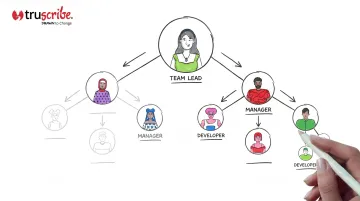
Spotify's engineering culture video uses illustrated animation and sequential drawing to explain complex organizational structures (squads, tribes, chapters, guilds) to engineering new hires. Key technique: abstract team structures are genuinely difficult to explain with words alone. Sequential animation builds the mental model visually, one layer at a time, so new hires grasp the system as it's revealed rather than trying to hold the whole picture at once.
Zendesk – Brand Personality as Onboarding Content
Zendesk's culture video uses voiceover narration, clever writing, and real office footage to communicate who they hire and what they value. It's both informative and entertaining, which is harder to pull off than it looks. A strong brand voice applied consistently to onboarding content signals to new hires what the company actually cares about.
Best Practices for Creating Effective Employee Onboarding Videos
Define the Purpose Before You Script Anything
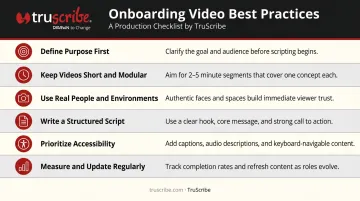
The most common mistake in onboarding video production is trying to cover too many topics in one video. Each video should have a single, clearly defined goal — introduce culture, explain a process, set first-week expectations — so the message stays focused and actionable.
Keep Videos Short and Modular
TechSmith's 2025 guidance on training video length explicitly rejects a single perfect duration, recommending videos be "as long as needed, as short as possible." The practical principle: break onboarding into a library of short, topic-specific videos rather than one long orientation recording. New hires can then revisit specific content on demand — a significant advantage over a single two-hour session they're expected to absorb once.
ATD's 2025 workplace research confirms that microlearning is now the dominant delivery format for new-employee onboarding, used by 93% of organizations surveyed.
Use Real People and Real Environments
Stock footage signals inauthenticity immediately. Footage of actual employees, real offices, and genuine work scenarios builds trust and emotional connection that no amount of production polish can replicate. This is especially true for culture and welcome videos, where the goal is belonging, not information transfer.
Write a Structured Script First
A clear narrative arc — context, content, call to action — and a consistent voice that reflects your company's tone is the foundation of every effective onboarding video, regardless of format. TruScribe's production process begins here, treating the script as the strategic core of the video.
For HR and L&D teams working from dense policy manuals or slide decks, this scripting phase is where content gets distilled into what new hires actually need to understand and remember.
Prioritize Accessibility and Multi-Platform Delivery
Captions, subtitles, and mobile-friendly formats ensure onboarding content reaches every new hire — remote workers, non-native speakers, and employees with hearing impairments. Accessible formatting measurably improves comprehension and completion rates across all audiences, not just those with specific needs. TruScribe offers ADA-compliant subtitles, closed captions, and full multi-language localization as part of their standard service offering.
Measure, Gather Feedback, and Update
Onboarding videos are living assets, not one-time productions. Build in a regular review cycle from the start:
- Track completion rates to identify where new hires disengage
- Survey employees after their first 30 days to surface gaps
- Update videos whenever policies, processes, or branding change
A library reviewed quarterly stays accurate and useful — one left untouched for two years becomes a liability.
How Whiteboard Animation Enhances Onboarding for Complex Topics
Live-action culture videos work well for introductions and testimonials. For everything else — abstract concepts, multi-step processes, compliance requirements, technical systems — whiteboard animation has a structural advantage.
The Cognitive Science Behind Sequential Drawing
A 2016 meta-analysis of 61 studies and 7,036 learners found that animation produced better learning outcomes than static graphics, particularly when the animation depicts change over time or sequential processes. The mechanism matters: the continuous drawing motion directs viewer attention deliberately, presenting one idea at a time rather than overwhelming working memory with a completed diagram.
This is the principle behind TruScribe's proprietary Scribology methodology — a structured approach that applies cognitive load reduction, sequential attention direction, and timing optimization to corporate onboarding content. The result is a hand-drawn format that builds genuine mental models — not just delivered information.
Where It Applies in Onboarding
Whiteboard animation is particularly effective for:
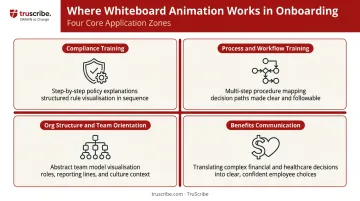
- Compliance training — breaking legal requirements and policy procedures into visually clear, step-by-step explanations that hold attention without losing accuracy
- Process and workflow training — mapping multi-step procedures in a sequence the brain can follow and retain
- Org structure and team orientation — explaining abstract structures (like Spotify's squad model) that static slides can't communicate effectively
- Benefits communication, where translating complex financial and healthcare decisions into something a new hire can actually act on often requires more than a PDF
TruScribe has delivered onboarding and orientation videos for organizations including Walmart (the "100 Pennies" cultural values video), Amedisys (core values onboarding), Navistar (culture transformation), and 4Wall Entertainment (foundations onboarding).
Across 5,000+ projects for more than 1,000 B2B clients in healthcare, financial services, manufacturing, and technology, one thing holds: when retention matters — when new hires need to apply what they've learned, not just sit through it — animation handles the complex parts better than text or static slides.
Frequently Asked Questions
What are onboarding videos?
Employee onboarding videos are short visual content pieces used to introduce new hires to company culture, values, policies, and role expectations. Most organizations use a series of videos — welcome, training, compliance, leadership — rather than a single orientation film.
What are the 4 stages of onboarding?
The four common stages are pre-boarding, orientation, role-specific training, and ongoing integration. Video supports each one: pre-boarding clips reduce first-day anxiety, orientation videos establish culture, training videos build role competency, and integration content reinforces values across the first 90 days.
What should be included in an employee onboarding video?
Content depends on the video type. Across a full program, key categories include company mission and culture, role expectations, tools and processes, team introductions, and compliance or policy information. The right content for any single video depends on its specific, defined purpose.
How long should an employee onboarding video be?
Individual onboarding videos should stay under 5 minutes, with many best-practice examples running 2-3 minutes. Shorter, modular videos consistently outperform single long-form recordings — new hires can revisit specific content on demand rather than rewatching an hour-long session to find one answer.
What is the most effective format for onboarding training videos?
Format should match content type. Live-action works best for culture introductions and employee testimonials. Animation — including whiteboard-style video — is better suited for complex processes, technical systems, and compliance topics where step-by-step visual clarity is non-negotiable.
How do onboarding videos improve employee retention?
Structured onboarding helps new hires feel prepared and connected from day one. BambooHR's 2023 research found that 70% of new hires decide within their first month whether a job is a fit — and clear, consistent video onboarding directly shapes that decision. Programs that reduce early confusion consistently see lower first-year attrition.