Introduction
Most organizations invest heavily in culture change. Workshops get scheduled. Value statements get laminated. And six months later, nothing has actually changed.
That pattern has a real cost:
- McKinsey found that only 26% of organizational transformations succeed at both improving performance and sustaining that improvement
- Gallup's 2024 State of the Global Workplace report puts the cost of disengagement at $10 trillion in lost productivity annually — with just 20% of employees worldwide actively engaged
For HR leaders, L&D professionals, and Employee Experience managers, those numbers aren't abstract. They represent turnover you're trying to stop, initiatives that didn't land, and culture gaps that keep widening despite real effort.
This article isn't about incremental improvements or best practices you've already heard. These are five bold, often uncomfortable moves that cut against conventional culture-change wisdom — and actually work.
Key Takeaways
- Focusing on one high-impact behavior creates measurable culture change faster than broad transformation campaigns
- Leaders must be living proof of the new culture — visible, public, and accountable
- Culture narratives stick when told through emotionally resonant stories, not memos
- Lasting shifts require redesigning systems — the structures that reinforce or undermine behavior every day
- Real-time metrics reveal culture health before small problems become systemic ones
Bold Move 1: Pick One High-Impact Behavior and Make It Non-Negotiable
Why "Boiling the Ocean" Kills Culture Change
When organizations try to shift values, mindsets, attitudes, and behaviors simultaneously, employees hit a wall. Gartner's 2023 HR leader survey found that 77% of HR leaders reported employee fatigue from constant change — and affected employees showed 42% lower intent to stay and 27% lower sustainable performance.
That's not an argument against change. It's an argument for focus.
The bold move is radical selectivity: identify one specific, observable behavior that — if adopted at every level — creates a ripple effect across the entire culture.
How to Identify the Right Behavior
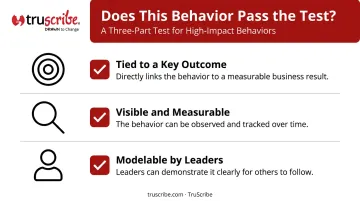
A high-impact behavior passes three tests:
- It's tied to a key outcome — not a vague aspiration, but something that directly moves a business needle
- It's visible and measurable — managers can observe it, recognize it, and track it
- It's modelable by leaders — executives can demonstrate it publicly, not just endorse it abstractly
The translation from abstract to specific is where culture change actually happens. "We value innovation" is a value statement. "Every team meeting must include one new idea pitched by someone who hasn't spoken yet" is a behavior. One is aspirational. The other is actionable.
The Science Behind Behavioral Cascades
Behavioral norms spread. A 2023 mixed-method workplace study across nine organizations found that workplace practices shaped coworker norms — and that effect extended beyond the original work context. When one behavior becomes normalized and visibly celebrated, it lowers the psychological barrier for adjacent behaviors to shift.
That effect is conditional, not automatic. The behavior has to be genuinely reinforced, not just announced.
What "Non-Negotiable" Actually Means
Non-negotiable doesn't mean punitive. It means:
- Modeled at the top without exception — the CEO does it too
- Built into existing processes — meeting norms, hiring rubrics, performance reviews
- Consistently recognized when people get it right
- Never quietly dropped when it creates discomfort
The common objection is that one behavior feels too small or too slow. It isn't. A single embedded behavior outlasts five forgotten initiatives — and it creates the foundation that makes Bold Move 2 possible.
Bold Move 2: Make Leaders the Living Proof, Not Just the Sponsors
Sponsorship vs. Embodiment
There are two ways leaders show up in culture change initiatives. The first is passive sponsorship: signing off on the program, appearing at the launch event, sending an all-hands email. The second is active embodiment: visibly demonstrating the new behaviors in high-stakes, public moments.
Passive sponsorship is the default — and it rarely moves the needle.
McKinsey's State of Organizations 2023 report found that transformations are 5 times more likely to succeed when leaders model the desired behavioral changes. That gap separates culture change that actually sticks from programs that generate energy at launch and erode by Q3.
What Active Embodiment Looks Like
These moments don't need to be theatrical. They need to be genuine and visible:
- A senior leader publicly admitting a mistake in a team forum to model psychological safety
- An executive canceling a recurring low-value meeting to demonstrate the new "protect people's time" value
- A manager asking for feedback from a direct report in front of the team, not just in a private 1:1
These moments get noticed and talked about — and they travel across the organization faster than any formal communication plan ever could.
The Cultural Congruence Problem
Employees constantly scan for gaps between what leadership says and what leadership does. Even a small inconsistency signals that the culture change is performative. Research on behavioral integrity, rooted in Simons' foundational work, shows that perceived alignment between managers' words and deeds directly drives employee trust and commitment.
When that alignment breaks down, resistance solidifies fast — and strong value statements can accelerate it. Harvard Business School research found that explicit values intensify attributions of hypocrisy when conduct contradicts them, producing active disenchantment rather than passive skepticism.
Building Accountability Structures
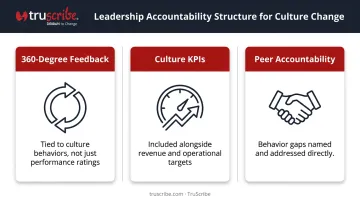
Bold organizations hold leaders accountable for culture metrics the same way they hold them accountable for financial results:
- 360-degree feedback tied to culture behaviors — not just performance ratings
- Culture KPIs included in leadership scorecards alongside revenue and operational targets
- Peer accountability among the leadership team, where behavior gaps are named and addressed directly
Practical challenge: Identify one high-visibility behavior the leadership team currently exhibits that directly contradicts the desired culture. Name it. Own it. Commit to eliminating it within 30 days — and make that commitment public.
Bold Move 3: Tell the Culture Story in a Way That Actually Sticks
Why Most Culture Communication Fails
Employees receive hundreds of messages daily. Text-heavy memos, slide decks, and intranet posts compete with everything else in that stream — and culture narratives told without emotional engagement are forgotten within days.
The neuroscience here is clear. Research published in the Proceedings of the National Academy of Sciences found that stories create neural coupling between speaker and listener — meaning a well-told story produces genuine shared comprehension, not mere information transfer. Narrative activates language processing, visual memory, and emotional response simultaneously — which is why stories encode more deeply than data or declarations.
A Culture Story vs. A Culture Statement
Most organizations have culture statements. Very few have culture stories. The difference is structural:
| Culture Statement | Culture Story |
|---|---|
| "We value integrity" | An employee who flagged a costly error before it shipped — and was celebrated, not blamed |
| "We put customers first" | A team that stayed late to fix a client problem no one asked them to fix |
| "We embrace change" | A department that overhauled its own process before leadership asked them to |
A culture story has a protagonist, a challenge, a turning point, and a tangible outcome. It's specific, human, and repeatable. A values statement is aspirational but abstract — it tells people what to believe, not what that belief looks like in practice.
How to Make the Story Land at Scale
One well-crafted story told consistently across multiple touchpoints outperforms many different messages across the same channels. Here's how to deploy it effectively:
- Keep video under 3 minutes — for distributed workforces, 1–2 minutes works best for culture and onboarding content
- Use a real employee example (with permission) — real protagonists are more credible and memorable than hypothetical scenarios
- Repeat across at least 90 days in multiple formats: team meetings, onboarding, internal comms, manager toolkits
- Choose formats that direct attention sequentially — whiteboard animation reveals information step by step, keeping viewers engaged without overloading them
TruScribe has produced culture-specific video content for organizations including Navistar (culture transformation), Amedisys (core values onboarding), and Walmart's cultural values program. Each project was designed to make abstract organizational values concrete and memorable for large, distributed employee populations. The Scribology methodology — built on cognitive load theory and visual anticipation principles — helps culture narratives move from watched to retained.
Bold Move 4: Redesign the Systems, Not Just the Values
Culture doesn't live in statements. It lives in systems.
If your hiring process still screens for old cultural norms, your performance review still rewards behaviors that contradict your new values, or your meetings still reinforce hierarchy over collaboration — your culture will not change. No matter how compelling the narrative is.
The Systems Worth Auditing
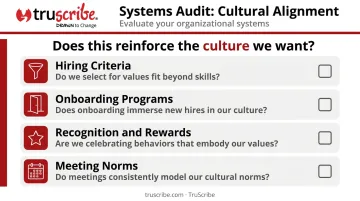
Map the five to seven most common daily experiences an employee has. Then ask one question about each: Does this experience reinforce the culture we say we want, or the one we're trying to leave behind?
The answers are almost always sobering. Focus your audit on:
- Hiring criteria and interview questions — Do they screen for the behaviors you've defined as non-negotiable?
- Onboarding programs — Do new employees encounter the desired culture from day one, or do they experience the legacy culture first?
- Recognition and reward structures — Are you celebrating the behaviors that align with the new values, or still rewarding what the old culture prized?
- Meeting norms — Do your meetings model your values in practice, or silently contradict them?
Systems Change Produces Measurable Results
When Adobe replaced its annual performance reviews with ongoing "Check-In" conversations — a direct restructuring of a core HR system — the company saw a 30% reduction in voluntary turnover. That's not a culture communication outcome. That's a systems change outcome. McKinsey's culture transformation research identifies system redesign as a required mechanism, not an optional enhancement. That means building target behaviors directly into performance management, rewards, and talent practices. Until those systems change, the values statement stays decorative.
Bold Move 5: Measure Culture Like a Business KPI
Annual engagement surveys have a structural problem: by the time data is collected, analyzed, and acted on, the cultural moment has passed. A team that was struggling six months ago has either recovered on its own or entrenched its dysfunction. The survey captures neither outcome accurately.
What to Measure Instead
Bold organizations treat culture as a living metric. Track leading indicators across three categories:
Behavioral indicators:
- Frequency of cross-team collaboration
- Idea submissions and adoption rates
- Feedback given and received (not just solicited)
- Frequency of the target high-impact behavior from Bold Move 1
Structural indicators:
- Manager-to-employee check-in completion rates
- Time-to-respond on employee concerns
- Whether recognition systems are being actively used
Sentiment indicators:
- Run pulse surveys targeting specific cultural dimensions
- Surface qualitative themes from listening sessions
- Track psychological safety scores at the team level
Closing the Accountability Loop
Unacted-on data is worse than silence. When employees see that survey results lead to no visible action, confidence in leadership collapses.
The bold move is transparency: share culture metrics openly — including the gaps — and invite the organization into problem-solving. When teams see leadership respond visibly to what the data shows, measurement stops being an HR exercise and starts driving the behavior change you're actually after.
Frequently Asked Questions
What are the 5 steps in changing culture?
Five steps drive meaningful culture change:
- Diagnose the current culture honestly
- Define the target culture and the specific behaviors that embody it
- Align and activate leadership as visible models
- Communicate the change story consistently across multiple channels
- Measure progress with real-time indicators, adjusting based on data rather than waiting for annual results
What are the 5 C's of culture change?
The 5 C's framework covers:
- Clarity — defining the desired culture precisely
- Commitment — holding leadership accountable
- Communication — consistent storytelling across channels
- Consistency — embedding culture in systems and processes
- Celebration — actively recognizing and reinforcing the right behaviors
What are the 4 types of organizational culture?
The Competing Values Framework — introduced by Quinn and Rohrbaugh in 1983 and later developed by Cameron and Quinn — identifies four archetypes: Clan (collaboration-focused), Adhocracy (innovation-focused), Hierarchy (process and control-focused), and Market (results and competition-focused). Most organizations blend elements of multiple types rather than fitting cleanly into one.
What are the 4 P's of culture?
The 4 P's are:
- Purpose — why the organization exists
- People — who carries and reinforces the culture daily
- Practices — the behaviors and rituals that make values visible
- Performance — how culture outcomes are measured and connected to business results
How long does organizational culture change take?
Gallup's experience-based guidance puts meaningful culture transformation at three to five years for deep, lasting change — though measurable behavioral shifts can emerge within 6–12 months when a focused, systematic approach is applied. The timeline accelerates significantly when leadership models the change visibly from the start.
What is the biggest obstacle to changing company culture?
The most common obstacle is a gap between stated values and actual leadership behavior. When employees observe that culture change applies to everyone except senior leaders, trust collapses and resistance firms up. The second most common obstacle is trying to change too many behaviors at once — which produces change fatigue and dilutes accountability across the organization.