Introduction
You sit down to write a video script. You know your topic. You understand the audience. But what comes out reads like a company memo — flat, formal, and forgettable. Sound familiar?
Most script writing guides focus on formatting: two-column layouts, slug lines, scene headings. Useful — but they skip the harder question. How do you make a script sound like you, with a recognizable human quality that keeps viewers listening instead of tuning out?
This matters more than many corporate communicators realize. Research across 181 studies on multimedia learning found that personalization — language that speaks to viewers rather than at them — is among the principles with the largest positive effects on learning outcomes.
Voice is what makes the difference between a script someone tolerates and one they actually follow.
This article covers what script writing style actually means in a corporate video context, the core elements that shape it, how to develop your own voice deliberately, and how that voice connects directly to the visual experience your audience will see on screen.
Key Takeaways:
- Script writing style combines tone, word choice, rhythm, and perspective to make a script distinctly human
- Formatting rules take an afternoon to learn — finding your voice takes deliberate practice
- Reading every draft aloud is the single most reliable diagnostic tool available
- Your core voice stays consistent across script types, but its emotional register shifts
- In whiteboard animation, script pacing directly controls what viewers see on screen
What Is Script Writing Style (and Why Does Voice Matter)?
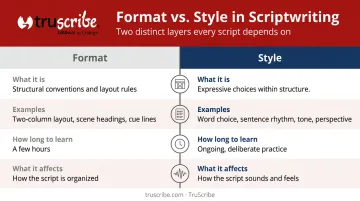
Script writing style is not the same as script format. Format covers structure — how a script is physically laid out on the page, where action blocks go, how dialogue is labeled. You can learn the standard corporate script format in a few hours.
Style is something different. It's the sum of expressive choices a writer makes within that structure: which words they reach for, how long their sentences run, whether they speak directly to the viewer or describe things from a distance.
Style is what gives a script a recognizable human quality. One script sounds like a credible, engaged person speaking. Another sounds like a policy document read aloud. The difference is almost never format.
Format vs. Style
| Format | Style | |
|---|---|---|
| What it is | Structural conventions and layout rules | Expressive choices within that structure |
| Examples | Two-column layout, scene headings, cue lines | Word choice, sentence rhythm, tone, perspective |
| How long to learn | A few hours | Ongoing, deliberate practice |
| What it affects | How the script is organized | How the script sounds and feels |
The distinction matters because most corporate writers spend their energy on format and assume style will follow. It doesn't. A script can be perfectly formatted and completely lifeless.
Voice is what determines whether audiences actually follow a script — not just receive it. When a script sounds human, people stay with it. When it sounds institutional, they drift, regardless of how accurate or well-organized the content is.
The Core Elements of Script Writing Style
Understanding what creates voice is the first step toward developing your own. Five elements do most of the work.
Tone
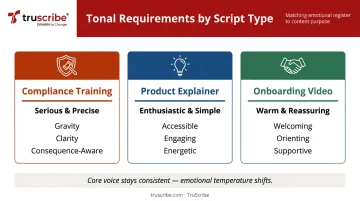
Tone sets the emotional register of a script. A compliance training video calls for seriousness and clarity — the stakes are real, and the audience needs to trust the information. A product explainer calls for enthusiasm and simplicity — the goal is to make something complex feel accessible and worth exploring.
Neither tone is wrong. Both are wrong when misapplied. A compliance script written with the breezy energy of a sales video loses credibility. A product explainer written with the gravity of a legal briefing loses its audience in the first 30 seconds.
Know the emotional register your audience needs before you write a single word.
Word Choice and Simplicity
This is where many corporate scripts fall apart. "Utilize" instead of "use." "Facilitate" instead of "help." "Leverage synergies" instead of anything a human would actually say out loud.
The CDC Audio Script Writing Guide puts it plainly: listeners hear a script once. Plain words, short sentences, and familiar phrasing are not signs of dumbing content down — they're signs of respecting how the ear processes language in real time.
Write for the ear, not the eye. Your viewer cannot re-read a sentence they didn't catch. Your word choices carry the entire communicative weight of the moment they appear.
Sentence Rhythm and Pacing
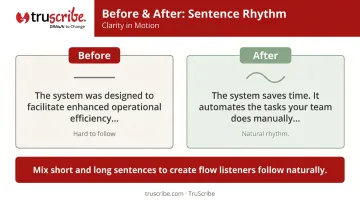
Read these two versions aloud:
"The system was designed to facilitate enhanced operational efficiency through the integration of automated workflow management solutions."
"The system saves time. It automates the tasks your team does manually — and it fits into the tools you already use."
The second version has rhythm. Short sentences create energy. Longer ones build more layered ideas when you need them. Mixing both creates a flow that listeners follow naturally, without noticing they're doing it.
Rhythm is constructed deliberately — sentence by sentence, choice by choice.
Point of View and Directness
Second-person scripts — ones that say "you" and speak directly to the viewer — create connection. Third-person scripts and passive constructions create distance.
Consider the difference:
- Third-person/passive: "Employees are expected to complete the training within 30 days."
- Second-person/direct: "You'll need to complete this training within 30 days."
Same information. Very different experience of receiving it. Direct, second-person framing is especially effective in corporate and instructional video — where the goal is behavior change, not just information transfer.
Authenticity vs. Formality
Many corporate writers feel a tension between sounding professional and sounding human. That tension is largely false.
The most effective scripts sound like a smart, credible person talking to another person — not like a document being read aloud. Conversational doesn't mean casual or imprecise. It means accessible, clear, and direct.
How to Develop Your Personal Script Writing Voice
Voice isn't something you find once and keep. It emerges through practice, becomes clearer through revision, and strengthens the more deliberately you cultivate it.
Audit What You Already Write
Start with what you've already produced. Pull emails, presentations, or past scripts you feel good about. Look for patterns: Do you tend toward short sentences or long ones? Do you use rhetorical questions? Do you reach for analogies? Do you front-load the key point or build to it?
These patterns are the raw material of your personal voice. You're not inventing something new — you're identifying what's already there and making it more intentional.
Read Drafts Aloud — Every Time
This is non-negotiable. Reading a script silently won't tell you how it will sound delivered. Reading it aloud tells you everything.
If you stumble over a phrase, the rhythm is off. If a sentence feels stiff coming out of your mouth, the word choices are too formal for the ear. If you can read a passage naturally and at pace, you're close.
The Learning Guild's video scripting guidance explicitly recommends conversational tone and short, ear-friendly sentences. The read-aloud test is how you verify you've hit that mark.
Define Your Voice Anchors
Choose three to five words that describe how you want your scripts to sound. For example:
- Clear, direct, slightly warm, never jargon-heavy
- Confident, conversational, grounded, precise
- Approachable, plain-spoken, occasionally dry
These become your personal brief. Every writing decision — word choice, sentence length, how to open a section — gets tested against them. If a phrase doesn't fit, revise it.
Study Writers Whose Style Resonates
Find communicators — presenters, scriptwriters, journalists — whose style you admire and analyze specifically what they're doing. Not to copy it. To identify transferable techniques.
What sentence structures do they favor? How do they open? How do they close? How do they signal a shift in topic without losing energy? Intentional study of specific technique — not general admiration — is what gives you something to actually apply.
Write in Volume, Then Refine
The more scripts you write, the more your instinctive style becomes visible — to you and to others. First drafts are supposed to be generic. Revision is where voice sharpens.
In each pass, look for:
- Sentences that sound like a textbook, not a person — rewrite them conversationally
- Phrases you'd never say aloud — cut or simplify them
- Moments where your natural rhythm breaks — adjust sentence length or structure
- Word choices that feel borrowed rather than yours — swap for language you'd actually use
Adapting Your Voice Across Different Script Types
Your core voice stays recognizable, but its emotional register shifts depending on what the script needs to accomplish.
Different script types call for different emotional temperatures:
- Compliance training requires gravity and precision — the audience needs to understand consequences
- Product explainers call for enthusiasm and simplicity — make something complex feel worth engaging with
- Onboarding videos benefit from warmth and reassurance — a new employee wants orientation, not interrogation
Voice Consistency with Tonal Flexibility
The same communicator writing both a compliance video and an onboarding video should sound like the same person, but not the same mood. The vocabulary patterns, directness, and rhythm remain recognizable. The emotional temperature shifts.
A quick comparison:
Compliance: "You're responsible for reporting any conflict of interest within 30 days of discovery. Here's exactly how to do that."
Onboarding: "Welcome to the team. Over the next few days, we'll walk you through everything you need to feel confident in your new role."
Same writer. Same directness and second-person framing. Very different register.
If your organization has brand voice guidelines, use them as a constraint, not a straitjacket. Where brand voice and personal voice meet is where the most compelling, credible scripts live.
Common Script Writing Style Mistakes That Undermine Your Voice
Writing for the Page, Not the Ear
Scripts written like reports — complex syntax, passive constructions, dense paragraphs — lose listeners. The viewer cannot re-read; they can only keep up or fall behind. The fix is simple: read every draft aloud before finalizing it. If it sounds like a document, it needs another pass.
Overloading with Information
A cluttered script has no voice. It has a list. Strong voice requires editorial confidence — the willingness to cut ideas that are accurate but not essential to the core message.
In corporate scripts — training, compliance, HR content — the instinct to include everything produces a script that communicates nothing clearly. Restraint is a craft decision. Signs your script is overloaded:
- Every section introduces multiple new concepts
- Bullet points exceed six items without grouping
- The narrator sounds rushed, not authoritative
- Viewers need to watch twice just to follow the logic
Inconsistency Across a Project
Voice breaks down when multiple contributors write different sections without alignment, or when a writer shifts registers — formal here, casual there — without purpose. Inconsistency signals lack of control, and it shows up everywhere: in the narrator's delivery, the visual team's choices, and the viewer's experience.
Establish your voice before you start writing. Protect it through every revision.
From Script to Screen: How Your Voice Shapes the Viewer's Experience
A script is not the final product. It's the foundation for a visual and auditory experience — and every voice choice you make shapes what that experience becomes.
Cognitive Load and Language Clarity
When script language is natural, conversational, and well-structured, it reduces the cognitive effort required to follow along. Mayer's Cognitive Theory of Multimedia Learning establishes that people learn more effectively from coordinated words and pictures than from either alone, provided the presentation is well-paced and the verbal channel doesn't overwhelm the visual one.
A conversational, clearly paced script does two things simultaneously: it carries the message and it clears the path for visual information to land.
Voice and Visual Timing
This connection is especially direct in whiteboard animation, where a voiceover script serves as the literal blueprint for what gets drawn and when. TruScribe's Scribology method is built around this relationship. Its core timing principle — calibrating the pace of visual reveals for maximum retention — means that a script's rhythm and pacing directly control what the viewer sees as they hear each idea introduced.
Sequential drawing reveals information one element at a time, in logical progression, synchronized to the spoken narrative. A measured, well-paced script gives each visual element time to develop and register before the next concept appears.
A rushed or uneven script creates cognitive mismatch: the visual and the spoken fall out of sync, and the viewer pays the price in comprehension.
This is why voice choices at the script stage are also, functionally, production decisions. Word length affects sentence duration. Sentence duration affects visual reveal timing. A script written with rhythm and pacing in mind gives visual artists and narrators a coherent throughline to work from.
Your Script as a Blueprint
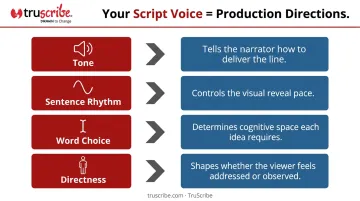
Think of every voice choice you make as a direction to someone downstream:
- Tone tells the narrator how to deliver the line
- Sentence rhythm controls the visual reveal pace
- Word choice determines how much cognitive space each idea requires
- Directness shapes whether the viewer feels addressed or observed
A strong script, voiced well and structured with intention, gives the entire production team something to build from. TruScribe's workflow sequences script development before any visual production begins for exactly this reason: the script is the source document that every subsequent decision flows from.
Every word you choose at the script stage becomes a constraint — or a gift — for everyone who works from it after you.
Frequently Asked Questions
What is script writing style?
Script writing style is the expressive quality a writer brings to a script — the tone, word choice, sentence rhythm, and perspective that give it a recognizable, human character. It's what makes a script sound like a person speaking rather than a document being read.
What is the format of script writing?
Format refers to the structural conventions governing how a script is laid out — slug lines, action blocks, and dialogue columns in film; two-column audio/visual layouts in corporate and documentary scripts. Format is distinct from style: format organizes information, while style determines how that information sounds and feels.
What are the types of script writing?
The main types include feature film screenplays, TV teleplays, documentary scripts, corporate and explainer video scripts, and training or e-learning scripts. Each has its own format conventions and tonal expectations — a feature screenplay leaves room for directorial interpretation, while a training script is written to be heard alongside visuals in a planned sequence.
What is the best script writing style?
There's no single best style, but the most effective scripts share common qualities: clarity, directness, tone appropriate to the audience, and authentic voice. The best style serves the message and the viewer — and sounds like a real person who actually cares about being understood.
How do you develop your own voice as a script writer?
Audit existing writing for natural patterns, define three to five voice anchor words, read every draft aloud, study communicators whose style you admire, and write in volume. Voice surfaces through practice and sharpens in revision.
How is writing a script for a video different from writing a screenplay?
Video scripts — corporate, explainer, training — are written to be heard alongside planned visuals, making conversational rhythm, simplicity, and ear-friendly word choice especially critical. Screenplays describe action and dialogue for interpretation by directors and actors, with far more latitude for complex language and visual ambiguity.