Introduction
Most organizational change initiatives don't fail because of poor planning. They fail because the people who need to work differently never actually do. Technology gets implemented. Processes get redesigned. But employees stay stuck in familiar habits — and the ROI evaporates.
The Prosci Change Management Methodology was built to address exactly that gap. Developed by Jeff Hiatt in 1994, Prosci is a research-based approach to managing the people side of change.
With 30+ years of practitioner research behind it, the methodology has become one of the most widely recognized frameworks in the field. Prosci reports that 80% of Fortune 100 companies use ADKAR.
This guide covers all three core components of the Prosci methodology: the ADKAR Model, the 3-Phase Process, and the PCT Model. By the end, you'll know how they work together, where Prosci delivers the most value, and where its limitations show up in practice.
Key Takeaways
- Prosci is a research-based change methodology founded in 1994, focused on individual adoption as the engine of organizational change
- Three integrated models form the core: ADKAR (individual change), the 3-Phase Process (organizational execution), and the PCT Model (project health)
- ADKAR's five stages (Awareness, Desire, Knowledge, Ability, Reinforcement) must be achieved in sequence — skipping any stage undermines the whole effort
- Projects with excellent change management are nearly 7x more likely to meet objectives than those with poor change management
- Prosci is adaptable and scalable, but it requires disciplined application — not just a communications plan
What Is the Prosci Change Management Methodology?
Prosci is a structured, adaptable, and repeatable approach to managing the people side of organizational change. Built on research from thousands of change practitioners worldwide, it represents 25+ years of research into what causes people to adopt and sustain new ways of working.
The name itself is a contraction of "Professional" and "Science" , reflecting its grounding in research rigor. The methodology was originally introduced in 2002 and refreshed in 2021 in response to practitioner feedback and evolving organizational needs.
Three Models, Three Layers
Prosci integrates three distinct frameworks, each addressing a different dimension of change:
| Model | Focus | Primary User |
|---|---|---|
| ADKAR Model | Individual transition outcomes | Employees, managers, coaches |
| 3-Phase Process | Organizational change execution | Change practitioners |
| PCT Model | Project health and balance | Sponsors, practitioners, project managers |
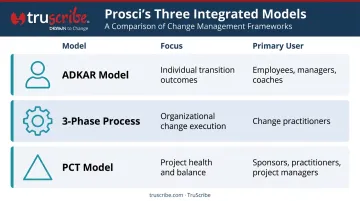
This layered architecture sets Prosci apart from more prescriptive frameworks like Kotter's 8-Step Model or Lewin's freeze-change-refreeze approach. Other models describe what to do at an organizational level. Prosci builds from the individual up, treating employee adoption as the actual mechanism of organizational change rather than a downstream consequence of it.
The Prosci Change Triangle (PCT) Model
The PCT Model identifies four critical elements of any successful change initiative:
- Success — the central goal, defined in terms of organizational outcomes
- Leadership/Sponsorship — executive engagement and visible commitment to the change
- Project Management — the technical side: scope, timeline, deliverables
- Change Management — the people side: readiness, adoption, reinforcement
Remove any one of the three corners and the initiative wobbles. A technically flawless rollout with no executive sponsorship rarely gets past surface-level compliance. And leadership visibility without a structured adoption plan produces plenty of awareness — but rarely the behavior change the project requires.
Practitioners use the PCT Assessment as a periodic health check throughout a project's lifecycle — at kickoff, go-live, and the outcomes date — to identify which factor is underperforming and where to refocus effort before the project gets derailed.
Why Organizations Use the Prosci Methodology
Organizational outcomes are the collective result of individual changes. No initiative succeeds unless the people who must work differently actually do. Prosci operationalizes this insight with tools that address individual readiness, not just project timelines.
The Business Case in Numbers
Prosci's correlation research, drawing on data from more than 2,600 change practitioners, makes the case quantitatively:
- 88% of projects with excellent change management met or exceeded objectives — versus 13% with poor change management (nearly 7x more likely)
- Projects with excellent change management are nearly 5x more likely to be on or ahead of schedule
- They're nearly 1.5x more likely to be on or under budget
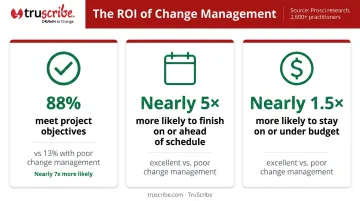
These aren't marginal differences. The spread between excellent and poor change management is wide enough to determine whether a major initiative gets celebrated or quietly shelved.
Where Prosci Works Best
The methodology is particularly well-suited to changes where employee adoption directly determines ROI:
- ERP and enterprise technology implementations
- Digital transformation and AI adoption initiatives
- Mergers, acquisitions, and post-merger integration
- Workforce restructuring and role redesign
- Large-scale process changes in manufacturing, healthcare, and financial services
In each scenario, the technology or process can be implemented perfectly — and still fail if the people side isn't managed. Prosci gives change leaders a structured way to address that human side before it becomes a project failure.
Scalability and Flexibility
Prosci scales across initiative size. The same methodology that governs an enterprise-wide ERP rollout applies equally to a department-level process change — adjusted for scope and risk, but structurally consistent. That consistency is what makes it practical for organizations running multiple changes at once, where a repeatable playbook saves time and reduces coordination overhead.
The ADKAR Model: Prosci's Framework for Individual Change
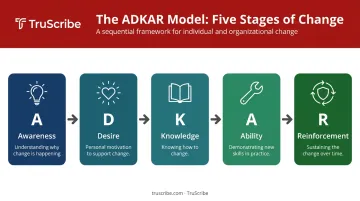
ADKAR is Prosci's most widely recognized model — and the most frequently misunderstood. It's an outcomes model, not a task checklist. The acronym maps five results an individual must achieve, in sequence, for a change to take hold:
A — Awareness of the need for change D — Desire to support and participate in the change K — Knowledge of how to change A — Ability to demonstrate new skills and behaviors R — Reinforcement to sustain the change over time
Sequence is non-negotiable. Training an employee who lacks Desire is like teaching someone a skill they don't intend to use. Each stage must be built on the one before it. Practitioners use ADKAR diagnostically — to identify exactly where an individual or group is blocked, and what intervention is needed.
Awareness
Awareness focuses on helping employees understand why the change is happening. That means explaining the business drivers, the risks of staying in the current state, and what success looks like. Employees need to hear the "why" before they can engage with the "what." Without this foundation, everything that follows lands on skeptical ground.
Desire
Desire is where many change programs stall. Employees can fully understand a change and still choose not to support it. Desire requires a personal decision — and it can't be manufactured through a policy announcement.
For large, distributed workforces, building Desire at scale requires communication that creates genuine emotional connection to the change rationale — not just informational volume. This is where format matters.
Organizations like Navistar have used whiteboard animation for culture transformation precisely because sequential, story-driven visuals build emotional engagement that text-heavy emails and slide decks structurally cannot. TruScribe's neuroscience-backed Scribology approach, applied across 5,000+ projects, shows a 2.3x higher retention rate versus traditional video formats and a 35% average increase in conversion rates: concrete evidence of audiences moving from passive awareness to motivated action.
In healthcare, manufacturing, and enterprise settings — where change communication must reach thousands of employees across varied roles and locations — the quality of that medium can determine whether Desire is built or bypassed entirely.
Knowledge
Knowledge covers what employees need to know to execute the change — new processes, systems, tools, expected behaviors. Prosci distinguishes between knowledge needed during the transition (how to navigate the change itself) and knowledge needed to perform effectively in the future state (how to work in the new environment). Both must be addressed; conflating them is a common design error in training programs.
Ability
Ability is where knowledge becomes practice. Consider this: an employee can pass a training module and still freeze when a real situation demands the new behavior. Coaching, on-the-job practice, and performance support close that gap — course completion certificates do not. This stage is the most resource-intensive to address well, and the most commonly underinvested.
Reinforcement
Without active reinforcement, well-implemented changes erode. People revert to familiar habits. Reinforcement means recognizing adoption, monitoring regression, and correcting gaps over time. It extends well past go-live and requires a named owner in the business — not a shared assumption that someone will handle it.
The Prosci 3-Phase Process
While ADKAR maps what individuals need, the 3-Phase Process gives practitioners the organizational workflow for delivering those outcomes at scale. It was designed to be iterative, not linear, especially in Phase 2, where the bulk of practitioner activity happens.
The three phases: Prepare Approach → Manage Change → Sustain Outcomes
Phase 1 – Prepare Approach
Phase 1 is about laying the groundwork before implementation begins. Practitioners:
- Define what success looks like in measurable terms
- Assess organizational change readiness and the scope of impact
- Identify who needs to change, how much, and from what baseline
- Develop a customized change management strategy
- Secure active sponsorship from leadership
The deliverable is a Change Management Strategy — a document that shapes everything that follows. Organizations that skip this phase, jumping straight to communications and training, typically find themselves reacting to resistance rather than anticipating it.
Phase 2 – Manage Change
Phase 2 is where execution happens. Practitioners develop and deploy a Master Change Management Plan, which incorporates five plan types:
- Communications plan: defines what messages go to whom, from whom, and when
- Sponsorship plan: activates leaders as visible, credible advocates for the change
- Coaching plan: equips managers to guide their teams through the transition
- Training plan: sequences Knowledge and Ability development to align with go-live milestones
- Resistance management plan: identifies and addresses barriers before they stall adoption
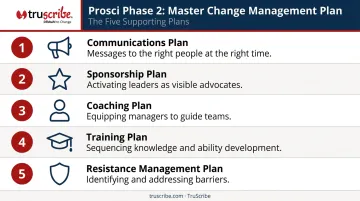
This phase operates in iterative cycles: plan, act, measure, and adjust. Adoption data and employee feedback drive real-time decisions. Practitioners stay actively engaged throughout the full implementation window, not just at launch.
Phase 3 – Sustain Outcomes
Phase 3 answers three critical questions:
- Are people actually working differently?
- What gaps still exist and what's needed to close them?
- Who in the business owns this going forward?
Practitioners review adoption performance, activate sustainment mechanisms, and formally transfer ownership to the business. Without this phase, even successful go-lives tend to decay: adoption peaks at launch, then slips back as the change team moves on to the next initiative.
Common Misconceptions and Limitations
Misconception 1: ADKAR Is a Change Management Strategy
ADKAR is a diagnostic and outcomes model. It tells you where people are in their change journey. Without the 3-Phase Process and PCT Model, you have insight but no organizational mechanism to act on it. Using ADKAR alone is like having a diagnostic tool but no treatment plan.
Misconception 2: Change Management Equals Communications
Communications is one of five plan types within Phase 2. Reducing change management to "sending emails about the change" is one of the fastest paths to failed implementation. The communications plan informs. The coaching plan enables. The resistance management plan prevents derailment. All five are necessary.
Misunderstandings aside, the methodology also carries genuine constraints that practitioners should plan for.
Real Limitations Worth Acknowledging
Prosci is not without genuine constraints:
- Cost: Prosci certification currently runs $4,500 (online) to $4,850 (in-person) for a 3-to-5-day program — a meaningful investment, particularly for smaller organizations
- Agile environments: ADKAR's sequential structure requires adaptation in Agile contexts. Prosci's own guidance suggests sustaining Awareness and Desire at the initiative level while aligning Knowledge and Ability to individual releases — but this adds planning complexity
- Complex systems: A 2025 peer-reviewed case study of a German public media organization found that ADKAR's linear structure didn't fully capture institutional and cultural complexity, particularly where systemic constraints and normative resistance are entrenched
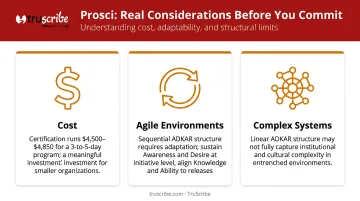
None of these constraints are dealbreakers. They do signal where teams need to plan for adaptation upfront — not retrofit it after rollout hits friction.
Conclusion
Prosci's methodology works because it treats individual adoption as the foundation of organizational outcomes — not an afterthought. That reframe is simple, but its implications for how change is planned and executed are significant.
That value only materializes through disciplined application. Organizations that understand all three components — ADKAR, the 3-Phase Process, and the PCT Model — and invest seriously in sponsor engagement, communication quality, and reinforcement are the ones that achieve the results their change initiatives were designed to deliver.
Those that treat it as a checkbox exercise, or reduce it to an ADKAR training and a few email blasts, tend to see the same outcome: surface-level compliance, stalled adoption, and change initiatives that quietly fade before delivering ROI.
Frequently Asked Questions
What is Prosci's ADKAR methodology?
ADKAR is Prosci's model for individual change — standing for Awareness, Desire, Knowledge, Ability, and Reinforcement. These five outcomes must be achieved sequentially for a change to stick. It works as a diagnostic tool to identify exactly where an individual is blocked in their change journey.
What is the Prosci 3-phase methodology?
The Prosci 3-Phase Process covers Prepare Approach, Manage Change, and Sustain Outcomes. It gives practitioners a structured, iterative workflow for planning, executing, and embedding change across an entire organization.
What are the 4 P's of Prosci?
Prosci's 4 P's (Project, Purpose, Particulars, and People) are a separate exercise used to connect change management to business results — distinct from the PCT Model's three corners of Leadership/Sponsorship, Project Management, and Change Management.
What is the Prosci Change Triangle (PCT) model?
The PCT Model depicts four critical aspects of successful change: a clearly defined Success goal at the center, with Leadership/Sponsorship, Project Management, and Change Management at the three corners. All three corners must stay balanced for an initiative to achieve its intended outcomes.
How does the Prosci methodology differ from Kotter's 8-step model?
Kotter's model prescribes organization-level leadership steps for driving transformation. Prosci's approach is anchored in individual adoption through ADKAR, diagnosing where each person is blocked and intervening at that level. One is practitioner-focused and diagnostic; the other is leadership-focused and prescriptive.
Is Prosci change management certification worth it?
Prosci certification is widely recognized, with 267,000+ certified practitioners across 80+ countries and a listing in SHRM's professional development portal. At $4,500–$4,850 for a 3-to-5-day program, the value depends on how frequently your organization manages complex change initiatives.