That gap isn't a delivery problem. Skilled facilitators, polished eLearning modules, and engaged learners can't compensate for a training program that was never designed to close a specific performance gap in the first place.
Training design is where that gap opens — or closes. It's the upfront, strategic work that determines whether a training program produces real behavior change or just satisfies a completion checkbox. Yet it's routinely confused with content development, rushed in favor of faster production, or skipped entirely.
This article covers what training design actually is, why it determines whether training works, what happens when organizations skip it, and which best practices consistently drive results.
Key Takeaways
- Training design covers gap analysis, behavioral objectives, format selection, and evaluation planning — all before content creation begins
- Poor training design, not poor delivery, is the primary reason trained skills fail to transfer to the workplace
- Only 42% of organizations report above-average alignment between learning initiatives and business objectives
- Strong design produces three measurable advantages: strategic alignment, improved knowledge retention, and ROI you can prove to stakeholders
- Skip the design phase and you risk inconsistent performance, high retraining costs, and lost credibility for L&D
What Is Training Design?
Training design is the structured process of analyzing performance gaps, setting clear objectives, selecting appropriate formats, and planning evaluation — all before content is built or a session is delivered.
Training design and instructional design are often used interchangeably, but they serve different functions:
| Training Design | Instructional Design | |
|---|---|---|
| Focus | Strategic and structural | Operational and content-focused |
| Answers | What needs to happen and why | How learning content is built and delivered |
| Outputs | Objectives, format decisions, evaluation plans | Modules, activities, assessments, interactions |
Training design is upstream of instructional design. Without it, instructional designers are building content without a blueprint.
That distinction matters when defining success. The measure of training design's value isn't whether a program looks polished or runs smoothly — it's whether learners apply what they've learned on the job and whether that application moves a meaningful business metric.
Why Training Design Is Critical: 3 Key Advantages
The advantages of rigorous training design show up in performance metrics, operational efficiency, and the credibility of the L&D function within the organization.
Strategic Alignment Between Learning and Business Goals
When training design begins with a clear needs analysis, every downstream decision — content, format, assessment — serves a defined outcome rather than a generic learning goal.
In practice, this means designers:
- Identify specific, observable behaviors that need to change
- Connect those behaviors to a measurable business metric (reduced error rates, faster onboarding, fewer compliance violations)
- Build the entire program around that chain of cause and effect
The numbers reveal how wide this gap is: Brandon Hall Group's 2025 research found that only 42% of organizations reported above-average-to-excellent alignment between learning initiatives and business objectives. The other 58% are spending real budget on programs that may not connect to what the business actually needs.

This matters most during high-stakes rollouts — new software adoption, regulatory compliance training, change management initiatives. In these scenarios, misaligned training doesn't just fail to help; it can actively create risk by leaving employees unprepared for the behaviors that count.
KPIs this alignment directly affects: employee performance scores, time-to-competency, onboarding completion rates, compliance pass rates, and productivity metrics.
Improved Knowledge Retention and On-the-Job Transfer
Well-designed training accounts for how people actually learn — building in spaced practice, scenario-based activities, and application planning tools that prepare learners to use skills on the job, not just recall them during a quiz.
The research on this is clear. A meta-analysis of 65 studies and 6,476 learners found that simulation and scenario-based training produced 14% higher procedural knowledge and 9% higher retention compared to control groups — with stronger effects when scenarios supplemented other instruction and allowed repeat attempts.
Those retention gains are worth protecting. The oft-cited "70% forgotten in 24 hours" claim overstates how fast skill decay actually happens — a 2025 procedural-skill meta-analysis found performance declined approximately 0.08 standard deviations per month for accuracy, task-dependent and gradual, not catastrophic overnight. Structured reinforcement tools built into the design phase can counteract this decay meaningfully.
Format decisions matter here too. For complex or abstract content, formats that combine visual and verbal channels reduce cognitive load and strengthen memory encoding — a principle grounded in dual coding theory.
Companies like Walmart and NASA have applied this directly in their L&D programs, using neuroscience-backed visual storytelling to improve retention of complex topics. TruScribe's Scribology methodology, built on cognitive load theory and dual coding principles, achieves 2.3x higher retention than traditional video by engineering how information is sequenced and revealed to learners.
KPIs this affects: post-training assessment scores, 30/60/90-day behavior observation results, retraining frequency, and manager-reported performance improvement rates.
Measurable ROI and Defensible Training Investment
Training design builds evaluation into the program from the start — not as an afterthought. This means defining success metrics, establishing baselines, and planning for behavior observation before a single module is developed.
The evaluation gap is significant. ATD research found that only 40% of TD professionals rated themselves proficient at evaluating learning impact. Brandon Hall Group found fewer than 16% of organizations were very effective at tracking a complete chain from participation through business impact.
When evaluation isn't planned at the start, the data needed to demonstrate impact simply doesn't exist by the time leadership asks for it. Low measurement proficiency is a symptom — the root cause is a design process that treats evaluation as optional.
The Kirkpatrick Model offers a proven framework here: design backwards from Level 4 (targeted business results), identify Level 3 critical behaviors, then specify the learning and reaction conditions required. This approach doesn't just produce justifiable ROI — it gives L&D teams a seat at the strategic table.
KPIs this affects: cost-per-employee-trained, training ROI percentage, time-to-performance, error and incident rate reduction, and business outcome metrics tied to specific programs.
What Happens When Training Design Is Skipped
When organizations skip structured design, training becomes content delivery rather than performance improvement. The gap between what employees know and what they do on the job persists — or widens.
The operational consequences are predictable — and they compound:
- Performance varies across teams because objectives were never tied to observable behaviors — managers fill the gaps differently
- Learners leave sessions informed but not equipped, pushing application coaching back onto supervisors
- Without measurable links to business outcomes, L&D budgets shrink and strategic influence erodes
- Ad hoc programs that worked for one team break down when deployed at scale
Every failed rollout chips away at organizational confidence in L&D. Once leadership stops seeing training as a performance lever, it gets treated as a cost to minimize rather than a capability to invest in.
Best Practices for Effective Training Design
Effective training design isn't a one-time upfront task. It's a repeatable, structured process — applied consistently across programs and refined based on actual outcomes.
Start with a Rigorous Needs Analysis
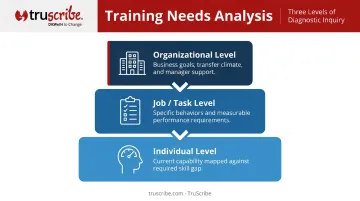
Needs analysis operates at three levels — and skipping any of them leads to solving the wrong problem:
- Organizational level — What business goals require this training? What does the transfer climate look like? Will managers support new behaviors on the job?
- Job/task level — What specific tasks or behaviors need to change? What are the performance requirements?
- Individual level — Who needs training, and what's the gap between their current capability and what's required?
Practical methods: stakeholder interviews, performance data review, manager observation, and pre-training assessments to establish a skill baseline. The goal is to determine whether training is actually the right solution. Some performance gaps are system problems, not skill problems.
Define Clear, Behavioral Learning Objectives
Objectives should describe what learners will be able to do — not what they will know — using observable, measurable language tied to real job tasks.
- Weak: "Understand data privacy requirements" (untestable, doesn't guide design)
- Strong: "Apply GDPR data handling procedures when processing customer requests in the CRM" (observable, testable, job-specific)
Well-written objectives also function as a communication tool with business stakeholders, establishing shared expectations for what the program will and won't accomplish.
Choose Delivery Formats Deliberately
Format selection should follow objective and audience analysis — not default to existing tools or convenience. Factors to weigh:
- Complexity of the skill
- Learner context (deskless vs. office-based, distributed vs. co-located)
- Geographic distribution and access constraints
- Cognitive load of the content
For complex or abstract content, formats that combine visual and verbal channels — such as whiteboard animation or scenario-based eLearning — are supported by cognitive science research on dual coding and working memory management. Format is a design decision, not a default.
Build Transfer and Reinforcement Into the Design
Training design must account for what happens after the session ends. The Blume et al. meta-analysis of 89 studies found supervisor support had a corrected correlation of .31 with training transfer — stronger than peer support or any individual learner characteristic.
This means designing for transfer includes:
- Manager observation checklists and coaching prompts
- Job aids and performance support tools accessible at the point of need
- Spaced reinforcement modules deployed in the weeks following training
- Application planning tools that prompt learners to identify when and where they'll use new skills in the first 1–2 weeks
Plan Evaluation Before You Build Content
That transfer data only has value if you've built the measurement infrastructure to capture it. Work backwards from the desired business outcome: define success metrics first, establish pre-training baselines, then design assessments and observation tools that capture behavior change at the job level — not just satisfaction at the course level.
This is what separates programs that demonstrate ROI from programs that assume it. Organizations that define measurement criteria after content is built are left guessing whether anything actually changed.
Conclusion
Training design is the foundation. Every downstream decision — content, format, delivery, assessment — is only as effective as the strategic thinking behind it.
Its three core advantages — strategic alignment, knowledge retention, and measurable ROI — compound when applied consistently and erode rapidly when skipped in favor of faster content production. Organizations that treat it as an ongoing practice — not a one-time project step — are the ones that can show leadership concrete numbers: what training produced, what changed, and what it cost to get there.
Review your design frameworks regularly against actual performance data. That feedback loop is what turns L&D from a cost center into a function leadership actively funds.
Frequently Asked Questions
What do you mean by training design?
Training design is the strategic process of analyzing performance gaps, setting behavioral objectives, selecting delivery formats, and planning evaluation — before any content is built. It's distinct from creating learning materials; it determines the structure and logic that makes those materials effective.
What are the 8 parts of training design?
The commonly cited components are: needs analysis, learning objectives, audience analysis, content structure, delivery format selection, learning activities, assessment design, and evaluation planning. Frameworks like ADDIE, SAM, and Kirkpatrick may label these differently, but these eight elements appear across most structured approaches.
What are the three types of TNA?
Training Needs Analysis operates at three levels: organizational (strategic goals and capability gaps), job-level (task and performance requirements for specific roles), and individual (each employee's current skill versus what's required). All three are needed for an accurate picture.
What is the difference between training design and instructional design?
Training design is strategic — it determines what training is needed, why, for whom, and how success will be measured. Instructional design is operational, focusing on how learning content, activities, and interactions are structured and built. Training design comes first and sets the boundaries within which instructional design operates.
What is the difference between L&D and T&D?
T&D (Training and Development) focuses on structured programs that build specific job skills. L&D (Learning and Development) is broader, covering training, career development, knowledge management, and organizational capability — with stronger ties to overall business strategy.
Why does training design matter more than training delivery?
Even the most skilled facilitator can't compensate for objectives that miss business goals or activities that don't prepare learners for real-world application. Design determines what knowledge transfer is possible — delivery only determines how well that potential is realized.