Introduction
Animated video pricing is one of the most confusing topics in B2B marketing — and the confusion is expensive. Buy too cheap and you get a video that undermines your brand. Over-specify and you're paying for cinematic 3D when a clear explainer would have done the job better.
The reality: animated video costs anywhere from a few hundred dollars to $50,000+ per finished minute, depending on style, provider, and complexity. Most B2B buyers land somewhere between those extremes without a clear sense of what they're actually getting.
This guide breaks down real price ranges by animation style and production tier, the variables that push costs up or down, what each phase of production actually costs, and how to match your budget to your actual communication goal — not just whatever fits the lowest line item.
Key Takeaways
- Animated video costs range from $1,000 to $50,000+ per finished minute depending on style and provider
- The biggest price drivers are animation style, complexity, video length, and who produces it
- Mid-range custom production ($5,000–$15,000/min) is the B2B sweet spot for customer-facing content
- Pre-production (scripting and storyboarding) delivers the highest return on any animation budget
- Rush timelines (under 2 weeks) typically add 25–50% to project cost
Animation Cost Overview: Pricing by Style and Tier
Animated video doesn't have a fixed price. Costs vary based on style, complexity, length, and who produces the work. Misunderstanding this leads to underbudgeting, choosing the wrong format, or paying for features that don't serve the goal.
Here's a realistic overview of current market ranges per finished minute:
| Animation Style | Approximate Range (per finished minute) |
|---|---|
| Whiteboard animation (custom) | $1,000–$5,000+ |
| 2D motion graphics | $4,000–$8,500 |
| 2D character animation | $2,000–$8,000+ |
| 3D animation (standard) | $4,000–$10,000 |
| 3D animation (intricate) | $20,000–$30,000 |
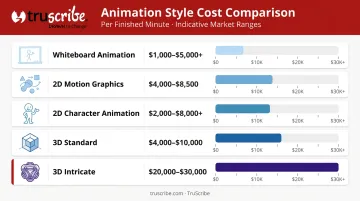
Sources: Blue Carrot's production pricing guide and Yans Media motion graphics benchmarks. Ranges reflect different provider types and complexity tiers — not a single market average.
Entry-Level ($1,000–$5,000/min)
What's included: Template-based or simplified designs, limited character movement, stock music and assets, minimal customization.
Best for: Internal communications, employee training, simple explainers where brand differentiation is not the priority.
Mid-Range ($5,000–$15,000/min)
What's included: Custom illustrations, fluid animation, professional voiceover, sound design, brand-consistent visuals. Custom whiteboard animation for B2B use typically sits in this range. Studios like TruScribe, which applies a neuroscience-backed methodology, produce work in this tier for clients where retention and comprehension are the goal.
Best for: B2B explainers, product demos, onboarding, sales enablement, and training programs where clarity and retention matter.
Premium ($15,000–$50,000+/min)
What's included: Advanced 3D modeling and rendering, cinematic lighting, complex character rigs, broadcast-quality output, full creative direction.
Best for: Brand campaigns, TV commercials, flagship product launches, or organizations competing for attention on streaming platforms.
Key Factors That Drive Animation Costs Up or Down
Pricing depends on creative, technical, and operational variables. Understanding these helps buyers make smarter trade-offs rather than defaulting to the cheapest option.
Animation Style and Complexity
Different styles require different skill sets, tools, and hours:
- 2D character animation — frame-by-frame movement plus custom illustration work
- 3D animation — adds modeling, rigging, texturing, and rendering by specialists
- Whiteboard animation — sequential hand-drawn visuals optimized for comprehension
- Motion graphics — graphic elements and typography with less character-intensive design work
Complexity within any style adds meaningful cost. Each additional character, animated background layer, or visual effect increases scope. There's no standard multiplier — get this detail into your brief before requesting quotes.
Video Length
Cost scales with duration, but not linearly. Blue Carrot reports the following motion graphics benchmarks:
| Duration | Approximate Cost Range |
|---|---|
| 30 seconds | ~$1,500–$2,000 |
| 60 seconds | ~$2,500–$3,500 |
| 2 minutes | ~$3,700–$4,400 |
| 5 minutes+ | Volume discount applies |
Per-minute rates decrease for longer projects because character assets and scene elements built early get reused. Longer isn't always better. Matching length to use case matters:
- Social/awareness content: 30–60 seconds
- B2B explainers: 60–90 seconds
- Training modules: 2–5 minutes, depending on topic density
Custom vs. Template-Based Production
Template-based animation uses pre-built characters and layouts with minimal customization. Fully custom work is built from scratch for your brand and story. The cost difference is real: custom production typically adds 30–70% to the base price. What you get in return is brand-specific visuals, narrative built around your audience, and a result that doesn't look like every other video in your category.
Choosing between the two comes down to your goals. Templates work for low-stakes internal content; custom work earns its cost when the video represents your organization externally or needs to drive behavior change.
Production Timeline
Rush timelines — delivery under two weeks — typically add 25–50% to project cost because studios must reprioritize workloads or bring in additional resources. Building in four to six weeks of lead time is the simplest way to avoid premium charges. TruScribe's standard production timeline, for comparison, is 20 working days from kickoff to final delivery, with expedited options available.
Audio and Post-Production Add-Ons
These are frequently quoted separately and can add $1,000–$5,000+ to any project:
| Element | Approximate Cost |
|---|---|
| Professional voiceover | $350–$450 per 1–2 finished minutes (GVAA non-broadcast rate) |
| Licensed stock music | ~$59 per track (PremiumBeat Standard license) |
| Sound design | ~$250 per finished minute |
| Custom music composition | Varies; negotiated per project |
Animation Cost Breakdown: What You're Actually Paying For
The price a studio quotes covers more than the animation. Understanding what each production phase costs helps evaluate quotes accurately and avoid overruns.
Pre-Production: 20–30% of Total Budget
Pre-production includes every deliverable created before a single frame is animated:
| Deliverable | Approximate Cost (per finished minute) |
|---|---|
| Scriptwriting | ~$400 |
| Storyboard | $200–$300 |
| Illustration/asset creation | $650–$750 |
Source: Blue Carrot production cost breakdown
As CG Spectrum notes, storyboards expose narrative inconsistencies and visual challenges before animation begins — avoiding the cost of re-animating the same scene multiple times. Changes in pre-production cost a fraction of changes made mid-production.
That sequencing logic carries into how structured studios operate. TruScribe, for instance, runs pre-production as four staged steps — Script → Drawings → Music and Voiceover → Editing — with client review and annotation built into each stage through an online collaboration portal.
Production: 50–60% of Total Budget
This is where the majority of labor hours land — asset creation, character animation, background animation, and compositing. Blue Carrot benchmarks:
- Animation: $800–$1,000 per finished minute
- Voiceover: $200–$300 per finished minute
This phase shows the biggest quality difference between entry-level and premium output. A studio with a team of five or six specialists will produce visually and technically different work than a single freelancer.
Post-Production: 20–30% of Total Budget
Post-production includes color correction, sound design, music integration, final rendering, and revision rounds.
Revision rounds are the most common source of scope creep. Define the number of included revisions in writing before signing any contract. What seems like a minor clarification mid-project can become an expensive re-animation cycle if it wasn't agreed upon upfront.
One-Time vs. Recurring Costs
Most animation projects are one-time investments. Organizations producing multiple videos per year can reduce per-project cost by building reusable asset libraries — character systems, branded templates, and modular scene components that carry across a content program.
TruScribe's Bulk Minutes Packages are designed for exactly this scenario. Organizations committing to 20+ videos get:
- Per-minute rates of $1,625–$2,300 depending on volume
- Built-in localization discounts
- Flexible budget allocation across departments
DIY vs. Freelancer vs. Studio: How Your Provider Affects Price
The same 60-second 2D explainer can cost $500 from an AI tool or $25,000 from a full-service production company. Provider type is one of the biggest pricing variables buyers overlook.
| Provider Type | Approximate Cost Range | Best For |
|---|---|---|
| DIY/AI tools | $0–$500/min | Internal use, quick turnaround, low-stakes content |
| Freelance animators | $1,000–$5,000/min | Custom work on a budget; buyer manages creative direction |
| Small-to-mid studios | $5,000–$15,000/min | B2B explainers, onboarding, training; full production management |
| Full-service companies | $15,000–$50,000+/min | Complex multi-format campaigns; broadcast-quality output |
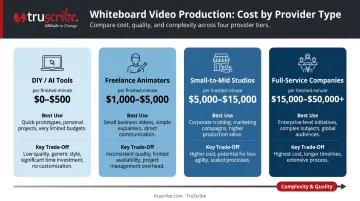
Freelancers typically cost 40–50% less than agencies — but buyers take on creative direction and quality management themselves. That trade-off works well for simple, bounded projects with low visibility stakes.
For customer-facing B2B content, compliance training, or enterprise onboarding programs, studio-level process management reduces risk and produces more consistent output. That's where the cost difference becomes an investment, not just an expense.
TruScribe operates in the studio tier, specializing in B2B whiteboard animation and visual communication for organizations like Merck, Fidelity, Microsoft, and Walmart — where clarity, retention, and professional presentation directly affect business outcomes.
How to Budget Smart for Animation
The right budget is the one aligned to your goals, audience, and expected return — not simply the lowest quote available.
Common Budgeting Mistakes
- Ignoring add-ons — voiceover, music, revisions, and platform optimization are often quoted separately and add up fast
- Over-specifying — 3D animation and advanced VFX add cost without necessarily advancing the message
- Skipping pre-production — underinvesting in scripting and storyboarding creates expensive mid-project corrections
- Choosing on price alone — without evaluating revision policies, process reliability, or creative direction capability
A Practical Budget Framework for B2B Buyers
Before finalizing a budget, consider:
- Intended audience and stakes — internal training needs less production investment than a customer-facing sales video
- Distribution lifespan — animation has a longer usable shelf life than live-action; amortize cost accordingly
- Production frequency — multi-video programs lower per-project cost through asset reuse and volume commitments
- Measurable objectives — conversion lift, training completion rate, or onboarding speed give you a return benchmark to evaluate against
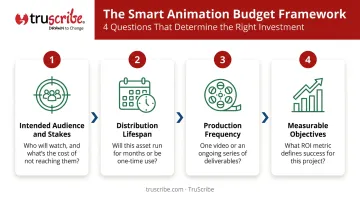
That last point — measurable ROI — is where accountability separates strong providers from weak ones. TruScribe backs its whiteboard animation work with a money-back guarantee: clients who follow the Scribology production process and don't see at least a 200% return on investment are eligible for a refund. That's a concrete standard to hold any animation investment against.
Matching style, provider, and scope to your actual communication goal is what separates a budget that works from one that just looks reasonable on paper.
Frequently Asked Questions
How much does an animated video cost?
Animated video costs range from $1,000 to $50,000+ per finished minute depending on style, complexity, and provider. Most B2B explainer videos fall between $5,000 and $15,000 for a 60-second custom production with professional voiceover and sound design.
How much does a 1-minute animated video cost?
A 60-second animated video typically costs $2,500–$25,000 depending on style. Motion graphics sit at the lower end; 3D animation sits at the upper end.
How much does a 2-minute animated video cost?
A 2-minute animation typically costs $3,700–$40,000, with per-minute rates often running 10–20% lower than a single-minute project because character assets and backgrounds carry over between scenes. Blue Carrot benchmarks a 2-minute motion graphics project at $3,700–$4,400.
Is whiteboard animation cheaper than 2D or 3D animation?
Custom whiteboard animation for B2B work falls in the $1,000–$5,000+ per minute range, making it more affordable than premium 2D character animation or 3D. It's a strong fit for corporate training and explainer content where clarity and retention matter most.
What type of animation is best for B2B corporate videos?
The right format depends on your communication goal. Motion graphics work well for data-heavy or process content. Whiteboard animation excels at explaining complex concepts with high audience retention. 2D character animation suits brand campaigns where personality is central.
How long does it take to produce an animated video?
A standard 60-second animated video typically takes 4–8 weeks, with pre-production accounting for the first 2–3 weeks. TruScribe's standard timeline is 20 working days, with expedited options available. Rush timelines under 2 weeks typically add 25–50% to project cost.