Introduction
U.S. digital video ad spend hit $64 billion in 2024, up 18% year-over-year — and IAB projects that figure will climb to $72 billion in 2025. Video has become the dominant direction of paid media — not a niche channel, but the channel.
The problem is that the channel is crowded. B2B digital video spend alone reached $4.1 billion in 2024, with 70% of large advertisers calling social video a "must buy." When everyone is running video ads, producing video is no longer a differentiator — using it strategically is.
This guide covers what video advertising is, why it works on a cognitive level, which formats and platforms to consider, and how to create and measure campaigns that drive real results — not just views.
Key Takeaways
- Video advertising is paid media — distinct from organic video marketing by its targeting precision and budget structure
- Video's effectiveness is backed by science, but format choice only matters when paired with strong execution
- B2B video ads demand clarity over entertainment; format choice is critical
- Sound-off viewing, early drop-off, and inconsistent platform metrics require deliberate planning
- Measuring the right KPIs at each funnel stage separates useful data from vanity metrics
What Is Video Advertising?
Video advertising is a paid marketing tactic that uses video content to promote a brand, product, or service across digital channels — social media, streaming platforms, websites, and search engines. You pay for placement, set targeting parameters, and control where your message appears and who sees it.
That's different from video marketing, which is the broader practice of using video content for organic brand-building, education, and engagement. Your YouTube channel, a product walkthrough posted on LinkedIn, a tutorial embedded in a blog — those are video marketing. A sponsored video that appears in a LinkedIn feed targeted by job title and company size? That's video advertising.
Paid vs. Organic Video: Understanding the Difference
The distinction matters because the mechanics are different:
- Paid video ads reach audiences based on demographics, behaviors, intent signals, and professional attributes — people who may never encounter your organic content
- Organic video builds over time through SEO, shares, and channel growth — effective, but slow and largely uncontrollable in terms of who sees it
For B2B marketers specifically, this gap is significant. A senior procurement manager evaluating enterprise software isn't browsing brand YouTube channels. Paid video can put your message directly in front of that person.
Video Advertising in the B2B Context
Most video advertising discourse focuses on consumer brands — fast-moving products, impulse purchases, emotional storytelling designed to sell in seconds. B2B advertising serves a fundamentally different purpose.
B2B video ads typically need to:
- Educate buyers on complex products or solutions
- Build credibility and trust during long sales cycles
- Move decision-makers from awareness to consideration, not from browsing to checkout
That means format choice carries more weight. A 6-second bumper ad won't explain an enterprise software platform. A well-structured explainer video that simplifies a genuinely complex idea can move a skeptical buyer from confusion to confidence — and that's the real communication challenge paid B2B video needs to solve.
Why Video Advertising Works: The Science of Viewer Engagement
Understanding why video works helps you use it more intentionally — and avoid putting faith in tactics that don't hold up.
The Cognitive Case for Video
Richard Mayer's multimedia learning research found that words paired with relevant visuals produced a median transfer-test effect size of 1.39 across 11 comparisons — a meaningful advantage over words alone in instructional contexts. The underlying principle is dual-coding: when auditory and visual channels process information simultaneously, comprehension deepens.
A 2021 randomized study of 247 undergraduates found equivalent immediate comprehension across text, video, and subtitled video. The often-cited "people remember 95% of video versus 10% of text" claim has no traceable primary source. Video has credible mechanisms for improving comprehension and retention, especially for complex or unfamiliar topics — the evidence just doesn't support treating it as automatically superior in every situation.
How Sequential Storytelling Builds Understanding
One thing video does particularly well is reveal information in a controlled sequence. Viewers follow the narrative as it unfolds, building clear mental models step by step rather than scanning ahead.
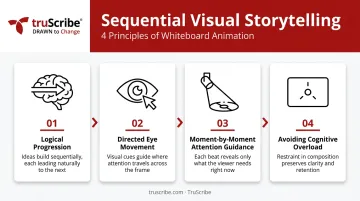
This is the principle behind why whiteboard animation performs well for complex B2B topics. TruScribe's proprietary Scribology methodology applies this directly:
- Reveals information in a logical progression mirroring how the brain builds understanding
- Directs the viewer's eye with precision through sequential drawing
- Guides attention moment by moment, avoiding cognitive overload
- Avoids overwhelming viewers with a completed visual all at once
The Trust Connection
Wyzowl's survey of 266 marketers and consumers found that 89% said video quality affects trust in a brand. While that's general video rather than paid-ad-specific data, the implication is clear: production quality and message clarity aren't just aesthetic concerns. They directly shape how credible your brand appears.
Types of Video Ads
Not all video ad formats are created equal, and the wrong format for your audience or platform will underperform regardless of creative quality.
The Main Formats
| Format | How It Works | Best For |
|---|---|---|
| In-stream | Plays before, during, or after video content (pre-roll, mid-roll, post-roll) | YouTube, broad awareness |
| Outstream | Auto-plays within editorial content, outside a video player | Publisher sites, reach |
| Social feed video | Appears natively in social feeds | LinkedIn, Instagram, TikTok, Facebook |
| OTT/Connected TV | Internet-delivered video on streaming services | Broad awareness, premium context |
| Native/in-feed video | Paid video placed in discovery or content surfaces | Content-native environments |
Interruptive vs. Non-Interruptive
In-stream formats (particularly pre-roll) interrupt what a viewer was already watching. That friction can work in your favor — it captures attention — but it also creates resistance. Non-interruptive formats like outstream and native video earn attention rather than demanding it, which tends to generate less resentment but requires stronger creative to hold viewer interest without the forced captivity.
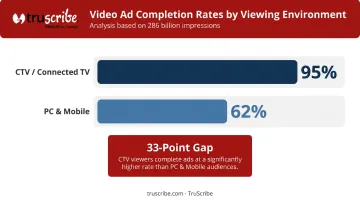
Completion rates differ significantly by context: Innovid's analysis of 286 billion impressions found approximately 95% completion on CTV versus 62% combined for PC and mobile — a gap driven largely by viewing environment, not just format.
Animated and Explainer Video for B2B
Format choice also shapes what kind of creative is possible. For B2B advertisers explaining technical or unfamiliar concepts, animated explainer video — whiteboard animation in particular — does something live-action simply can't: it makes abstract ideas visible. You can't film a data architecture or a regulatory compliance workflow, but sequential drawing can represent both clearly.
TruScribe, for example, uses this principle as the foundation of its Scribology method — calibrating visual pacing and minimalist design so that each element directs attention rather than competing for it. The goal isn't aesthetics; it's comprehension.
How to Create Effective Video Ads
Start with Audience and Goal
Before scripting anything, answer two questions:
- Who specifically is this ad for?
- What should they believe or do after watching?
A video targeting a CISO evaluating cybersecurity software on LinkedIn needs a completely different message, tone, and format than one targeting small business owners on Facebook. Skipping this step produces videos that feel generic because they are.
Hook Viewers in the First Three Seconds
Viewer drop-off is steepest at the start. Google's ABCD framework (developed with Ipsos and Nielsen) recommends at least two shots in the first five seconds and early brand or product introduction — don't bury the lead.
Practical approaches:
- Open with a bold visual or unexpected image
- Ask a question that names the viewer's exact problem
- Demonstrate the outcome immediately, then explain how you get there
Prioritize Clarity Over Cleverness
The most common reason B2B video ads underperform isn't poor production quality — it's an abstract or information-dense message that viewers can't process quickly. Clever is harder to remember than clear.
For complex topics, this means:
- One central idea per video
- Simple visual metaphors over technical diagrams
- Narration and visuals telling the same story, not competing
Design for Sound-Off Viewing
Around 85% of social video plays without audio — autoplay defaults to muted across most feeds, and most viewers don't turn the sound on. Your video needs to communicate the core message even without narration.
Practical requirements:
- Captions or subtitles on every video
- On-screen text reinforcing key points
- Visual storytelling that makes sense without sound
Sequential formats like whiteboard animation have a structural edge here: each new element draws in front of the viewer, directing attention beat-by-beat through the story without relying on audio at all.
Close with a Single, Specific CTA
Once the message lands, don't leave viewers guessing what to do next. A strong CTA:
- Names the exact action: "Watch a 3-minute demo" outperforms "Learn more" every time
- Appears on screen as text, not just spoken in narration
- Matches where the viewer is in the funnel — "Request a quote" demands commitment; "See how it works" meets early-stage curiosity without friction
Choosing the Right Platform for Your Video Ads
Where you run your video ads matters as much as what's in them. Each platform attracts a different audience, supports different formats, and rewards different content styles — so the choice should be driven by where your buyers actually spend time.
Platform Overview
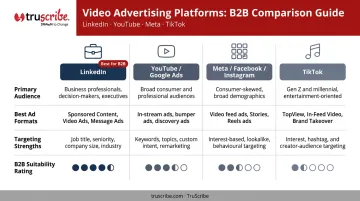
- YouTube/Google Ads: Strong for broad awareness and search-intent targeting. Skippable in-stream, non-skippable (generally 15 seconds or less), and bumper (6 seconds or less) formats available. Good reach, competitive CPMs
- LinkedIn: The standout for B2B. Targeting by job title, function, seniority, company, industry, and company size makes it uniquely precise for reaching decision-makers. Higher CPMs, but the targeting quality justifies it for most B2B advertisers
- Meta (Facebook/Instagram): Effective for retargeting and visual storytelling at scale. Useful for B2B when combined with custom audience segments or lookalike targeting
- TikTok: Suited for younger or consumer-oriented audiences. Less relevant for most B2B categories, though some brands use it for employer branding
Match Platform to Format
Platform and format length have to be decided together. A 2-minute product explainer won't survive on TikTok. A 6-second bumper ad won't work on LinkedIn if your audience needs context before they can understand what you're selling.
For most B2B advertisers, the starting point looks like this:
- LinkedIn Sponsored Video + 60–90 second explainer: The default choice for complex offerings targeting decision-makers by role or seniority
- YouTube pre-roll: Well-suited for retargeting warm audiences or running broader awareness campaigns at lower CPMs
How to Measure Video Advertising Success
Align KPIs to Funnel Stage
| Funnel Stage | Metrics to Track |
|---|---|
| Awareness | Impressions, reach, video completion rate |
| Consideration | Click-through rate, dwell time, view-through rate |
| Conversion | Cost per lead, cost per acquisition, pipeline influenced |
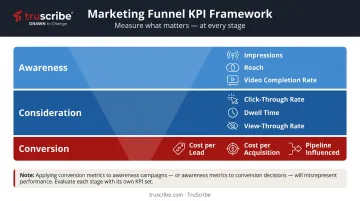
Don't measure awareness campaigns on conversion metrics — you'll pull budget from campaigns doing their job because they're being evaluated on the wrong criteria.
Understand Platform View Definitions
"Views" are not consistent across platforms:
- Meta: 2 continuous seconds with at least 50% of pixels on screen (MRC-accredited)
- YouTube TrueView: 30 seconds, or completion if shorter, or an interaction
- TikTok: At least 2 continuous seconds in one impression session; also reports 6-second, 25%, 50%, 75%, and 100% completion metrics
Raw view counts across LinkedIn, YouTube, and Meta are not measuring the same thing. Standardize on the metrics that matter to your objective rather than defaulting to whichever number looks best.
Iterate Systematically
The first video ad campaign rarely hits its potential. A/B test one variable at a time:
- Opening hook (visual vs. question vs. demonstration)
- Video length (30 seconds vs. 60 seconds vs. 90 seconds)
- CTA copy and placement
- Format (animated vs. live-action vs. whiteboard)
Document what works, scale it, and keep testing. Campaigns built on documented learning compounds — each round of testing narrows the gap between spend and results.
Frequently Asked Questions
What is a video advertisement?
A video advertisement is a paid promotional video distributed across digital channels — social media, streaming platforms, or websites — to promote a product, service, or brand. It's distinguished from organic video by its paid placement and targeted distribution to specific audiences.
How much does it cost to make a video ad?
Costs vary widely by format and production approach. Agency-produced video generally runs $100–$175 per hour, with many projects coming in under $10,000 according to Covalent's 2024 pricing guide. Animated and whiteboard video production varies further — contact studios directly for a scoped quote.
What is the difference between video advertising and video marketing?
Video marketing is the broader strategy of using video content to build brand presence and audience engagement, including organic posts and educational content. Video advertising refers specifically to paid placements with defined targeting, budgets, and distribution objectives.
What makes a video ad effective?
A strong hook in the first three seconds, a clear and single-minded message, design that works without audio, and a specific call to action aligned to the viewer's buying stage. Clarity matters more than production sophistication, especially in B2B contexts.
How long should a video ad be?
It depends on format and platform. Bumper ads run 6 seconds; social ads typically perform best under 30 seconds. Longer explainer or product demo videos — 60 to 90 seconds — can work well in mid-funnel B2B contexts when the content is compelling and the viewer has demonstrated interest.
What are the best platforms for B2B video advertising?
LinkedIn leads for professional targeting by job title, seniority, and industry. YouTube/Google Ads complements it well for awareness and search intent, while Meta platforms support B2B retargeting effectively when paired with custom audience lists.