Introduction
Marketers aren't losing the war for attention—they're fighting it with shorter ammunition. According to Dr. Gloria Mark's research at UC Irvine, the average time spent on one screen before switching has dropped from 2.5 minutes in 2004 to approximately 47 seconds today. That's not a trend. It's a neurological shift, and short-form video is the format built to meet it.
HubSpot's 2026 State of Marketing data confirms what many marketers already suspect: short-form video ranks as the #1 highest-ROI content format, with 49% of marketers citing it as their top-performing channel—nearly double the 29% who credit long-form video.
You'll find the psychology behind why short-form video works, how B2B teams are using it for sales enablement and training, and practical guidance for creating videos that drive real results.
TruScribe, a neuroscience-backed visual communication studio with 5,000+ B2B video projects delivered since 2010, approaches this with a clear conviction: brevity is only half the equation. The other half is directing attention precisely and building understanding fast.
Key Takeaways
- Short-form video is the #1 ROI content format for marketers in 2026, cited by 49% of respondents in HubSpot's global study
- Shrinking attention spans are neurologically measurable—short-form video is structurally built to match how the brain actually works now
- B2B teams use short-form video beyond awareness: sales enablement, employee training, and onboarding are high-impact applications
- The first 1–3 seconds are decisive: your hook must answer "why keep watching?" before a viewer swipes away
- Repurposing long-form content into short clips is the most scalable path to expanding reach without rebuilding from scratch
What Is Short-Form Video in Marketing?
"Short-form" has outgrown its original definition. While the format started with strict time limits under 60 seconds, it's better understood today by how it's consumed: fast, mobile-first, vertically oriented, and built to deliver one clear idea.
Videos from 15 seconds to 3 minutes qualify as short-form—provided the pacing and structure are tight. A 2-minute video that wanders isn't short-form. A 90-second video that answers one question precisely is.
The Platforms Shaping the Ecosystem
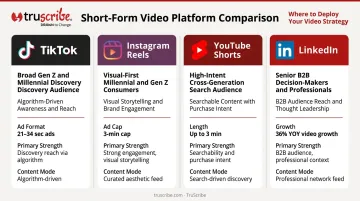
Each major platform serves a distinct audience and purpose:
- TikTok — Massive discovery reach, algorithm-driven distribution, strong impulse behavior; in-feed ads recommended at 21–34 seconds
- Instagram Reels — Visual brand storytelling, strong engagement metrics; videos over 3 minutes won't be recommended to new audiences
- YouTube Shorts — Searchability, integration with long-form strategy, strong purchase intent data; now supports up to 3-minute uploads
- LinkedIn — Professional audiences, growing video feed, B2B-specific engagement; video viewership grew 36% year-over-year from late 2024 through early 2025
Short-Form as a Search Tool
Short-form video has moved beyond social discovery. Adobe research found that 74% of Gen Z internet users use TikTok for search, with 51% favoring it over Google for certain queries. Google itself surfaces short video content in main search results, Discover, and Images—meaning a well-optimized short video can capture intent at the bottom of the funnel, not just the top.
That reach across both discovery and search means short-form video isn't just a top-of-funnel tactic. For B2B marketers, it's a channel where buyers are actively looking for answers—which changes how the format should be planned and measured.
The Psychology Behind Short-Form Video: Why It Works
Attention Spans Are a Measurable Reality
Dr. Gloria Mark's longitudinal research gives marketers something concrete to work with. Screen focus time dropped from 2.5 minutes in 2004 to 75 seconds by 2012—and has continued declining to roughly 47 seconds in recent measurements. The cause isn't cognitive decline. Constant notifications, competing apps, and years of rapid switching have simply rewired how people allocate attention.
Short-form video is structurally optimized for this environment. A 60-second video that delivers one complete idea fits within the brain's current threshold for sustained focus without demanding anything it's not currently wired to give.
The Zeigarnik Effect and Why People Keep Watching
Zeigarnik's foundational research established that people remember incomplete tasks better than completed ones. Short-form video platforms leverage this directly—each video feels like one piece of a larger story, compelling viewers to watch another, then another. Even informational short-form content benefits from this: viewers return to channels and creators because each piece feels like part of an ongoing sequence, not a closed chapter.
The First 3 Seconds Decide Everything
Meta's research found statistically significant ad recall after just 0.25 seconds of exposure, with average mobile feed dwell time at 1.7 seconds. TikTok's own guidance confirms that a strong hook in the first 3 seconds produces measurably higher watch-through rates.
The emotional trigger in those opening seconds matters most. Short-form videos succeed by immediately landing an emotion — curiosity, humor, or an unexpected angle — before the viewer's thumb moves on. Unlike long-form content, where brands have time to build context, short-form has no runway. The emotional hook is the strategy.
Mobile Consumption Shapes Everything
A 2025 US survey found 81% of short-form viewers primarily watch on smartphones. That single stat has real production implications. Vertical, mobile-native video isn't just a creative preference — it's where the audience already is, how they hold their device, and what their thumb is already trained to scroll past. Getting the format right is part of getting the message right.
Best Practices for Creating Effective Short-Form Videos
Lead with a Hook That Earns Attention
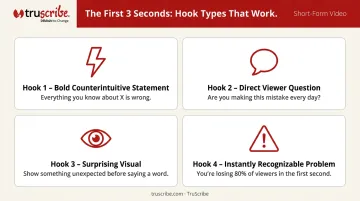
The first 1–3 seconds must answer one implicit question: "Why should I keep watching?" Effective hooks take several forms:
- A bold, counterintuitive statement
- A direct question the viewer is already asking themselves
- A surprising visual that creates immediate curiosity
- A problem the viewer immediately recognizes
Build to nothing. The hook is the opening.
One Video, One Idea
The most effective short-form videos are laser-focused on a single question or concept. Covering multiple points dilutes both retention and algorithmic performance—platforms struggle to categorize unfocused content, which reduces distribution.
This discipline is especially hard for B2B marketers, who often feel compelled to include every product benefit in a single video. Resist that instinct. A focused 60-second video will outperform a scattered 3-minute one almost every time.
Answer First, Contextualize Second
The inverted pyramid principle applies directly to short-form video. Lead with the direct answer or core insight, then add supporting context. This respects viewer time and ensures the key message lands even if watch time is short.
Traditional marketing storytelling builds to a reveal. Short-form reverses that structure — open with your conclusion, then explain why it's true.
Optimize for Sound-Off Viewing
A 2019 Verizon Media and Publicis Media survey of 5,616 US consumers found 69% watched video without sound in public and 25% did so even in private settings. Captions, text overlays, and strong visual storytelling are non-negotiable—not nice-to-haves.
This is also a direct accessibility win. Captions serve viewers with hearing impairments, ESL audiences, and anyone in a noise-sensitive environment.
Authentic Production Beats Polish
Duolingo's YouTube Shorts viewership grew 430% year-over-year using content that prioritizes personality over production value. Intentional framing, clear audio, and authentic delivery consistently outperform over-produced content that feels corporate.
For B2B marketers, that means resisting the urge to over-engineer. A well-structured, clearly lit 90-second video recorded in your office will outperform a polished video that says nothing specific.
Short-Form Video for B2B: Sales Enablement, Training, and Beyond
Accelerating the Sales Process
Short-form video answers buyer questions before the sales conversation happens. Hoel Roofing and Remodeling, documented in a case study by IMPACT, used short-form sales videos to answer recurring buyer objections and cut sales appointment times in half—allowing reps to spend less time on foundational explanations and more time closing.
The mechanism is straightforward: when prospects arrive to meetings already educated on pricing, process, and expectations, the conversation starts at a higher level. TruScribe's sales enablement clients—including Pegasystems, Siemens, and HPE—use whiteboard explainer videos to simplify complex product propositions before buyer interactions, with TruScribe reporting an average 35% increase in conversion rates across client engagements.
Employee Training and Onboarding
Employees consume information in short bursts—on mobile devices, between tasks, rarely at a desk with an hour to spare. Short-form video meets them there; dense training manuals don't.
TruScribe has produced training and onboarding videos for Walmart, Medtronic, Raising Cane's, Amedisys, and others—replacing dense training manuals with sequential visual content that guides comprehension rather than overwhelming it. Their Scribology methodology achieves 2.3x higher retention than traditional video formats, a direct result of sequential drawing, minimalist design, and timing optimization that reduces cognitive load throughout the video.
Explaining Complex B2B Topics Through Visual Animation
Some B2B topics genuinely resist simplification through talking-head video or text. The following content types consistently benefit from sequential visual construction:
- Complex compliance requirements and regulatory procedures
- Multi-step operational or enterprise software processes
- Pharmaceutical mechanisms and clinical workflows
- Abstract technical concepts in IT and cybersecurity
This is where TruScribe's whiteboard animation format delivers a specific advantage. Rather than presenting completed visuals all at once, Scribology reveals information through sequential drawing—guiding viewer attention precisely, building mental models step by step, and making abstract concepts concrete within a compact runtime. For topics where comprehension drives action, that precision matters.
Measuring B2B Short-Form Video ROI
Views and likes are the wrong metrics for B2B video. The meaningful indicators are:
- Watch-through rate — Did they see the full message, or drop off before the CTA?
- Downstream actions — Did they book a call, click a link, or progress through onboarding?
- Sales feedback — Are prospects arriving to meetings more informed and ready?
- Pipeline influence — Can video views be correlated with deal progression?
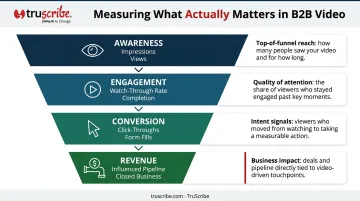
Vidyard's analytics framework maps video goals to appropriate metrics: awareness to impressions and views, engagement to watch time and completion, conversion to click-throughs and form fills, and revenue to influenced pipeline and closed business. This framework applies directly to B2B short-form campaigns.
How to Repurpose Content into Short-Form Video
The Content Pyramid Model
Start with one substantial long-form asset—a webinar, keynote, deep-dive training session, or recorded internal presentation—and extract multiple self-contained clips for distribution across platforms. Gary Vaynerchuk's content model documents this systematically: a single keynote can generate 30+ platform-specific micro-content pieces.
For B2B teams, this approach maximizes return on content already created without requiring constant net-new production.
Practical Steps to Start This Week
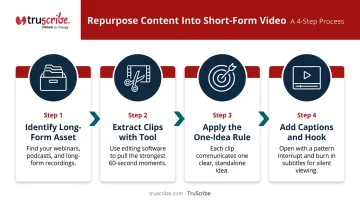
- Identify your highest-performing long-form asset — a webinar recording, training session, or video call where a subject matter expert explained something clearly
- Use a clip-extraction tool to identify strong moments, add captions automatically, and reformat footage for vertical viewing
- Apply the one-idea rule — only extract clips that answer a single, clear question; discard segments that try to cover multiple points
- Add captions and a text hook in the first 3 seconds before publishing to any platform
For organizations with extensive training libraries or webinar archives, this repurposing approach works best when each clip starts with a tight, purposeful script. TruScribe's scripting services can help structure raw source material so clips land with clarity — no rebuilding from scratch required.
Frequently Asked Questions
What is a short-form video in marketing?
Short-form video is mobile-first content typically ranging from 15 seconds to 3 minutes, built around a single idea and optimized for quick consumption on platforms like TikTok, Instagram Reels, YouTube Shorts, and LinkedIn. What separates it from other formats is tight pacing, vertical orientation, and a one-message-per-video discipline.
What is the 3-3-3 rule in marketing?
The 3-3-3 rule lacks a single formal origin—definitions vary across sources. The most useful interpretation for video applies a "first 3 seconds" principle: capture viewer attention immediately, deliver core value within the first 30 seconds, and include a clear call to action before the video ends. It's a practical hook-body-CTA framework, not an industry-certified standard.
What is the 5-5-5 rule for social media?
The 5-5-5 rule also lacks a verified formal origin, with definitions varying by source. The most common interpretation involves posting consistently, engaging with other accounts daily, and responding to comments—designed to maintain visibility and community interaction without overwhelming content teams. Treat it as a general engagement rhythm rather than a precise formula.
How long should a short-form video be?
There's no universally correct length. Strong short-form videos often fall between 15 and 90 seconds, but the best guidance is simpler: make the video as long as it needs to be to answer one question clearly—and no longer. Watch-through rate is the most reliable signal of whether your length is working.
How do you make short-form video work for B2B marketing?
B2B short-form video performs best when it answers a specific buyer or employee question — pricing, process, what to expect, how something works. Distribute on LinkedIn and YouTube for professional reach, and extend use beyond awareness into sales enablement and employee training.