Introduction
Every screenwriter hits the wall. Sometimes it's mid-draft, when a scene refuses to move. Sometimes it's before a single word is typed, staring at a blank page with nothing to react to. And sometimes it's in rewrite, when notes keep pointing to the same gap — a character who doesn't feel real, a scene that doesn't land.
Prompts don't replace the writer's instinct. They give it something to push against.
This post organizes 75 prompts across five categories: character and emotional arcs, dialogue and conflict, story structure, visual storytelling, and genre-specific scenarios. Each category includes 15 prompts plus a quick exercise tip. Whether you're developing a feature, a TV pilot, a short film, or a corporate explainer video, find the section that matches your current problem and start there.
Key Takeaways
- These 75 prompts map to five distinct phases and needs of the screenwriting process
- Prompts apply to features, pilots, short films, and business or training video scripts
- The most generative prompts put characters in morally charged or emotionally contradictory situations
- Visual storytelling prompts are especially useful when the image — not dialogue — carries the full communicative load
- Any prompt works as a warm-up, a mid-draft fix, or a rewrite starting point
How to Use These Script Writing Prompts
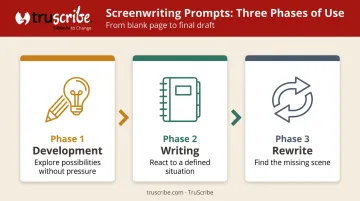
Prompts deliver the most value at three specific points in the writing process:
- Development phase — Before committing to a story, use prompts to explore character paths and scene possibilities without the pressure of getting it right
- Writing phase — When you hit a wall on a specific scene, a prompt gives you a defined situation to react to rather than a blank page to fill
- Rewrite phase — When feedback identifies a gap in motivation, tension, or structure, prompts help you find the scene you're missing
How to Run a Prompt Session
- Set 15–20 minutes per session and write without stopping to edit
- Read the result aloud. BBC Bitesize and the UNC Writing Center both recommend it for catching awkward rhythms, missing logic, and unnatural dialogue — and most writers skip it, which shows in their drafts
- One session per prompt is enough — the goal is raw material, not a finished scene
A Note on Categories
These prompts are not genre-locked. A thriller prompt can yield a comedic scene. A character arc prompt can unlock a structural problem. Move across categories freely. The labels exist to help you find a starting point, not to limit you to one.
15 Character and Emotional Arc Prompts
Character arc prompts force writers to externalize internal states — not through exposition, but through behavior, reaction, and choice. They help writers surface the gap between what a character actually wants and what they think they want — the tension that Michael Hauge and Syd Field both identify as the engine of dramatic need.
That tension doesn't require a feature-length runtime to matter. A two-minute training video still needs a protagonist whose perspective shifts by the end — otherwise, there's no story, just information.
The Prompts
- A character tells a convincing lie for the first time in their life — and immediately has to decide whether to correct it.
- A protagonist's worst flaw surfaces during an otherwise generous act.
- A character is offered exactly what they've wanted for years and, upon receiving it, says nothing.
- Write the moment a person realizes they've been wrong about someone they deeply resented.
- A character helps a stranger with a problem that is unmistakably their own problem.
- Someone recognizes a person from their past but pretends not to.
- A character confesses something important — but confesses to the wrong person.
- Write the moment just before a character gives up — and show what stops them, without dialogue.
- A person refuses to accept comfort when they need it most. Show why through behavior, not words.
- A character discovers that a belief they built their identity around is factually incorrect.
- Someone receives an apology they've waited years for — and it doesn't feel the way they expected.
- A character acts with complete courage and is rewarded with nothing.
- Write a scene where a character's joy and shame occur simultaneously.
- A person makes a decision that benefits everyone around them at personal cost — and never mentions it.
- A character reaches the end of a long effort and finds the destination looks exactly like where they started.
Exercise Tip
Pick one prompt result and identify three moments across a script where the character's internal truth is revealed, concealed, or contradicted by their own actions. Mapping those three moments gives you a functioning arc — not just a strong scene.
15 Dialogue and Conflict Prompts
Good dialogue is almost never about what characters say directly. Robert McKee defines dialogue as verbal action — characters speak to pursue desires — and argues that when speech is transparent to a character's inner life, audiences believe and enter the scene. Edward Albee extends that principle to silence: staying silent is its own deliberate act.
These prompts train writers to use conversation as an arena for conflict, subtext, and revelation.
- Two characters argue heatedly — but about two entirely different things, neither realizing it.
- One character dodges five consecutive direct questions. Write the conversation.
- A confession is mistaken for sarcasm. Neither character corrects the misunderstanding.
- Write a long exchange where silence is used as a weapon — deliberately and consciously.
- A casual conversation ends in an accidental betrayal no one intended.
- A character finishes someone else's sentence and instantly regrets it.
- A heated argument ends in unexpected laughter. Show how they got there.
- Write a one-page argument where no one raises their voice.
- Two people talk around the real subject for an entire scene. The real subject is never spoken aloud.
- A character says "I don't care" six times during a conversation. Show — through everything else — that they care completely.
- A negotiation where both parties want the same outcome but can't say so.
- Write a conversation where one character knows something the other doesn't — and the knowing character says nothing.
- A person tells the truth in a way that lands as a lie.
- Two old friends meet after years apart. They speak warmly. The scene ends in distance.
- A character asks a question they already know the answer to. Write why.
Exercise Tip
Write the same scene twice: once where the character says exactly what they mean, once where they say the opposite. The gap between those two drafts is where subtext lives — and where most of the real tension is.
15 Story Structure and Plot Prompts
Structure prompts help writers practice the architecture of escalation, reversal, and payoff. These are especially useful for writers who have interesting characters but struggle to build scenes that accumulate toward each other.
Story setup speed matters regardless of format length. Audiences — whether watching a short film or a feature — make keep-or-quit decisions fast. These prompts train you to earn attention before you've spent it.
The Prompts
- Start at the midpoint of your story and write forward and backward from there, treating the midpoint as the narrative anchor rather than the climax.
- Build a scene that ends on a cliffhanger, then cut immediately to a scene with no apparent connection.
- Design an act break using only emotional weight. No action, no confrontation — just a shift in the character's internal state that changes everything that follows.
- Write a teaser that only makes complete sense after the story ends.
- A protagonist fails three times before succeeding. Each failure teaches something different.
- Create a "lowest point" moment using only silence and visuals — no dialogue.
- Flip an established ally into an obstacle mid-scene, without making either character a villain.
- Write a confrontation where a secret reveal completely changes who holds power.
- Build a scene that the audience understands but the protagonist does not — and write the moment the protagonist catches up.
- Construct a false resolution: the character believes they've won, then discovers they haven't.
- Write an opening that could belong to three different genres — then commit to one in the final line.
- Design a scene where the stakes escalate without the characters speaking.
- Build a sequence where three separate characters make the same mistake in different contexts.
- Write the moment a plan falls apart and improvisation takes over.
- Construct the final scene first. Then write the opening image that sets up its emotional payoff.
Exercise Tip
Use these prompts to build a beat sheet, not just a scene. Map each structural moment to a position — setup, midpoint, climax — and check whether the emotional stakes escalate consistently from one beat to the next. If they plateau, that's your structural problem.
15 Visual Storytelling Prompts for Video Scripts
Visual storytelling prompts challenge writers to build meaning through what an audience sees — without relying on dialogue to explain it. This is the foundational discipline of screenwriting, and it becomes even more critical in formats where the visual carries the full communicative load.
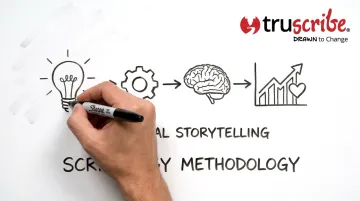
TruScribe's Scribology methodology, the neuroscience-backed framework behind their whiteboard explainer videos, is built on exactly this principle. Sequential visual motion reveals ideas in a deliberate order, directing viewer attention with precision.
The core mechanism is visual anticipation: watching something drawn in real time keeps the brain active, predicting what comes next rather than passively receiving a finished image. TruScribe's methodology attributes 2.3x higher retention than traditional video formats to this effect. For writers developing explainer or training video scripts, visual-first prompts help establish a script's structural logic before a single line of narration is written.
The Prompts
- A house and its contents reveal everything about its owner — without a word of dialogue.
- A character prepares for something with great care. At the last moment, they decide not to go.
- A room slowly reveals a secret through a sequence of visual details. The secret is never stated.
- A character tries to erase something and cannot — show the attempt and the failure visually.
- The aftermath of an argument, shown entirely through what was left behind.
- A locked drawer is opened for the first time. Show the reaction without naming what's inside.
- A location triggers a flashback — reveal the connection through visual rhyme, not narration.
- Show an emotional response — grief, relief, anger — using only physical behavior.
- A moment of betrayal, with no spoken words.
- Two characters say goodbye using only objects. No words, no direct eye contact.
- A character wins something. Show the cost of winning through what they do immediately after.
- A space changes meaning over the course of three visits — same location, different emotional register each time.
- A character lies. Reveal the lie only through what the camera observes, not through what's said.
- Show time passing in a single location using only visual accumulation — no cuts, no narration.
- A character finds something they lost. Show whether finding it was good or bad through their behavior alone.
Exercise Tip
Limit scene description to two sentences per action block for every prompt in this category. That constraint forces maximum visual impact with minimum prose and trains the instinct to show rather than tell.
15 Genre-Specific and High-Concept Prompts
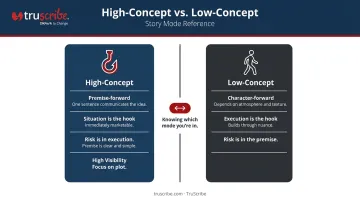
Genre prompts push writers into specific tonal and structural conventions that force creative risk-taking. Film scholar Justin Wyatt argued that a high-concept premise is readily communicable — one sentence does the work. Low-concept ideas depend on character, texture, and execution. Both approaches have value; what matters is knowing which mode you're working in before you start.
The Prompts
Thriller / Mystery
- A person receives a handwritten note with only an address and a time — no name, no explanation.
- Two strangers in a diner realize they've been followed by the same car for over an hour.
- A hostage negotiator gets through to a caller who has made no demands.
- A witness recants their testimony — not because they were wrong, but because they were right.
- Someone discovers the crime they've been hired to investigate involves a person they trust completely.
Drama
- Two people share a park bench on the anniversary of something painful for both of them — neither knows the other's reason for being there.
- A person forgives someone who never asked for it, and that person doesn't understand why.
- A child asks a parent a question the parent is completely unprepared to answer honestly.
- Two siblings meet at a parent's house to divide belongings. The argument is never about the objects.
- A person has thirty minutes to tell the truth — and uses twenty-eight of them deciding whether to.
Comedy
- A person arrives at a costume party that is not a costume party.
- Two strangers spend three hours at a DMV and become inexplicably, specifically close.
- A character improvises an elaborate story to avoid a conversation — and the lie becomes more demanding than the truth.
High Concept
- A character discovers their own memories have been selectively edited. They don't know by whom — or if they did it themselves.
- Two timelines of the same person's life mirror each other in opposite directions: one life improving as the other deteriorates, crossing at a single moment.
Exercise Tip
Write a one-sentence logline for three of these prompts. The constraint is the point: if you can't reduce an idea to a single sentence, you haven't yet located its core. Most scripts that stall in development fail not from lack of material, but from a premise the writer never fully understood.
Frequently Asked Questions
What are good script ideas?
The strongest ideas combine a specific situation with a character who has something to lose — the focus should be conflict, stakes, and emotional truth, not plot complexity. The five categories in this post offer starting points across character, dialogue, structure, visuals, and genre.
How do screenwriting prompts help with writer's block?
Research on writer's block links it to perfectionism and the pressure to generate original ideas from nothing. Prompts bypass that pressure by giving writers a defined situation to react to — shifting the challenge from invention to interpretation, which is a much lower bar for starting.
Can script writing prompts be used for corporate or explainer video scripts?
Yes — the principles of visual storytelling, character motivation, and narrative tension apply just as directly in a two-minute training video as in a feature film. A character whose perspective shifts by the end works in any format.
How long should a script writing prompt exercise be?
One to three pages — roughly a 15–20 minute timed session. That's long enough to develop a real dynamic between characters or a genuine narrative beat, short enough to complete and review in a single sitting.
What is the difference between a high-concept and low-concept script idea?
High-concept ideas are premise-forward and immediately communicable — the situation is the hook. Low-concept ideas depend on character, atmosphere, and execution rather than a single compelling premise.
How do I turn a prompt into a full screenplay?
Use the prompt to generate a scene first, then ask three questions: what does the character want, what's stopping them, and what changes by the end? Those answers give you a complete story structure to build from.