Introduction
Change is constant in modern organizations. Managing it successfully is not.
Gartner's change-effectiveness research found that only 45% of employees achieved the change goals set by their organization — meaning the majority of change initiatives fall short of what leadership intended. That gap between intent and execution is where organizations lose time, budget, and employee trust.
This guide is written for HR, L&D, Operations, and leadership teams responsible for guiding people through organizational transitions. It covers what change management is, how to implement it in five steps, and what separates initiatives that stick from those that lose momentum and miss their goals.
Key Takeaways
- Change management is a structured approach to transitioning people, processes, and culture — not a one-time communications exercise.
- Cultural and psychological preparation must come before any logistical rollout begins.
- The five core steps are: prepare the organization, develop a vision and plan, implement the change, embed it in culture, and review results.
- Most change initiatives fail for people-related reasons — resistance, poor communication, and lack of buy-in — not technical ones.
- Clear, consistent, multi-format communication is the single most critical factor in driving adoption.
What Is Change Management?
Change management is a structured approach to transitioning individuals, teams, and organizations from a current state to a desired future state. It addresses the people, processes, and cultural dimensions of change — not just the logistical ones.
Incremental vs. Transformational Change
The type of change you're managing determines the intensity of the approach. What works for a workflow tweak won't hold up under a company-wide restructuring.
| Type | Description | Management Intensity |
|---|---|---|
| Incremental | Small, gradual improvements to workflows or processes | Lower — focused adjustments to communication and training |
| Transformational | Large-scale shifts in structure, strategy, or culture | Higher — requires full change management rigor across all phases |
How Change Management Differs from Project Management
These two disciplines solve different problems — and confusing them is one of the most common reasons change initiatives stall.
- Project management delivers outputs — on time, within scope and budget
- Change management ensures the people affected by those outputs actually adopt and sustain new ways of working
A technically successful rollout that employees don't understand or accept will still fail. The goal isn't just delivery — it's durable adoption.
Why Change Management Matters in Organizations
Without a structured approach, change initiatives don't just slow down — they actively damage the organization. Common failure patterns include delayed adoption, budget overruns, employee disengagement, and reversion to old behaviors.
McKinsey's 2021 survey of 1,034 participants found that fewer than one-third of transformations improved and sustained performance. Organizations outside the successful group captured only 37% of potential financial benefits from their initiatives.
When Change Management Is Non-Negotiable
Structured change management is particularly critical during:
- Technology implementations — new ERP, CRM, or enterprise systems
- Mergers and acquisitions — cultural and operational integration
- Restructuring — role changes, team realignments, reporting shifts
- Compliance transitions — regulatory or policy-driven requirements
- Digital transformation programs — broad-based process and system overhauls
Organizations in healthcare, financial services, manufacturing, and technology face these pressures regularly — often simultaneously.
Change Capability as a Competitive Advantage
McKinsey's research found that organizations acting on comprehensive transformation approaches — including mindset and behavior change alongside process changes — were more likely to outperform peers — and sustain those gains over time. Organizations that treat change capability as a repeatable discipline, not a one-time project, are the ones that pull ahead when market conditions shift.
How to Implement Change Management: A 5-Step Process
No two change initiatives are identical, but they follow a consistent lifecycle. These five steps apply to both incremental and transformational change — with the level of rigor scaled to the scope of the initiative.
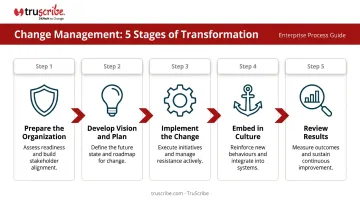
Step 1: Prepare the Organization for Change
Cultural and psychological preparation must come before logistical planning. Employees need to understand why change is necessary before they can accept what is changing.
Organizational readiness in practice looks like:
- Identifying executive sponsors and mid-level champions who will visibly support the change
- Assessing which teams or roles are most affected and will require the most support
- Gauging existing resistance or anxiety — so it can be addressed before it becomes obstruction
- Communicating the case for change early, before formal plans are announced
Skipping this step is one of the most common and costly mistakes in change management. Employees who feel blindsided resist harder and longer.
Step 2: Develop a Clear Vision and Strategic Plan
A solid change plan defines more than what will change. It answers:
- Strategic goals — what the change is designed to achieve
- KPIs — how success will be measured
- Scope — what is included and what is not
- Stakeholders — who owns what at each phase
The plan also needs to be honest about uncertainty. Transformational change rarely follows a straight line from current state to future state. Build in contingency thinking and decision rules for when roadblocks emerge, rather than assuming a linear path.
Step 3: Implement the Change
Implementation is where plans meet reality — and where many change efforts stall.
Effective change managers do more than instruct people to comply. They:
- Empower employees with the tools, training, and authority to act
- Celebrate short-term wins to sustain momentum and demonstrate progress
- Identify and remove roadblocks before they compound
- Communicate consistently throughout — not just at launch
Progress updates matter. Employees who see evidence that the change is working are far more likely to stay engaged than those left wondering whether anything is actually happening.
Sustained implementation sets the stage for the harder work: making the change permanent.
Step 4: Embed the Change in Culture and Processes
Go-live is not the finish line. Without deliberate reinforcement, employees — particularly those who were ambivalent from the start — tend to drift back to familiar habits.
Anchoring change operationally means:
- Updating performance expectations and workflows to reflect new behaviors
- Revising job descriptions so the change becomes part of how roles are defined
- Integrating new processes into onboarding, so future employees inherit the new way by default
- Ensuring leadership continues to model the desired behaviors long after launch
Prosci's research found that 81% of respondents who planned reinforcement met or exceeded their change objectives, compared to just 15% among those who did not. Yet only 44% of practitioners reported actually allocating reinforcement resources. This gap explains a significant share of change failures.
Step 5: Review Progress and Analyze Results
A post-implementation review, done honestly, is what separates organizations that improve their change capability from those that repeat the same mistakes.
Metrics worth tracking include:
- Adoption rates and usage data for new systems or processes
- Proficiency measures and skill assessments
- Employee feedback and sentiment data
- Speed to full adoption compared to the original plan
The insights from this review should feed directly into the next initiative. Each completed change builds organizational muscle — so the fifth initiative moves faster and sticks harder than the first.
Key Factors That Determine Change Management Success
Leadership Commitment and Active Sponsorship
Visible executive and managerial commitment is one of the strongest predictors of change success. Prosci's research found 79% objective attainment with extremely effective sponsors, compared to just 27% with ineffective ones.
Leaders must do more than endorse the change. They need to model it, resource it, and actively remove barriers — throughout the process, not just at kickoff.
Communication Clarity and Frequency
Ambiguous or infrequent communication is a primary driver of employee resistance. Effective change communication answers three questions every employee is asking:
- Why is this happening?
- What does it mean for me?
- What do I need to do?
McKinsey's 2014 survey found enterprise transformations were 12.4 times more likely to succeed when senior managers communicated continually. A single announcement — regardless of how well-crafted — is not a communication strategy.

Visual formats help employees absorb complex organizational changes more effectively than text-heavy memos alone. TruScribe's whiteboard animation videos, for instance, use sequential visual reveal to help employees build clear mental models of what is changing and why — particularly useful when teams are already navigating uncertainty.
Employee Buy-In and Resistance Management
Resistance is a natural psychological response to change — not a character flaw. Successful change management anticipates it rather than being surprised by it.
Practical approaches include:
- Creating safe channels for employees to raise concerns
- Involving employees in shaping how change is implemented, not just informing them of decisions
- Acknowledging legitimate concerns rather than dismissing them
Training and Capability Development
Employees who feel underprepared are significantly more likely to disengage or resist. Training must be:
- Role-specific — not generic
- Practical — focused on what employees actually need to do differently
- Timed appropriately — close enough to rollout that skills don't atrophy before they're needed
Measurement and Course Correction
Change management is an ongoing process, not a one-time event. Establishing clear KPIs tied to adoption — and reviewing them on a regular cadence — allows teams to detect slippage early. Small problems are manageable. The same problems left unaddressed for months are not.
Common Mistakes and Misconceptions in Change Management
Treating It as a Project Management Exercise
Many organizations focus on task completion, timelines, and deliverables while neglecting the human dimension entirely. A technically perfect rollout that employees don't understand or accept will still fail. Change management is fundamentally about people — the logistics serve the people, not the other way around.
Assuming Communication Is a One-Time Announcement
A single all-hands meeting or company-wide email does not constitute a communication strategy. Employees move through different stages of acceptance at different paces, and different questions arise at each stage. Effective communication must be:
- Repeated — one message rarely lands the first time
- Multi-format — written, visual, and verbal channels reach different people
- Sustained — maintained across the entire change lifecycle, not just at launch
Skipping the Reinforcement Phase
Many change initiatives are declared done at go-live — and without sustained reinforcement, the change decays. The Prosci data cited earlier is instructive: the difference between 81% and 15% objective attainment comes down to whether reinforcement was planned and resourced.
Yet fewer than half of practitioners allocate resources to this phase. If there's one place to invest additional planning effort, reinforcement is it.
Frequently Asked Questions
What is change management in simple terms?
Change management is a structured approach to helping people within an organization adapt to new processes, systems, or structures. It covers the preparation, communication, training, and reinforcement needed to ensure lasting adoption — not just the technical rollout.
What are the 5 steps of change management?
The five steps are: prepare the organization for change, develop a clear vision and plan, implement the change, embed it into culture and processes, then review results. Each step addresses both the logistical and human dimensions of the transition.
What are the most common change management models?
The most widely used frameworks include Kotter's 8-Step Model, the ADKAR Model, Lewin's Unfreeze-Change-Refreeze, Prosci's 3-Phase Process, and McKinsey's 7-S Framework. The right model depends on the scope and nature of the change — they are not interchangeable.
Why do most change management initiatives fail?
The most common reasons are lack of leadership commitment, poor or inconsistent communication, insufficient employee involvement, and failure to embed changes into culture after initial rollout. In nearly every case, the breakdown happens at the human level — not in the systems or processes themselves.
What is the difference between change management and project management?
Project management focuses on delivering outputs on time, within scope and budget. Change management focuses on ensuring the people affected by those outputs actually adopt and sustain new behaviors. Both are necessary for a successful initiative — neither replaces the other.
How does communication affect change management success?
Effective communication is how employees learn why change is happening, what's expected of them, and that they have support throughout. When communication is unclear or inconsistent, employees fill the gap with assumptions — and that uncertainty is consistently cited as a top driver of failed initiatives.