
Introduction
The U.S. B2B trade show market is estimated at $15.8 billion in 2024, and industry activity is accelerating — CEIR's Q4 2024 data shows the exhibition index up 6.0% year over year, with 37% of completed 2024 events exceeding pre-pandemic performance.
That growth sounds promising. The problem is that every competitor in your space is showing up too.
Most companies treat trade shows as an obligation — book the booth, ship the materials, show up, hope for leads. The ones that consistently win treat it differently: every decision, from booth design to follow-up timing, is made with intention and measured against a clear ROI threshold.
The gap between a costly booth and a profitable one rarely comes down to budget. It comes down to four things:
- Preparation before you arrive
- Display quality that earns a second look
- How your team engages visitors on the floor
- What happens in the 48 hours after the show closes
This post delivers 25 actionable tips B2B exhibitors can apply immediately — before, during, and after their next trade show.
Key Takeaways
- Start preparation 60–90 days before the show — not the week before
- Your booth must communicate your core value within seconds of a passerby's glance
- Train staff on qualifying questions and genuine listening, not scripted pitches
- Capture detailed lead notes during the show — badge scans alone produce cold leads
- Follow up within 48 hours while conversations are still fresh
Before the Show: 7 Tips to Set Yourself Up for Success
Set Clear Goals and Choose the Right Show
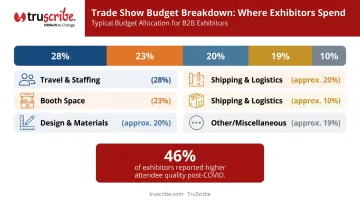
Tip 1 — Calculate ROI before you commit. Add up booth space, travel, materials, and staffing costs against realistic revenue scenarios. According to EXHIBITOR's budget research, booth space alone consumes 23% of the average exhibitor's trade show budget, with design, shipping, and travel adding another 38%. The decision to exhibit should be driven by a defined ROI threshold — not habit or industry tradition.
Tip 2 — Prioritize audience fit over event size. A smaller, well-targeted show will consistently outperform a large, poorly matched event. EXHIBITOR's 2022 data shows that while 83% of companies reported lower post-COVID show attendance, 46% reported higher attendee quality — a direct reminder that volume and prospect fit are two very different things.
Tip 3 — Get the attendee list early. Many shows provide it in advance. Cross-reference it against your Ideal Customer Profile and identify specific contacts and companies worth pursuing before you arrive. This list becomes the foundation of your pre-show outreach — and your first opportunity to get ahead of the competition.
Pre-Show Marketing and Logistics
Tip 4 — Launch outreach 4–6 weeks before the show. Use email, LinkedIn, and direct mail to personally invite target prospects. Include your booth number and a clear reason to stop by — a live demo, an exclusive offer, or a piece of content they can't get elsewhere.
Video works especially well here. Vidyard's 2024 benchmark data shows video messages generate 8x higher click-through rates and 4x higher reply rates than text-only outreach — a meaningful edge when inbox competition is high.
Tip 5 — Pre-schedule meetings with priority prospects. Foot traffic is unpredictable. Pre-scheduled one-on-one meetings with high-priority contacts create guaranteed, focused conversations — the kind that floor interactions rarely match in depth or quality.
Tip 6 — Build a detailed pre-show checklist. Cover every supply, piece of equipment, printed material, digital asset, and staff assignment. The cost of arriving without a key item is disproportionate to the cost of checking a list in advance. Common culprits include:
- Connector cables and power adapters
- Printed product sheets and leave-behinds
- Login credentials for live demos
- Staff assignments and contact numbers
Tip 7 — Arrive early on setup day. Walk the venue, meet organizers, introduce yourself to neighboring exhibitors, and resolve any booth or logistics issues before show hours begin. A problem found during setup is fixable; the same problem found during show hours usually isn't.
Booth Design Tips That Stop Foot Traffic
Tip 8 — Create a unified visual theme. Your booth display should reflect your brand identity and communicate your core value at a glance. A disjointed or cluttered display forces attendees to work to understand you — and they won't. They'll keep walking.
Tip 9 — Prioritize bold, readable signage. EXHIBITOR's guidance recommends designing primary signage for visibility at 50–100 feet and secondary signage for 10–50 feet. A practical rule: one inch of letter height per three feet of viewing distance. If your headline isn't legible from across the aisle, attendees will never stop to read the rest.
Tip 10 — Use video content as a looping booth display. Motion pulls the eye in a crowded hall. A short, looping explainer or whiteboard animation video communicates your message without requiring a staff member to be in constant motion.
Formats like TruScribe's whiteboard animation are built for high-distraction environments. Their Scribology methodology uses sequential visual storytelling, revealing information step by step through hand-drawn illustration, to guide attention precisely and reduce cognitive overload.
In a busy trade show hall, where most polished video content competes through visual density, this approach does the opposite: it simplifies, draws the eye, and holds it. TruScribe's 30-second booth videos are designed around the "glance-and-grab" reality of trade show floors, built to stop foot traffic and connect passersby to your larger brand story.
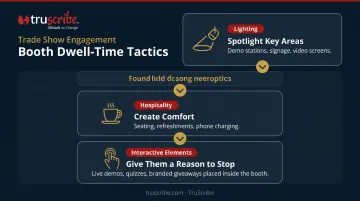
Tips 11–13 — Maximize dwell time with physical booth elements:
- Lighting (Tip 11): Spotlight your demo station, key signage, and video screens. A flat, poorly lit booth looks low-effort next to a well-lit competitor — and lighting is one of the highest-ROI investments most exhibitors overlook.
- Hospitality (Tip 12): Comfortable seating, refreshments, or a phone charging station increase dwell time and create natural openings for conversation. People who stop and sit are easier to engage than passersby.
- Interactive elements (Tip 13): A live product demo, a short quiz, or a giveaway draw gives attendees a reason to stop. Place branded items inside the booth — not at the edge — so visitors have to step in to collect them, putting them in front of your team.
Staffing and Engaging Visitors on the Show Floor
Tip 14 — Build a complementary team. The strongest booths combine a sales rep who can convert qualified interest, a product or technical expert who can handle deep questions, and a communicator who handles initial engagement. Sending only junior staff or only marketing personnel is a costly mistake that shows up immediately on the floor.
Tip 15 — Train staff on your brand story, not just your product. Every team member should be able to deliver a clear 30-second narrative explaining the core problem you solve. The most effective floor interactions follow an 80/20 rule: listen 80% of the time, talk 20%. Staff who monopolize the conversation are missing qualification data entirely.
Tip 16 — Get out from behind the table. Position staff at the aisle edge. Make eye contact. Initiate. Passive booth behavior — waiting for people to approach — quietly kills lead volume without anyone noticing until it's too late.
Tip 17 — Open with questions, not pitches. "What brings you to the show today?" is a far more effective opener than an unsolicited product introduction. Curiosity-driven openers feel natural, surface qualification data immediately, and keep the exchange from turning into a one-sided pitch.
Tip 18 — Staff the booth at all times. Build a rotation schedule that accounts for breaks, meals, and networking walks. An empty booth or a single visibly distracted staffer sends a clear signal to passing attendees — and not a good one.
Tip 19 — Treat every visitor as a long-term connection. The visitor who isn't ready to buy today may refer a colleague next quarter or influence a purchase decision you never see coming. Pushing a sale on an unqualified visitor damages your reputation faster than any bad booth design. Keep every conversation unhurried and human.
Lead Qualification and Capture
Tip 20 — Equip staff with two to three qualifying questions. Determine within the first few minutes whether a visitor matches your target profile. Useful examples:
- "Are you involved in evaluating or selecting solutions like this?"
- "What's the biggest challenge your team is dealing with right now?"
- "What are you currently using to solve this problem?"
Those answers reveal quickly whether the conversation is worth pursuing. If there's no fit, disengage gracefully — thank them for stopping, offer something useful, and move on. Don't let a non-prospect occupy 20 minutes of booth time.
Tip 21 — Capture detailed notes for every qualified lead. EXHIBITOR data shows at least 40% of trade show floor leads go unfulfilled — and the single biggest reason is that badge scans without context produce cold leads. For every qualified contact, capture:
- Their specific pain point or challenge
- What they responded to at your booth
- Their decision timeline
- Any next step they mentioned
Without this context, even a warm conversation becomes a cold contact by Monday morning.
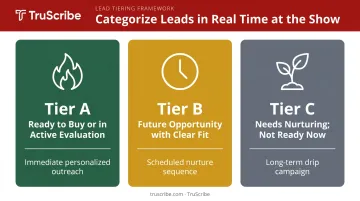
Tip 22 — Tier your leads immediately. Use the event's badge scanner or a mobile capture tool to categorize prospects in real time:
- Tier A — Ready to buy or in active evaluation
- Tier B — Future opportunity with clear fit
- Tier C — Needs nurturing; not ready now
This tiering cuts through post-show chaos — your best leads get personalized outreach while the conversation is still fresh.
Post-Show Follow-Up: Where Trade Show ROI Is Won or Lost
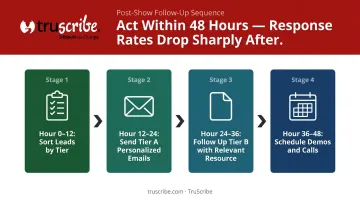
Tip 23 — Follow up within 48 hours. EXHIBITOR research shows only 62% of exhibit leads are contacted within five days — and response rates drop sharply the longer you wait. Send personalized follow-up messages while your interaction is still fresh. Including a visual reminder — a photo of your booth or team — helps prospects recall the conversation you had.
Tip 24 — Personalize every outreach using your lead notes. Reference the specific challenge the prospect shared at the show. Connect it directly back to your solution. Include one clear, low-friction next step — a demo, a call, a relevant resource. The more specific your message, the more likely it is to earn a response.
Once your follow-up cadence is running, close out the event properly.
Tip 25 — Run a post-show debrief with your team. Before you close the books, evaluate what worked:
- Which engagement tactics produced the most qualified conversations?
- Which display elements generated the most interest?
- Which qualifying questions opened the best discussions?
- What would you change about setup, staffing, or the booth design?
Document the answers. Each show should inform the next. Teams that build on prior shows compound their results — those that don't keep starting from zero.
Frequently Asked Questions
How far in advance should you start preparing for a trade show?
Most exhibitors should begin 60–90 days out, covering goal-setting, booth design, pre-show outreach, and staff training. Waiting until the final few weeks almost always results in reactive decisions — rushed design, missed outreach windows, and undertrained staff.
How many staff members do you need for a trade show booth?
At minimum, two people — so the booth is never unattended. EXHIBITOR's rule of thumb is one staffer per 50 square feet of open exhibit space. Larger or high-traffic booths benefit from three to four members with defined roles across engagement, qualification, and technical depth.
What makes a trade show booth display stand out?
Standout booths combine readable signage (visible from 50+ feet), motion (looping video or live demos), cohesive branding, and hospitality elements. The key is communicating your core value within the first few seconds — before an attendee decides to keep walking.
How do you qualify leads quickly without being pushy?
Open with curious, conversational questions about what the attendee does and what they're looking for at the show. Let their answers guide the qualification naturally. Done well, it feels like a helpful conversation — because it is.
What should you do in the first 48 hours after a trade show ends?
Sort leads by priority tier, send personalized follow-up messages that reference specific booth conversations, and schedule any promised demos or calls. Speed and personalization separate effective follow-up from the generic emails most prospects receive.
How do you measure trade show ROI?
Measure against goals defined before the show: qualified leads generated, meetings booked, deals closed within a set window, and cost per lead. Without pre-defined metrics, evaluating performance — or improving it next time — is largely guesswork.