Introduction
Picture two presenters walking into the same boardroom. The first opens with a slide packed with metrics — retention rates, compliance percentages, quarterly figures. The second opens with a sentence: "Meet Sarah. It's her third week, and she's already lost."
One room leans back. The other leans in.
Storytelling closes that gap — the space between data delivered and meaning felt. In business communication, that gap is the difference between a message that sticks and one that evaporates before the meeting ends.
This guide covers what storytelling actually is, why it works at a neurological level, and how to apply narrative structure to real business challenges — from onboarding videos to sales enablement.
Key Takeaways:
- Storytelling uses character, conflict, and resolution to make information emotionally resonant and memorable
- Narrative texts outperform expository content by roughly half a standard deviation in recall and comprehension
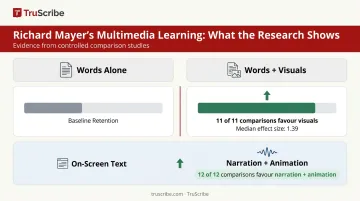
- Visuals paired with narration improve problem-solving transfer across every experimental comparison studied
- Effective storytelling videos follow a clear arc — not just a sequence of facts
- Whiteboard animation mirrors the brain's natural processing rhythm through sequential, guided reveals
What Is Storytelling? Definition, Origins, and Purpose
The Definition
Storytelling is the deliberate use of narrative — characters, conflict, and resolution — to communicate ideas, values, or information in a way that is memorable and emotionally resonant. Oxford Reference defines narration as "the communicative act or process of relating a sequence of events or giving an account of a situation." What distinguishes storytelling from information transfer is intent: a story shapes how an audience receives a message, not just what they receive.
Raw data informs. A story gives data context, stakes, and meaning. Consider the gap between "compliance violations increased 18% this quarter" and "here's what happened to a team that skipped the process" — the first delivers a number; the second creates urgency that actually changes behavior.
A Brief History
Humans have been telling stories far longer than we've been writing them down. The Smithsonian documents systematic symbolic markings by approximately 77,000 years ago, while the British Museum traces African rock art to around 30,000 years ago. UNESCO notes that oral traditions have transmitted cultural knowledge, values, and collective memory across generations long before formal literacy existed.
The medium has changed — cave walls to scrolls to screens — but the underlying mechanism hasn't. Narrative structure remains one of the most reliable ways to move information from short-term exposure to long-term memory — a fact that makes storytelling as relevant to a compliance training video as it was to a campfire legend.
Three Types Worth Distinguishing
That history shapes how we categorize storytelling today. Each type serves a distinct purpose:
| Type | Focus | Example |
|---|---|---|
| Personal storytelling | Lived experience and self-expression | A keynote speaker sharing a formative moment |
| Brand storytelling | Company values and mission | A brand origin video |
| Business storytelling | Driving audience behavior change | A compliance training video with a relatable protagonist |
This guide focuses on business storytelling — specifically how narrative structure drives comprehension, retention, and action in organizational contexts.
Why Storytelling Works: The Neuroscience Behind It
Neural Coupling
When communication works, something measurable happens in the brain. A 2010 fMRI study published in PNAS found that during successful spoken communication, listener brain activity became spatially and temporally coupled with the speaker's — meaning the brains essentially synchronized. Anticipatory coupling (where the listener's brain activity preceded the speaker's) correlated with comprehension at r = 0.75, p < .01.
Shared understanding, in other words, has a measurable neurological signature — not a metaphor for connection, but evidence of it.
Oxytocin, Empathy, and Engagement
Emotional narrative exposure triggers oxytocin — a neurochemical tied to empathy and prosocial behavior. Research by Barraza and Zak found that emotional video content was associated with a 47% increase in oxytocin from baseline, and higher oxytocin correlated with greater generosity.
A separate PNAS study found that storytelling sessions with hospitalized children raised mean oxytocin levels significantly while reducing cortisol and reported pain. The mechanism transfers directly to business video: emotionally resonant content changes how viewers feel toward what they're watching, which shapes how they respond.
Narrative Transportation
That emotional engagement feeds directly into a cognitive state researchers call narrative transportation. Green and Brock found that when people are absorbed in a narrative, they adopt story-consistent beliefs and evaluate protagonists more favorably. For business communication, this is significant: a viewer absorbed in a training scenario is more open to the behavior change that scenario models. Transportation doesn't require fiction — it requires narrative structure.
Visual Storytelling and Dual-Coding
Richard Mayer's multimedia learning research found that words combined with pictures outperformed words alone in 11 of 11 comparisons, with a median transfer-test effect size of 1.39. In a separate set of comparisons, animation paired with narration outperformed animation with on-screen text in all 12 of 12 cases.
When narrative and visuals work together — as in video — more cognitive pathways activate at once, deepening comprehension and improving how well viewers retain and apply what they've learned.
The Core Elements of Effective Storytelling
All compelling stories share structural elements, regardless of medium or format. Understanding these is the foundation for building any effective business communication.
Relatable Character (The "Who")
Every story needs a protagonist the audience can see themselves in. In business storytelling, that's rarely a fictional hero — it's the new employee on their first week, the sales rep losing a deal they should have won, the manager struggling to explain a policy change. The audience engages when they recognize themselves in the character's situation.
Conflict or Problem (The "Stakes")
Conflict creates tension. Without a clear problem, there's no reason for the audience to stay invested. In a business context, this might be: a process that keeps failing, a compliance gap with real consequences, a customer who can't understand your product. Define the problem specifically — vague challenges produce vague engagement.
A practical tip: name the cost of the problem. What happens if it isn't solved? That's the emotional stake that keeps viewers watching.
Resolution (The "Transformation")
Resolution is where the story earns its purpose. The protagonist overcomes the conflict — through a new process, a clearer understanding, a product that works. In business storytelling, this is where the value of whatever you're communicating becomes concrete. Bury the resolution in jargon, and the story fails. Make it clear and visual, and the audience understands what they're supposed to do differently. TruScribe's Scribology method is built around this principle — using sequential visual drawing to reinforce the resolution so it lands rather than getting lost in complexity.
Emotion and Authenticity
Audiences disengage from stories that feel manufactured. Authentic emotional stakes drive engagement; production quality alone does not. A compliance video that acknowledges real anxiety lands differently than one that presents a smiling employee breezing through a checklist. When the emotional stakes feel real, audiences trust the message — and act on it.
What Is a Storytelling Video?
A storytelling video is any video format that uses narrative structure — character, conflict, resolution — to communicate a message, rather than presenting information as a sequence of disconnected facts.
Common Formats in Business
| Format | Best For |
|---|---|
| Whiteboard animation | Complex B2B concepts, training, onboarding |
| Live-action brand video | Culture, values, executive messaging |
| Customer testimonial | Social proof, sales enablement |
| Motion graphics explainer | Product features, process overviews |
Each format has strengths, but the format alone doesn't make something a storytelling video. A testimonial without narrative arc is just a quote. A motion graphics piece without a protagonist is just a features list.
Why Whiteboard Animation Works for B2B
Of these formats, whiteboard animation is the strongest fit for B2B storytelling — not because of aesthetics, but because of how it structures attention. TruScribe's hand-drawn Scribology approach takes that structural advantage further:
- Sequential reveal guides the viewer's attention step by step, preventing cognitive overload
- Minimalist design removes visual competition, keeping the brain focused on the message
- Visual anticipation — watching something being drawn — creates active engagement rather than passive viewing
- Hand-drawn visuals activate deeper memory pathways compared to digital graphics or stock animation
TruScribe's internal data shows the Scribology method delivers 2.3x higher retention than traditional video formats and an average 35% increase in conversion rates across client engagements. The sequential draw style — revealing one idea at a time rather than displaying everything at once — is the primary driver behind both numbers.
How to Use Storytelling in Business Video Communication
A 3-Step Process
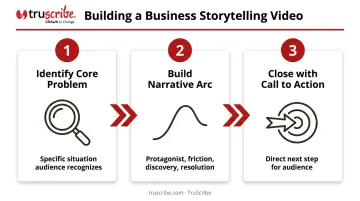
Identify the audience's core problem — Not a vague challenge, but a specific situation your audience recognizes from their own experience. What keeps them from succeeding? What are the consequences of the status quo?
Build a narrative arc — Introduce a relatable protagonist navigating that problem. Show the friction. Then show discovery — a process, a product, an insight — that changes the situation. The arc doesn't need to be long. A two-minute video can carry a complete story.
Close with a clear call to action — Resolution without direction wastes the story's momentum. Whether it's completing a training module, requesting a demo, or changing a behavior, the final moment should tell the audience exactly what to do next.
Business Use Cases That Deliver Results
Video storytelling produces concrete results across these core functions:
- Employee onboarding — TruScribe's work with Walmart's "100 Pennies" culture video communicates organizational values at scale to a large, distributed workforce
- Compliance training — A whiteboard video produced for Eli Lilly through MediaPRO earned a Summit Award for creativity and gained wide recognition in the Information Security field
- Sales enablement — Narrative-driven pitch content outperforms feature-list selling; research on entrepreneurial pitches shows founding stories meaningfully increase the likelihood of success
- Product launches — TruScribe's work with Pegasystems, Microsoft, and Google demonstrates how complex technology products become understandable through sequential visual narrative
- Change management — Storytelling videos for clients like Navistar help employees connect emotionally to organizational transitions, rather than resisting them
According to Wyzowl's 2026 video marketing survey (266 respondents), 93% of video marketers reported improved product or service understanding and 83% reported increased sales — based on self-reported perception rather than tracked conversions.
TruScribe as a Storytelling Partner
TruScribe works directly with organizations that need storytelling expertise without building production infrastructure in-house. With 5,000+ projects delivered for over 1,000 B2B clients — including Microsoft, Google, Walmart, Merck, and NASA — the team brings narrative expertise and the neuroscience-backed Scribology method to turn complex messages into clear, memorable video stories.
The guarantee is simple: follow the production process, and if the project doesn't deliver at least a 200% return on investment, TruScribe will write a check for the value of the work.
Frequently Asked Questions
What is a storytelling video?
A storytelling video uses narrative structure — character, conflict, and resolution — to communicate a message rather than presenting facts in isolation. Formats range from whiteboard animation to live-action depending on the communication goal, but the structure, not the style, is what makes it a storytelling video.
What are the 5 C's of storytelling?
The 5 C's — Circumstance, Curiosity, Characters, Conversations, and Conflict — are a practitioner checklist for building complete stories. They help communicators confirm that context is set, tension is present, and the audience has a reason to stay engaged through the resolution.
What are the key elements of a good story?
A good story needs a relatable character, a meaningful conflict with real stakes, and a satisfying resolution. Emotion and authenticity tie these together; a technically correct structure still falls flat if the audience doesn't feel anything.
Why is storytelling important in business communication?
Storytelling makes complex information more digestible, builds emotional connection, and significantly improves message retention. A 2021 meta-analysis found narrative texts outperformed expository content by Hedges' g = 0.55 — a meaningful advantage when the goal is comprehension and recall.
How do you structure a story for a business video?
Establish the audience's specific problem, introduce a relatable character navigating it, show the solution, and close with a clear resolution and call to action. The structure doesn't need to be complex; it needs to be honest and focused on one clear outcome.
What makes video storytelling more effective than text-based content?
Video combines visual, auditory, and narrative elements simultaneously, activating more cognitive pathways at once. Mayer's multimedia learning research found that words plus pictures improved problem-solving transfer across all 11 experimental comparisons — a consistent advantage that text alone cannot match.