Introduction
Most organizations know engagement matters. Fewer know what to do about it.
According to Gallup's State of the Global Workplace 2025 report, only 20% of employees worldwide are engaged at work. The remaining 80% are either going through the motions or actively working against their teams. The economic toll: roughly $10 trillion in lost productivity annually — approximately 9% of global GDP.
The response from most organizations? A team lunch. An annual survey. A one-off recognition event. None of these are engagement strategies. They're what happens when an organization has no strategy at all.
Lasting engagement requires addressing root causes: unclear expectations, absent managers, feedback that disappears without action, and communication that employees tune out.
This guide covers what engagement actually is, what drives it, proven strategies to improve it, the role of communication, and how to measure progress over time.
Key Takeaways
- Only 20% of employees globally are engaged — costing the world economy $10 trillion annually
- Managers account for 70% of the variance in team engagement levels
- Well-recognized employees are 45% less likely to turn over within two years
- Frequently burned-out employees are 2.6x more likely to seek a new job
- Annual engagement surveys leave you reacting to problems — not getting ahead of them
What Is Employee Engagement and Why Does It Matter?
Employee engagement goes beyond satisfaction. A satisfied employee shows up and does the job. An engaged employee brings discretionary effort — thinking beyond their job description, caring about outcomes, and investing in the organization's success.
Gallup defines engagement as "the involvement and enthusiasm of employees in their work and workplace." That definition has three practical expressions:
| Persona | What It Looks Like | Global Share (2025) |
|---|---|---|
| Engaged | Emotionally invested, drives performance and innovation | 20% |
| Not Engaged | Present, but contributing time without energy or passion | 64% |
| Actively Disengaged | Unhappy, resentful, potentially undermining colleagues | 16% |
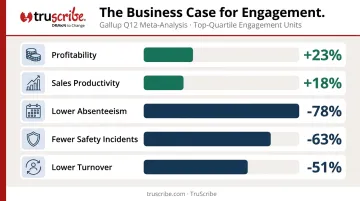
The business case for closing that gap is well-documented. Gallup's Q12 meta-analysis — covering 183,806 business units across 90 countries — found that top-quartile engagement units delivered:
- 23% higher profitability
- 18% higher sales productivity
- 78% lower absenteeism
- 63% fewer safety incidents
- 51% lower turnover in low-turnover organizations
These gains compound. Higher retention reduces recruiting costs, lower absenteeism protects productivity, and greater profitability creates room for the investments that drive further engagement — making this less a cost center decision and more a growth strategy.
The Core Drivers of Employee Engagement
Perks don't build engagement. Neither do quarterly pizza parties or a ping-pong table in the break room. Sustainable engagement is built on five foundational conditions — and organizations that address all five consistently outperform those that don't.
Clarity and Purpose
Employees who understand how their individual work connects to broader organizational goals are far more likely to be engaged. As of 2024, only 46% of U.S. employees clearly knew what was expected of them — down from 56% in 2020. Unclear expectations aren't just frustrating; they're one of the most common root causes of disengagement.
Recognition and Being Valued
Recognition works when it's specific, timely, and tied to real behaviors. "Good job" lands flat. "The way you handled that client call last Thursday — staying calm and finding a workable solution — that's exactly what we stand for" lands differently. Peer recognition matters too: employees who regularly give recognition are 26% more likely to be engaged themselves.
Growth and Development Opportunities
Employees who see a visible path forward — through training, mentorship, or internal mobility — are more likely to invest in their current role. According to SHRM analysis of exit interview data, career development gaps were the leading cause of voluntary turnover in 2024. That's a retention problem with a clear solution.
Manager Relationships and Psychological Safety
Gallup's research attributes 70% of the variance in team engagement to the manager or team leader. That's not a small variable — it's the dominant one. Psychological safety, the belief that employees can speak up, take risks, and share honest feedback without fear, is what makes that manager relationship either an engagement accelerator or a ceiling.
Employee Voice and Feedback Loops
Gathering feedback means nothing if employees never see what happens next. When input disappears without visible action, disengagement follows. Closing the loop — communicating what you heard and what you're doing about it — is how organizations build the trust that keeps people engaged.
How to Improve Employee Engagement in the Workplace
Engagement improves through consistent systems, not one-off initiatives. The strategies below are interconnected — pulling one lever in isolation produces limited results.
Build a Recognition-Rich Culture
Recognition should be a regular operational habit, not an annual award ceremony. Practical approaches:
- Embed peer nominations into existing team rituals (weekly standups, monthly all-hands)
- Celebrate milestones publicly — work anniversaries, project completions, client wins
- Tie recognition to specific behaviors connected to company values, not generic praise
A longitudinal study of nearly 3,500 employees found that well-recognized employees were 45% less likely to turn over within two years. Programs that fail tend to be infrequent, generic, or feel performative. The difference is specificity and consistency.
Invest in Meaningful Onboarding and Ongoing Development
Onboarding is the first and most critical window for shaping engagement. The perceptions and habits formed in the first 90 days are difficult to reverse.
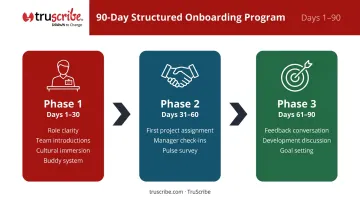
A structured approach looks like this:
- Days 1–30 — Role clarity, team introductions, cultural immersion, and a buddy system
- Days 31–60 — First real project contribution, manager check-ins, early pulse survey
- Days 61–90 — Feedback conversation, development discussion, 90-day goals set
How that content is delivered matters just as much as the structure itself. One persistent failure: overwhelming new hires with text-heavy policy documents they won't read or remember. Visual, story-driven training — such as whiteboard animation videos — significantly improves comprehension and retention compared to static manuals. TruScribe's work with clients like Walmart and Amedisys demonstrates the impact: their neuroscience-backed approach achieves 2.3x higher retention than traditional video formats by revealing information sequentially, in a way the brain can actually process.
Prioritize Wellbeing and Prevent Burnout Structurally
Burnout is not an individual resilience failure — it's a workload and culture problem. Treating it with wellness app subscriptions while ignoring chronic overload is addressing the symptom, not the cause.
Structural interventions that actually move the needle:
- Realistic capacity planning — protect against scope creep and under-resourcing
- Meeting hygiene norms — default meeting lengths, no-meeting blocks, asynchronous alternatives
- Leadership modeling — managers who never unplug implicitly signal that employees shouldn't either
The stakes are real: employees who frequently experience burnout are 63% more likely to take a sick day and 2.6 times as likely to actively seek another job.
Give Employees Autonomy and Ownership
Micromanagement kills engagement. But autonomy without clarity creates anxiety. The balance requires two things to coexist:
- Clear accountability — defined decision rights, outcomes, and expectations
- Genuine trust — managers who set the destination but don't dictate every step
The difference shows up in retention data: employees who feel trusted to make decisions report significantly higher job satisfaction than those who require sign-off for routine tasks.
Foster Connection and a Sense of Belonging
Social connection at work is a psychological driver of engagement — not a nice-to-have. This matters for in-person and remote teams alike.
Specific tactics:
- Cross-functional pairing — structured informal conversations across departments
- Employee Resource Groups (ERGs) — communities that reflect diverse identities and interests
- Inclusion in everyday communications — not reserved for dedicated campaigns, but embedded in how leaders communicate regularly
How Clear Communication Drives Employee Engagement
Communication is the connective tissue of every other engagement strategy. When employees feel uninformed, unclear about priorities, or excluded from decisions, every other driver weakens. SHRM research found that 85% of employees feel more engaged when leaders communicate transparently — yet 29% of U.S. employees cite a lack of clear, honest leadership communication as a factor in workplace disconnection.
What Transparent Communication Looks Like in Practice
It means explaining not just what is changing, but why. During difficult moments — layoffs, restructuring, strategic pivots — employees don't expect perfection; they expect honesty. What erodes trust is the gap between what leadership says and what employees experience.
Transparent communication also requires consistent two-way channels. Town halls, manager one-on-ones, and pulse surveys are only valuable if employees believe their input influences something. The same principle applies to how information flows downward: two-way channels fail when the outgoing messages are too dense to absorb.
Communicating Complex Information at Scale
One of the most common internal communication failures is sending dense, text-heavy content — policy updates, compliance training, change announcements — and expecting employees to absorb it.
They won't. Not because they don't care, but because the format fights against how the brain processes information.
TruScribe addresses this directly. Their Scribology-based whiteboard animation videos use sequential visual storytelling to simplify complex messages, covering everything from benefits enrollment to compliance requirements to strategic initiatives. For large organizations communicating across departments, locations, and roles, this approach produces higher comprehension rates and fewer costly misunderstandings.
Closing the Communication Loop
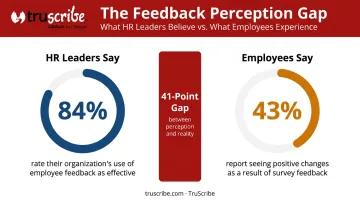
After surveys, town halls, or change announcements, follow-up communications that summarize what was heard and what actions will follow are among the highest-ROI trust-building practices available. Yet Qualtrics XM Institute found that while 84% of HR leaders rated their organization's use of employee feedback as effective, only 43% of employees said they had seen positive changes from previous surveys.
That 41-point gap is where trust erodes. Each unanswered survey cycle compounds the problem, until employees stop responding altogether.
How to Measure Employee Engagement
You can't improve what you can't see. Most organizations measure engagement too infrequently, with too blunt an instrument, and then wonder why scores don't move.
Core Measurement Tools
| Tool | Best For | Cadence |
|---|---|---|
| Annual engagement survey | Trend data, org-wide benchmarks | Yearly |
| Pulse surveys | Real-time tracking on specific themes | Monthly or quarterly |
| eNPS | Fast proxy for overall workforce sentiment | Quarterly or ad hoc |
Measuring continuously — rather than once a year — gives leaders the ability to act before disengagement becomes attrition.
KPIs Beyond Survey Scores
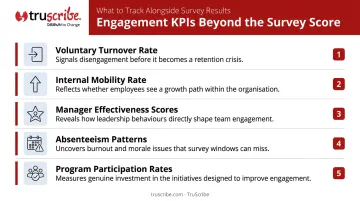
Survey scores are a lagging indicator. Track these alongside them:
- Voluntary turnover rate — especially among high performers
- Internal mobility rate — signal of growth opportunities being used
- Manager effectiveness scores — derived from team-level surveys
- Absenteeism patterns — early warning of burnout or disconnection
- Participation rates in engagement programs and surveys
Segment Your Data
A single org-wide engagement score can mask serious problems. A team that scores 8/10 on average might contain a department at 4/10 and another at 9/10. Segment by department, role, location, and tenure: the pockets of disengagement hidden in aggregate data are often exactly where voluntary turnover is already building.
The cadence matters less than what happens next. Organizations that act visibly on findings — communicating what they heard and what changed — see scores move. Those that collect data and go quiet typically see participation drop by the next cycle.
Frequently Asked Questions
What are the 5 C's of employee engagement?
The 5 C's are Care, Connect, Coach, Contribute, and Congratulate — a set of managerial behaviors that create the conditions for engagement to grow.
What are the 4 types of employee engagement?
The four types are cognitive (actively thinking about work), emotional (feeling connected to the organization), behavioral (going beyond minimum requirements), and social (engagement through team relationships).
What are the 10 C's of employee engagement?
First outlined by Seijts and Crim in the Ivey Business Journal, the 10 C's cover a structured range of leadership behaviors — from Connect and Clarity to Credibility and Confidence — designed to sustain engagement over time.
What are the biggest signs of employee disengagement?
Key warning signals include declining participation in meetings or surveys, increased absenteeism, reduced quality of work, and withdrawal from team interactions. Disengagement typically shows up in behavioral patterns before an employee formally resigns — which is why tracking eNPS and pulse scores over time matters.
How do managers impact employee engagement?
Managers account for 70% of the variance in team-level engagement, according to Gallup. They shape employees' daily experience of psychological safety, clarity, recognition, and development more directly than any other organizational variable — making manager quality the highest-leverage factor in any engagement strategy.
How do you measure employee engagement effectively?
Effective measurement combines quantitative tools (pulse surveys, eNPS, voluntary turnover rates) with qualitative signals (open-text feedback, participation trends). The most important practice is acting on findings visibly — employees who don't see responses to their feedback eventually stop providing it.