
Introduction
Most organizations have tried microlearning. Many are still disappointed with the results — low completion rates, knowledge that evaporates within days, and training that never quite changes behavior on the job.
The problem rarely sits with the format. It sits with the strategy behind it.
The Ebbinghaus Forgetting Curve illustrates why this matters: without reinforcement, learned information decays rapidly after a single training event. One-and-done training — even when delivered in short bursts — cannot overcome that fundamental reality.
ATD's 2025 survey of 271 talent development professionals found that roughly two-thirds of organizations now use microlearning, up 28 percentage points since 2017. Adoption is accelerating. Without a deliberate strategy behind it, that adoption just produces shorter content — not better learning outcomes.
What follows is a practical breakdown of what microlearning actually is, the cognitive science that makes it work, and five strategy tips that go well beyond "just make it shorter."
Key Takeaways
- Microlearning is purpose-built around one learning objective — not a long course chopped into pieces
- The Ebbinghaus Forgetting Curve and cognitive load theory explain why focused, repeated exposure outperforms single training events
- Spaced repetition, flow-of-work delivery, and active recall turn short content into lasting behavior change
- Visual formats reduce cognitive load when designed with intention, not used purely as decoration
- Measuring only completion rates misses the point; behavior change is the real ROI signal
What Is Microlearning — And Why It's More Than Just "Short" Content
Microlearning delivers focused, bite-sized learning modules — typically 2 to 10 minutes — built around a single learning objective. According to ATD's definition, a microlearning segment should cover one or two specific objectives, with 2–5 minutes rated most effective by practitioners.
The critical distinction most L&D teams miss: breaking a 60-minute course into 10 chunks is not microlearning. That's just a long course in a smaller container.
True microlearning is purpose-built. Each module is designed around:
- A specific performance gap or behavior gap
- The moment in the learner's workflow when that gap matters most
- One concept, one objective, one clear action the learner can take
Those three criteria define strategic intent — the line separating real microlearning from content-chunking. Content-chunking starts with existing material and asks, "How do we make this shorter?" Microlearning design starts with the learner and asks, "What does this person need to do, and when do they need it?"
That's why two organizations can run identical microlearning programs on paper and see completely different outcomes. The format is the same; the intent is not.
Why Traditional Training Fails: The Science That Makes Microlearning Work
The Forgetting Curve Problem
Hermann Ebbinghaus studied memory decay by measuring the effort required to relearn material over time. A 2015 replication of his original experiment confirmed the core finding: retention declines meaningfully within hours of a learning event and continues to drop over subsequent days without reinforcement.
The practical implication for L&D is clear — a single training event, however well-designed, cannot produce durable knowledge on its own. The brain needs re-exposure.
Spaced Repetition: The Evidence-Backed Fix
Spaced repetition addresses the forgetting curve by distributing practice across time. Cepeda et al.'s quantitative synthesis of 317 experiments confirmed that distributed practice consistently produces better delayed recall than massed study. The optimal spacing interval depends on the desired retention horizon — not a fixed universal schedule — which means microlearning sequences should be designed with the specific recall window in mind.
Cognitive Load Theory
Working memory has a limited capacity — research places it at roughly 3–5 meaningful chunks of information at a time. When learners face too many concepts simultaneously, comprehension collapses.
Microlearning addresses this directly by isolating one concept per module, giving the brain processing room before the next idea is introduced.
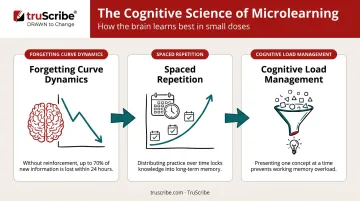
Together, these three mechanisms drive the scientific case for microlearning:
- Forgetting curve dynamics — retention drops sharply without reinforcement
- Spaced repetition — distributing practice over time locks in long-term recall
- Cognitive load management — limiting concepts per session keeps comprehension intact
The evidence is consistent. What varies is whether training programs are actually designed to take advantage of it.
5 Expert Tips for a Microlearning Strategy That Delivers Results
Tip 1: Anchor Every Module to a Single, Measurable Learning Objective
The most common microlearning design mistake is treating modules as content delivery vehicles. A module that covers "everything about the new compliance policy" is not microlearning — it's a compressed lecture.
Every module needs to answer one question: What should the learner be able to DO after this?
Use Bloom's Taxonomy action verbs to write objectives that drive behavior, not just awareness:
| Bloom's Level | Example Verbs | Sample Objective |
|---|---|---|
| Apply | demonstrate, use, practice | Demonstrate the correct escalation process for a data breach |
| Analyze | compare, differentiate, examine | Compare two vendor contracts to identify key risk clauses |
| Evaluate | assess, judge, appraise | Assess whether a customer situation requires supervisor involvement |
Objectives written at the Apply level or higher force module design toward practice and performance — which is where retention actually occurs.
Tip 2: Design for Spaced Repetition — Not One-and-Done Delivery
A single microlearning module is not a strategy. A sequenced delivery schedule is.
Effective spaced repetition in a microlearning program looks like this for compliance training:
- Day 1 — Initial module: A 4-minute animated explainer on data handling requirements
- Day 2–3 — First reinforcement: A short quiz presenting two real-world scenarios; learner selects the compliant action
- Day 10 — Spaced follow-up: A visual summary card reinforcing the three key rules, delivered via LMS notification
- Day 30 — Contextual application: A branching scenario where decisions carry visible consequences
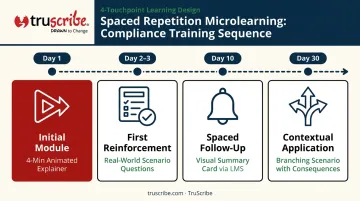
Each touchpoint revisits the same core concept in a new format. The variation matters — reintroducing material in a different context forces the brain to reconstruct the memory rather than simply recognize it.
Tip 3: Embed Microlearning in the Flow of Work
Josh Bersin coined the "learning in the flow of work" concept in 2018: training is most effective when it appears within the platforms and workflows employees already use, at the moment of need — not scheduled into a separate learning event.
How to identify "trigger moments" for embedded delivery:
- Map the specific on-the-job situations where knowledge gaps cause errors or delays
- Identify the system or tool the employee is using at that moment (Slack, Teams, LMS)
- Design a microlearning nudge — a 3-minute module or a single-question reinforcement — that delivers at exactly that point
For a product knowledge use case, this might mean a brief animated explainer pushed to a sales rep's Teams channel the morning before a product demo, not buried in a quarterly training calendar. The closer the learning lands to actual use, the stronger the transfer.
Tip 4: Use Visual Formats to Reduce Cognitive Load and Direct Attention
Dual-coding theory explains why visual microlearning works: when verbal and visual information are delivered together, learners process content through two cognitive channels simultaneously, creating more retrieval pathways and stronger recall.
But this only holds when the visuals are intentionally designed — not decorative.
Effective visual microlearning formats:
- Present one idea per visual frame
- Synchronize narration and visual reveal so the image illustrates what's being said at that moment
- Eliminate decorative elements that compete for attention
These principles are what make whiteboard-style sequential animation effective for microlearning. TruScribe's Scribology methodology applies them directly: sequential hand-drawing reveals one concept at a time, minimalist design eliminates visual clutter, and each frame is built to direct working memory toward the message. For a 3–5-minute module, that level of cognitive efficiency isn't optional — it's the difference between content that sticks and content that doesn't.
Format-to-objective alignment matters just as much as visual execution. Animated explainers suit conceptual knowledge; scenario-based visuals suit decision-making; whiteboard-style sequential reveals suit process understanding and complex idea simplification.
Tip 5: Build In Practice, Feedback, and Milestone Moments
Comprehension without application doesn't produce durable learning. Passive consumption builds fleeting familiarity, not transferable skill.
Roediger and Karpicke's research demonstrated that repeated testing outperformed repeated studying for delayed recall — students who were tested performed significantly better one week later than those who simply re-read material. The same principle applies in corporate microlearning: low-stakes practice opportunities that force active recall are more effective than passive consumption.
What practice looks like in a microlearning sequence:
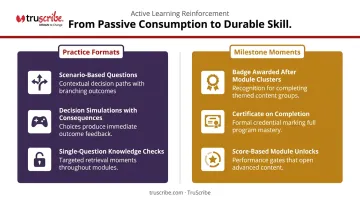
- Scenario-based questions where learners choose between realistic options
- Short decision simulations with visible consequences
- Single-question knowledge checks that must be answered before the next module unlocks
Milestone moments serve a different but equally important function. After every 5–10 modules, build in a cumulative checkpoint that acknowledges progress — a badge, a certificate, or a score-based module unlock. A meta-analysis of 40 gamification experiments found small but consistent positive effects on cognitive outcomes, motivation, and behavior. Milestones combat learner drop-off across longer learning journeys by making progress visible and meaningful.
Choosing the Right Formats for Your Microlearning Content
Format selection is a strategic decision. Mismatching format to learning objective is one of the most common execution failures in microlearning design.
| Format | Best For |
|---|---|
| Short animated explainer | Conceptual knowledge, process overviews, idea simplification |
| Whiteboard-style sequential video | Complex topics requiring mental model construction |
| Branching scenario / simulation | Decision-making, compliance, interpersonal skills |
| Interactive quiz / knowledge check | Reinforcement, retrieval practice, assessment |
| Infographic | Quick reference, visual summaries, at-a-glance frameworks |
ATD's practitioner research rates 2–5 minutes as the most effective duration for microlearning segments. Objective focus matters more than runtime: a module that covers one objective well in 6 minutes will consistently outperform a module that crowds three objectives into 4 minutes.
How to Measure and Optimize Your Microlearning Strategy
Completion rates are the most commonly tracked microlearning metric. They are also the least useful on their own.
Measuring microlearning effectiveness requires tracking at three levels:
- Engagement metrics — completion rates, time-on-module, drop-off points within individual modules
- Knowledge metrics — pre/post quiz scores, assessment pass rates, score progression across a sequence
- Performance metrics — observable behavior change on the job, manager assessments, business KPIs tied to the training objective
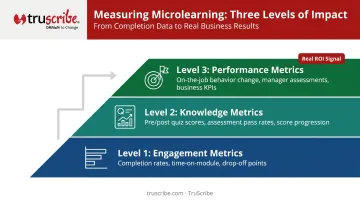
The real ROI signal is at Level 3. Did the training change what people do at work? Without tracking performance-level outcomes, you cannot answer that question.
Practical optimization using LMS data:
Identify which module in a sequence shows the steepest drop in knowledge scores or the highest exit rate. That module is your redesign priority.
xAPI-enabled LMS platforms track granular learner activity — specific questions failed, moments where learners exit, time spent per screen — giving L&D teams the data to pinpoint where reinforcement is needed rather than guessing.
One useful diagnostic: if quiz scores on Module 4 drop significantly compared to Module 3, the issue is likely either a spike in content complexity, a gap in the spaced repetition schedule, or a format mismatch. Diagnosing which cause is at play determines whether you rewrite the content, adjust the delivery schedule, or change the module format — and gets you to a solution faster than rebuilding from scratch.
Frequently Asked Questions
What is the microlearning approach?
Microlearning is a training methodology that delivers content in short, targeted modules — typically 2–10 minutes — focused on a single learning objective. It's designed to fit naturally into the flow of work, reduce cognitive overload, and support retention through repeated, spaced exposure rather than one-and-done training events.
What are the techniques of microlearning?
Core techniques include spaced repetition, scenario-based practice, visual-first formats, learning-in-the-flow-of-work delivery, and gamification elements like badges and progress milestones. Adaptive sequencing — adjusting what a learner sees next based on their assessment performance — is an advanced technique used in more mature microlearning programs.
Does microlearning actually work?
Yes, when properly designed. Spaced repetition, active recall, and reduced cognitive load are well-supported by learning science. Short content alone doesn't produce results — the strategy behind sequencing, delivery timing, and practice integration is what drives retention and behavior change.
What are some examples of successful microlearning?
Common use cases include:
- Onboarding new hires with role-specific 3-minute video modules
- Compliance refreshers delivered via weekly interactive quizzes
- Product knowledge updates for sales teams via short animated explainers
- Soft skills development through branching scenario simulations
How long should a microlearning module be?
ATD practitioners rate 2–5 minutes as most effective, with up to 10 minutes considered acceptable. Duration matters less than objective focus — each module should cover one concept completely rather than optimizing purely for clock time.
How do you measure the effectiveness of microlearning?
Track three levels: engagement (completion rates, drop-off points), knowledge transfer (pre/post assessment scores), and on-the-job performance change (behavior observations, business KPIs). Completion rates alone tell you people finished — not whether anything actually changed.