Yet adoption doesn't equal effectiveness. Most organizations produce videos without a repeatable process behind them. They skip the preparation phase, choose formats by trend rather than function, and publish without a measurement plan. The result: content that gets made but doesn't perform.
This article covers what video marketing actually is, why the cognitive science behind it matters, how to prepare before production begins, and a practical 10-step process to build campaigns that consistently deliver results.
Key Takeaways
- Video marketing is the strategic use of video to achieve specific, measurable business goals — not just content creation
- The neuroscience of multimedia learning makes video uniquely effective for comprehension and retention
- Preparation — knowing your goals, audience, and journey stage — determines whether a video performs or sits unwatched
- A clear 10-step process removes guesswork and creates scalable, repeatable results
- B2B video, especially for complex topics, must simplify and clarify — not just entertain
What Is Video Marketing?
Video marketing is the planned use of video content to educate, engage, and convert a target audience in service of specific business objectives. That distinction — planned and purposeful — is what separates a video marketing strategy from random content production.
For B2B organizations, the scope extends well beyond social media clips or branded ads. Video marketing includes:
- Explainer videos that break down complex products or services into clear, digestible narratives
- Product demos that move prospects from interest to decision
- Training and onboarding content that accelerates employee readiness
- Internal communications for change management and strategic alignment
- Post-sale customer education that reduces support burden
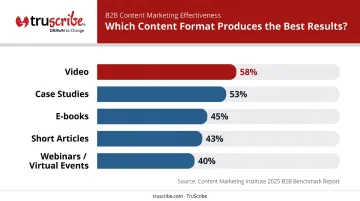
Video is one piece of a broader content marketing strategy, yet it consistently outperforms other formats on engagement. The Content Marketing Institute's 2025 B2B benchmark report found that 58% of B2B marketers said video produced their best organizational results — ahead of case studies (53%), e-books (45%), and short articles (43%). The gap makes sense: video combines visual and auditory input simultaneously, which research on dual-channel processing consistently ties to stronger comprehension and recall.
Why Video Marketing Delivers Results
The Cognitive Case for Video
Video's persuasive power is grounded in brain science, not intuition. Richard Mayer's Cognitive Theory of Multimedia Learning proposes that humans process information through separate visual and auditory channels, with limited working memory capacity. Across 11 of 11 transfer-test comparisons, learners receiving words plus pictures outperformed words-only groups, with a median effect size of 1.50. Well-coordinated narration and visuals don't just add variety — they improve how information is encoded.
This is why video works for complex B2B topics: it activates multiple processing channels simultaneously, builds mental models faster, and leaves content more retrievable later.
Three Business Benefits That Matter
1. More time with your content Wistia's analysis of its 100 highest-traffic pages found visitors averaged 6 minutes on pages with video versus 4.3 minutes without — roughly 40% longer. More time spent means more message absorbed.
2. Higher engagement from B2B buyers LinkedIn research of 1,700 US and UK B2B technology buyers found 63% said short-form social video helps inform buying decisions. Video isn't just a consumer medium — it directly influences how business buyers evaluate options.
3. Faster comprehension of complex topics For B2B organizations communicating technical, regulatory, or abstract concepts, video's combination of visuals and narration reduces the cognitive effort required to understand new information — which matters enormously when your audience is time-pressed and expertise-conscious.
How TruScribe's Scribology Method Applies These Principles
TruScribe's Scribology method was built around exactly these cognitive principles. Sequential hand-drawn visuals guide viewer attention with precision — because the brain naturally follows motion and emerging images. Each element is revealed deliberately, building mental models step by step rather than overwhelming viewers with a fully-rendered scene.
Across TruScribe's 5,000+ delivered projects, that approach produces 2.3x higher retention than traditional video formats and an average 35% increase in conversion rates. For B2B topics like compliance training, product education, and change management — where comprehension and recall directly affect outcomes — that's an operationally significant edge.
Before You Hit Record: How to Prepare Your Video Marketing Strategy
Most organizations skip the preparation phase. They move straight from "we need a video" to "let's start production," and that gap is where campaigns fall apart. Costly reshoots, misaligned messaging, and videos that no one watches trace back to decisions that weren't made before filming began.
Preparation is what separates a video project from a video strategy.
The Three Preparation Fundamentals
Before a single frame is filmed or animated, every team must resolve:
- A clear business objective tied to a measurable outcome — not "increase brand awareness" but "increase demo request form completions by 20% in Q3"
- A defined audience with specific pain points — who is watching, what do they already know, what keeps them from taking the next step
- The journey stage this video addresses — awareness, consideration, or decision-stage content require entirely different approaches
The Internal Stakeholder Challenge
For B2B teams, preparation also means organizational alignment — and this step is frequently underestimated. Before production begins:
- Get leadership buy-in on both the message and the investment
- Align legal and compliance review timelines — especially in regulated industries like healthcare, financial services, and technology
- Confirm distribution channels — where the video will live determines format, length, and caption requirements from day one
TruScribe's pre-production process starts with a free video strategy review covering goal definition, audience mapping, and journey-stage alignment before any script is written. Resolving those questions early prevents costly mid-production revisions.
10 Steps to Video Marketing Success
Step 1: Define Your Goals and Objectives
Every video must begin with a single, measurable goal. Awareness, lead generation, conversion, onboarding, or retention — pick one. A video trying to achieve all of these dilutes every single one.
Write your goal as a KPI-tied statement: "This video will increase completion rates for our new hire compliance training module from 60% to 85% within 90 days of launch." That specificity guides every downstream decision.
Step 2: Know Your Target Audience
Build an audience profile before scripting begins:
- Who's watching: an end user, a decision-maker, or both?
- What specific problem does this video solve for them?
- Viewing context: desktop during work hours, or mobile between meetings?
- What do they already know, and where does the explanation need to start?
B2B audiences are different from B2C viewers. They bring domain expertise, limited time, and a low tolerance for content that wastes either. Respect that in every format and length decision.
Step 3: Map the Video to the Buyer's or Employee Journey
Different video types serve different journey stages:
| Journey Stage | Video Goal | Example |
|---|---|---|
| Awareness | Educate broadly | 90-second explainer on a market problem |
| Consideration | Differentiate and demonstrate | Product demo showing your solution's key advantages |
| Decision / Action | Build confidence and direct next step | Customer testimonial with a clear CTA |
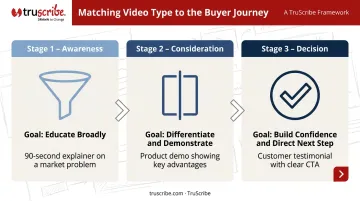
The same logic applies to the employee journey: pre-boarding orientation videos, mid-program training modules, and change management communications each serve a different moment and require a different approach.
Step 4: Set Your Budget and Identify Resources
Budget directly affects format, production quality, and distribution reach. The better question isn't "how much does a video cost?" — it's "what is my cost per outcome?"
For the build-vs-buy decision:
- In-house production works for high-volume, lower-stakes content like internal updates or social clips
- Professional video partners are worth the investment for high-stakes content — product launches, compliance training, executive communications — where message clarity and production quality directly affect results
TruScribe's Bulk Minutes Packages, for example, allow enterprise teams to spread production investment across departments — HR, sales, marketing, and L&D — while accessing a per-minute rate as low as $1,625 at the 60-minute tier. For organizations with ongoing content needs across multiple departments, that per-minute rate can cut per-video costs substantially compared to one-off production pricing.
Step 5: Choose the Right Video Format for Your Goal
Format should follow function, not trend. The most effective B2B video formats by use case:
- Whiteboard animation for complex explanations, compliance training, and product education where cognitive clarity is the priority
- Live-action for culture content, executive communications, and testimonials where human presence matters
- Screen recordings when showing the actual interface is the point — software demos and technical walkthroughs
- Motion graphics for data storytelling and visual reports where numbers need context to land
The format-audience mismatch is one of the most common production mistakes: using a fast-cut consumer social format for a dense compliance topic undermines both comprehension and credibility.
Step 6: Write a Script That Tells a Story
The script is the most important asset in your production. Everything downstream — visuals, voiceover, pacing, and final edit — flows from it.
A strong B2B video script follows this structure:
- Hook (first 5–10 seconds): a specific problem, a surprising fact, or a direct question that earns the next 30 seconds of attention
- Problem statement: name the pain point clearly and specifically
- Solution or insight: explain how and why, not just what
- Call to action: one clear next step, not three options
At TruScribe, script development is the first production phase — nothing moves to illustration until the message is locked. Their team offers scripting from scratch, editorial refinement, or production from client-supplied drafts, depending on where the client starts.
Step 7: Plan Production Logistics
Underestimating pre-production is one of the most reliable causes of budget overruns and missed deadlines. Before production begins, confirm:
- Voiceover talent (in-house or sourced) and recording timeline
- Visual style and brand guidelines
- Number of review and approval rounds and who holds final sign-off authority
- Realistic delivery timeline that accounts for stakeholder availability
TruScribe delivers single whiteboard explainer videos within 20 working days of kickoff, even for technically complex topics — a timeline that reflects the efficiency of a structured, sequential production workflow.
Step 8: Optimize for Each Distribution Channel
One video rarely performs equally across all channels without adaptation. Key considerations by platform:
- Website/landing page: keep load time under 2 seconds; embed rather than autoplay for better user experience
- LinkedIn: supports horizontal (16:9), square (1:1), and vertical formats; captions are supported and recommended since many users watch without sound
- Email: most email clients don't support inline video playback reliably; use a linked thumbnail that opens a hosted video page
- Internal LMS: use your LMS for curriculum structure and assessments; embed videos from a business video host that provides transcripts, captions, and viewing analytics
Captions are not optional. WCAG 2.2 requires captions for prerecorded audio in synchronized media, and they also improve comprehension for viewers watching in noisy or sound-off environments.
Step 9: Launch and Promote Your Video
Distribution effort should be proportional to production investment. "Post and hope" is not a distribution strategy. A complete launch plan includes:
- Embed on relevant landing pages and product pages
- Include in email campaigns with a thumbnail that drives click-through
- Share through sales sequences at the relevant conversation stage
- Repurpose clips for LinkedIn and other social channels
- Brief sales, support, and customer success teams so they can use it in context
Step 10: Measure Results and Iterate
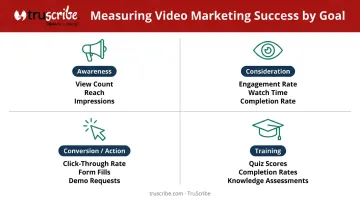
Tie your metrics to your original goal:
| Goal | Primary Metrics |
|---|---|
| Awareness | View count, reach, impressions |
| Consideration | Engagement rate, watch time, completion rate |
| Conversion / Action | Click-through rate, form fills, demo requests |
| Training | Quiz scores, completion rates, knowledge assessments |
Wistia reports approximately 16% average CTA conversion across more than 36,000 CTAs — a useful benchmark for gauging whether your video is performing against industry norms. More importantly, data from each video should directly inform the next one: what length drove the highest completion? Where did viewers drop off? What CTA generated the most clicks?
Common Video Marketing Mistakes and How to Avoid Them
Three mistakes account for the majority of underperforming B2B video campaigns:
1. No defined goal or audience before production begins The result is content that doesn't connect with anyone specifically — because it wasn't built for anyone specifically. Define both before scripting starts.
2. Overloading a single video with too many messages One video, one idea. Every additional message you add competes with your primary message and reduces the chance that any of them land.
3. Investing in production but skipping distribution A well-produced video with no promotion plan is an expensive file sitting on a server. Distribution should be budgeted and planned before production wraps.
Beyond these three, one structural assumption consistently undercuts otherwise solid campaigns.
The Length Misconception
Longer videos don't signal more value — they signal less respect for the viewer's time.
Vidyard's analysis of 943,305 business videos found 65% of viewers completed videos under one minute, compared to just 20% for videos over 20 minutes. That's not a mandate to keep everything under a minute. Demos and training content genuinely need more time. It is, however, a reason to cut every second that doesn't earn its place.
For most B2B contexts, keep it tight:
- Explainers and marketing videos: under 2–3 minutes
- Social clips: under 90 seconds
- Training and demos: as long as the content genuinely requires
Frequently Asked Questions
What is video marketing?
Video marketing is the strategic use of video content to achieve specific business goals — from awareness and lead generation to employee training and customer retention. Unlike casual video creation, every production decision connects back to a measurable objective.
How much should a 3-minute video cost?
Cost varies widely based on format, animation style, and vendor. Wyzowl's pricing study found quotes for a 60-second animated explainer ranging from $600 to $250,000 — a 3-minute video at professional quality will typically run higher. Evaluate cost against the expected business outcome, not the sticker price alone.
What types of videos work best for B2B marketing?
Explainer videos, product demos, customer testimonials, and training or onboarding videos consistently perform well in B2B contexts. The best format depends on where the audience sits in their journey — short explainers for early awareness, demos and case studies closer to the decision.
How do you measure the success of a video marketing campaign?
Tie metrics to your original goal: awareness = reach and impressions; engagement = watch time and completion rate; conversion = click-through and form fills; training = quiz scores and completion rates. Each video type needs its own success benchmark.
How long should a marketing video be?
B2B explainers and marketing videos generally run under 2–3 minutes; social clips under 90 seconds. The right length depends on message complexity and where the viewer sits in the funnel — there's no single rule that applies to every format.
What is the first step in building a video marketing strategy?
Define a clear, measurable business objective — before scripting, budgeting, or format decisions. Every other decision in the process flows from knowing exactly what the video is supposed to accomplish.