Introduction
Picture this: your L&D team spends months developing a compliance training video. It launches globally. Employees in Germany, Brazil, and Japan complete it — but post-training assessments reveal poor retention, and regional managers report that the content felt "off." The language was technically translated, but the cultural framing, examples, and tone never landed.
That's the cost of skipping genuine localization.
According to CSA Research's survey of 8,709 consumers across 29 countries, 76% of people prefer product and service information in their own language, and 40% won't purchase from websites in another language.
The same principle applies inside the organization. Training, onboarding, and compliance materials that employees can't fully absorb become a liability — one that shows up in assessment scores, audit findings, and manager escalations.
What follows covers what localization actually involves, how it differs from translation, which content types to prioritize, and how to build a strategy that holds up across markets.
Key Takeaways
- Localization adapts the full content experience — not just words, but tone, imagery, formatting, and cultural context
- 76% of global consumers prefer content in their own language; B2B buyers are no different
- Training and compliance content carry the highest risk when localization is skipped
- Whiteboard and animated videos localize faster and cheaper than live-action formats
- An effective localization strategy starts with a content audit and ends with market-specific performance metrics
What Is Content Localization?
Content localization is the process of adapting content to fit the language, culture, and behavioral expectations of a specific target market. That includes far more than translated text — it also covers imagery, tone, formatting conventions (dates, currencies, units of measure), idiomatic expressions, color symbolism, reading direction, and cultural references.
The ISO definition is precise on this point: localization covers translation of textual material plus adaptation of non-textual material for the target locale. Those two things together constitute localization. Translation alone is just one part.
Localization vs. Translation: Where the Line Falls
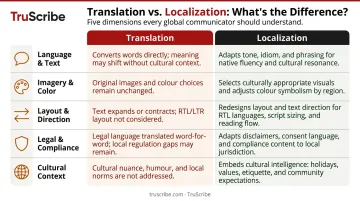
Translation converts words from one language to another. Localization makes the entire content experience feel native.
A simple example: Pepsi's "Come Alive with the Pepsi Generation" slogan was reportedly translated into Chinese in ways that read more like "Pepsi brings your ancestors back from the dead." The words translated. The meaning didn't.
Localization fixes that by addressing everything translation misses:
- Imagery and color choices carry different meanings across cultures — red signals danger in some markets and prosperity in others.
- Arabic and Hebrew read right-to-left, which requires full interface redesigns, not just text swaps.
- Disclaimers valid in the US may be inadequate or actively misleading under EU or UK law.
- What's funny in one culture is often baffling — or offensive — in another.
- Dates, phone numbers, addresses, and currency formats all vary by region and must match local expectations.
Not every market demands the same level of effort. Some need only light-touch adaptation — adjusted formats and translated text. Others require a full redesign at every touchpoint, from visuals to legal copy to interface layout. The gap between those two scenarios is why market assessment has to come before content production, not after.
Why Content Localization Matters for Global Growth
The trust argument is direct: audiences who encounter content that feels native to their culture engage more, trust the source more, and act more often. Forrester research found that nearly two-thirds of B2B buyers wanted websites and marketing material in their own language — making localization a B2B growth driver, not just a consumer-facing nicety.
The SEO Dimension
Localized web content ranks for keywords in the target language, opening organic traffic that English-only content will never reach. Ahrefs' 2024 analysis found that non-English searches drove 67% of Wise's, 62% of Canva's, and 52% of Amazon's organic traffic — all organizations with mature multilingual content strategies.
The technical elements that compound those gains over time include:
- Localized metadata optimized for each target language
- Hreflang tags that signal language and regional targeting to search engines
- Country-specific URL structures (subdomains or subdirectories)
- Copy aligned with local search behavior and keyword intent
The Competitive Edge
Those SEO gains also signal a broader strategic window. Many B2B organizations — particularly in internal communications — are still producing English-first content and hoping it travels. Companies that build localization infrastructure early gain ground in new markets while competitors scramble to adapt.
The cost of getting it wrong is concrete. Dolce & Gabbana's 2018 campaign in China — criticized for cultural insensitivity rather than poor translation — triggered removal from Tmall and JD.com, and Reuters later reported a decline in the brand's Asia-Pacific revenue share. A technically accurate translation that misreads cultural context can do as much damage as no localization at all.
Types of Content That Benefit Most from Localization
Not all content carries equal localization risk. These categories should be at the top of any prioritization list.
Marketing and Campaign Content
Website copy, landing pages, email campaigns, social media posts, and paid ads all need cultural and linguistic adaptation. The challenge isn't just accuracy — it's maintaining brand voice while making that voice feel locally authentic. A tone that reads as confident in the US can read as arrogant in Japan, or overly casual in Germany.
Legal and Compliance Content
Contracts, terms of service, data privacy notices, and regulatory documentation require more than translation — they require legal accuracy specific to each region's laws. OSHA's standards require training to be delivered in a manner employees can understand; UK HSE guidance sets the same expectation for migrant workers. Generalist translators are rarely equipped for this. Subject-matter experts with legal knowledge of the target market are necessary.
Training and Employee Communications
Onboarding materials, compliance training, change management content, and HR communications are high-stakes localization priorities for any multinational organization. Employees absorb and retain information better when it's delivered in their native language and cultural context. ATD's 2024 survey of 311 talent development professionals found that more than 80% believed localization improved employee satisfaction and information retention.
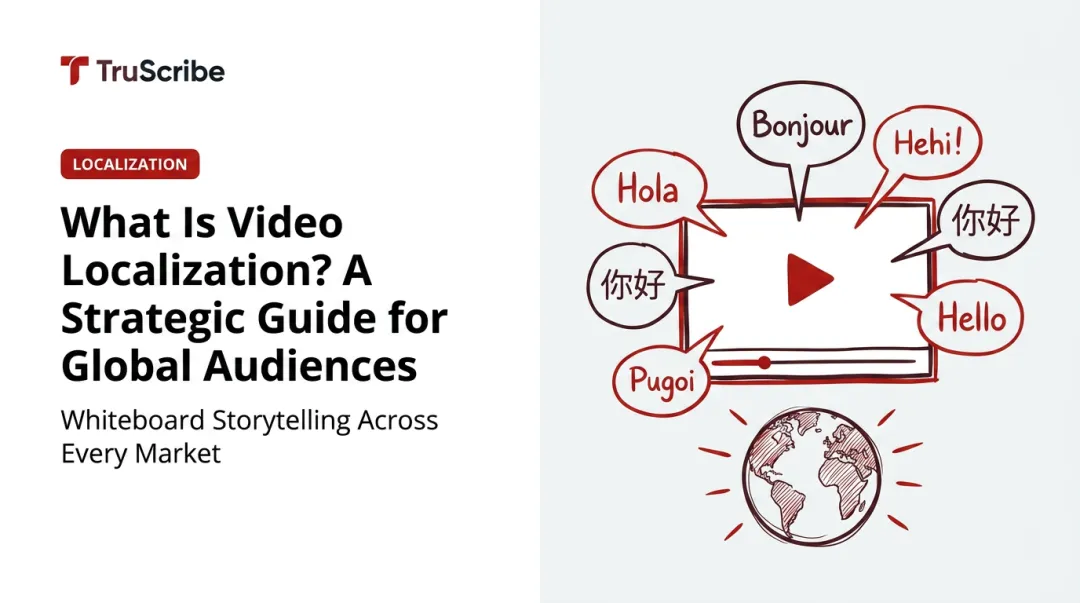
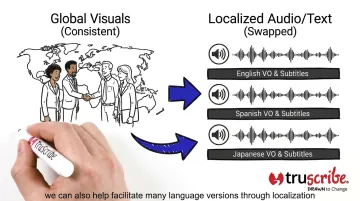
That retention advantage makes video format a critical decision in training localization. Animated and whiteboard-style explainer videos — the kind TruScribe produces for global organizations like Siemens, Medtronic, and Danfoss — are structurally easier to localize than live-action productions. Because the visual and audio layers are separate, voiceover can be re-recorded in a new language without rebuilding the illustration. You can add subtitles or closed captions as a discrete layer.
The visuals themselves — hand-drawn and minimalist by nature — tend to communicate across cultural boundaries more cleanly than photographic content.
Technical Documentation and UI/UX Content
Product manuals and support documentation require specialists with both linguistic and technical fluency. App interfaces, navigation labels, tooltips, and error messages need adaptation not just in language but in layout — including text expansion (German text, for instance, runs roughly 30% longer than English equivalents) and cultural expectations around call-to-action placement.
How to Build a Content Localization Strategy
Step 1 — Define Target Markets and Assess Localization Depth
Identify which markets you're entering or growing in. Then categorize each by the degree of localization required:
- Low — Audiences tolerate non-native content; light translation and formatting adjustments suffice
- Medium — Some cultural adaptation expected; tone and imagery need review
- High — Fully native experience essential; deep adaptation across every touchpoint
This prevents over-investing in markets that don't need it and under-investing in ones that do.
Step 2 — Audit Content and Prioritize Assets
Inventory existing content, then rank by business impact and audience sensitivity. Sequence using an effort-vs.-impact matrix:
- High-traffic conversion pages
- Onboarding and training materials
- Compliance and legal documentation
- Marketing campaigns in priority markets
- Secondary digital content and support resources
Step 3 — Assemble Your Team and Establish Governance
Identify owners across marketing, legal, L&D, HR, and product, then assign a central localization manager. For video content at scale, also factor in:
- Voiceover talent for each target language
- Subtitling specialists who understand timing and readability
- Cultural reviewers — a distinct role from translators, and equally critical
Step 4 — Build Your Style Guide and Localization Kit
Document brand voice guidelines, approved terminology glossaries, grammar conventions, and cultural do's and don'ts for each target market.
This becomes the single source of truth for everyone working across markets: translators, designers, content creators, and reviewers. Without it, consistency breaks down as the team scales.
Step 5 — Select Tools and Define Your Workflow
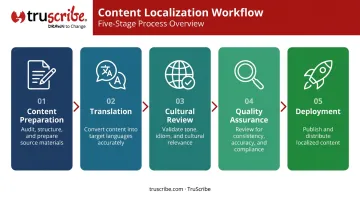
Decide how translation will be managed: in-house, agency, AI-assisted, or hybrid. Establish a clear workflow:
Content preparation → Translation → Cultural review → QA → Deployment
Build iterative updates into the workflow from the start — content evolves, and a localization process that can't keep pace will stall your entire publishing cycle.
Step 6 — Launch, Monitor, and Iterate
Roll out localized content in phased waves, starting with the highest-priority markets and content types. Set market-specific baselines before launch so you can measure actual impact:
- Traffic and search visibility by market
- Engagement rates and time-on-page
- Conversion performance against source-language benchmarks
- Support ticket volume (a drop signals better comprehension)
Teams that track these metrics early can course-correct before small gaps become costly rework. Build localization into your content operations calendar — not just your launch plan.
How to Measure the Success of Your Localization Efforts
Measurement should be market-specific, not global averages. Track these indicators:
Engagement and conversion metrics:
- Time-on-page and bounce rates in target markets vs. pre-localization baselines
- Video completion rates for localized training content
- Conversion rates (sign-ups, purchases, form completions) by language/region
SEO and organic traffic:
- Rankings for target-language keywords
- Organic traffic volume from each localized market over time
- Multilingual SEO gains compound over months, not weeks — set realistic timelines accordingly
Operational indicators:
- Decrease in support tickets or customer complaints post-localization
- Reduction in employee misunderstandings following localized training rollouts
- Faster localization turnaround and fewer revision cycles over time — a maturing process signal
Training content warrants its own measurement layer. Knowledge retention scores and assessment pass rates — compared before and after localization — directly show whether employees understand what you're communicating, not just whether they watched it.
Frequently Asked Questions
What is an example of content localization?
A global company adapts its employee onboarding video for Brazil by re-recording narration in Portuguese, replacing US-specific examples with locally relevant scenarios, updating date and currency formats, and swapping out imagery that carries different cultural connotations in Brazilian workplaces.
What are the four levels of translation?
The four levels are word-for-word (literal), meaning-for-meaning (semantic), idiomatic (natural phrasing), and dynamic/cultural equivalence. Most professional localization operates at the idiomatic or dynamic level to ensure content resonates naturally rather than just technically reading correctly.
What is the difference between content localization and translation?
Translation converts text from one language to another. Localization adapts the full content experience — cultural references, imagery, tone, formatting, legal compliance, and layout — so the content feels native to the target market, not just linguistically accurate.
What types of content should be prioritized for localization first?
Prioritize conversion-critical web pages, onboarding and compliance training, and key marketing campaigns — particularly in markets where cultural misalignment carries high cost, such as regulated industries or markets where your competitors are already localized.
How do you measure whether a content localization strategy is working?
Track engagement rates, conversion rates, organic search traffic by language and region, support ticket volume, and — for training content — employee knowledge retention and assessment scores compared to pre-localization baselines.
Is video content harder to localize than written content?
Video requires more coordination, not more difficulty. Animated and whiteboard-style videos — where visuals and audio are already separate — adapt cleanly through voiceover replacement or subtitle overlays. Building in separable audio at production time is itself a strategic localization decision.