According to the AFI, a screenplay is a uniquely formatted document that functions as a film's blueprint—and that word formatted carries more weight than most beginners realize. Script readers, development executives, and producers use formatting as an immediate professionalism signal. A wrong font or incorrect margins tells them the writer hasn't done their homework.
This guide covers the five essential elements of a screenplay, a step-by-step writing process, the story structure frameworks working professionals use, and the most common mistakes to avoid—so you can write your first (or next) script with confidence.
Key Takeaways
- Feature-length screenplays typically run 90–120 pages, with one page equaling roughly one minute of screen time
- Every professional script contains five core elements: scene headings, action lines, character introductions, dialogue, and transitions
- Three-act structure is a professional roadmap; industry readers evaluate every script against it by default
- Poor formatting and unfilmable descriptions are among the most common reasons scripts get rejected, regardless of idea quality
- Outlining before writing is the single habit that separates amateur scripts from professional ones
What Is a Movie Script and Why Formatting Matters
A screenplay describes only what can be seen or heard on screen—character actions, spoken dialogue, and scene locations—written in a standardized format so directors, producers, actors, and crew all interpret it the same way. Unlike prose, a screenplay never enters a character's internal world unless that inner life is externalized through action or dialogue.
Formatting exists for one practical reason: standardization enables the one-page-per-minute convention. The Academy's formatting specifications define exactly how every script should look:
- Font: 12-point, 10-pitch Courier
- Left margin: 1.5 inches
- Right and top margins: 1 inch each
These specs exist so production teams can estimate screen time directly from page count.
When a script arrives in the wrong font or with irregular spacing, readers notice immediately. The Academy explicitly flags non-Courier type, unusual spacing, excessive bold text, and long descriptive passages as signals of an unprepared writer. A script that breaks these rules tells a reader the writer hasn't done the homework—before they've read a single scene.
The 5 Essential Elements of a Movie Script
Scene Headings (Slug Lines)
Every scene opens with a scene heading in ALL CAPS, containing three parts:
- INT. or EXT. — interior or exterior location
- The specific location — "DETECTIVE'S OFFICE," not just "OFFICE"
- Time of day — DAY or NIGHT (indicating lighting conditions for the crew, not the literal clock)
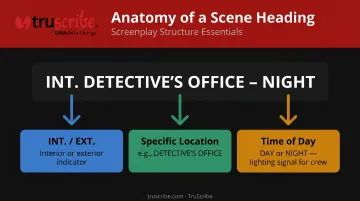
Example: INT. DETECTIVE'S OFFICE – NIGHT
A scene set in 1920 during daytime is still labeled DAY. The time indicator tells the crew how to light the set, nothing more.
Action Lines
Action lines describe everything the audience can see or hear—movements, environmental details, sound effects, visual events. Key rules:
- Write in present tense, third person: "She crosses the room," not "She crossed the room"
- Keep paragraphs to 3–5 lines maximum to maintain pacing
- Important sounds or objects can appear in ALL CAPS for emphasis
- Never write "we see" or "we hear"—these constructions pull the reader out of the story
Character Introductions and Dialogue
The first time a character appears, write their name in ALL CAPS, followed by their age and a brief description:
MARCUS COLE (40s), former detective, the kind of man who irons his shirts but forgets to sleep.
After that first introduction, the character name appears normally in action lines—but always in ALL CAPS above their dialogue block.
Dialogue formatting:
- Character name: centered, ALL CAPS
- Parentheticals: brief acting directions below the name, used sparingly
- Extensions: (O.S.) for off-screen dialogue, (V.O.) for voice-over narration
Transitions
Transitions signal how scenes connect. Use them sparingly—overuse marks a writer as inexperienced.
| Transition | When to Use |
|---|---|
| FADE IN: | Opening of the script only (left-justified) |
| FADE OUT. | End of the script (right-justified) |
| CUT TO: | Intentional emphasis between scenes |
| DISSOLVE TO: | Suggests passage of time (increasingly rare) |
In modern spec scripts, scene headings imply the cut—reserving CUT TO: for moments that demand editorial emphasis, not routine scene changes.
Title Page
With transitions handled, the only remaining formatting requirement sits outside the script itself: the title page. A professional title page contains:
- Script title (centered)
- "Written by" followed by the author's name
- "Based on" credit, if applicable
- Contact email in the bottom-left corner
One page, plain and clean. No images, no decorative fonts, no color.
How to Write a Movie Script: Step-by-Step
Step 1: Develop Your Premise and Outline First
Before opening any software, professional screenwriters start with a clear premise—one or two sentences answering:
- Who is the protagonist?
- What do they want?
- What is the central conflict?
- What is at stake?
A weak premise won't sustain 90+ pages, no matter how well-written the individual scenes are.
After locking the premise, outline before you write. This is the step most beginners skip and most professionals never skip. A solid outline maps:
- The inciting incident
- Major plot turns
- The midpoint shift
- The "all is lost" moment
- Climax and resolution
Without this roadmap, scripts almost always start strong and collapse in the second act. Outlining lets you solve structural problems before they're written into dozens of pages you'll have to cut.
Step 2: Set Up Industry-Standard Formatting
Non-negotiable formatting specifications:
- Font: 12-point, 10-pitch Courier (not Times New Roman, not Arial)
- Left margin: 1.5 inches
- Right, top margins: 1 inch each
- Page numbers: Upper right, starting on page 2
- Opening: FADE IN: (left-justified)
Use dedicated screenwriting software—Final Draft, Celtx, WriterDuet, or Fade In. These tools auto-format scene headings, dialogue blocks, and transitions correctly. A standard word processor requires manual formatting that rarely matches industry spec and creates avoidable errors.
Your title page is separate from page one of the script itself. The first scene should establish world, tone, and central character quickly—readers and producers form their first impression within the opening five pages.
Step 3: Write Scene by Scene
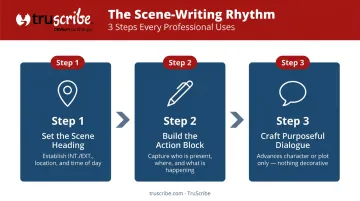
The writing rhythm professionals use:
- Set the scene heading: establish location and time of day
- Build a tight action block: who is present, where we are, what is happening
- Craft dialogue that advances character or plot — nothing more
Every scene needs a clear purpose: introduce information, escalate conflict, or reveal character. A scene should end differently than it began—someone wants something, encounters an obstacle, and either succeeds or fails. If a scene doesn't change anything, it can usually be cut.
Show, don't tell. Nothing can exist only in a character's mind. If it can't be seen or heard on screen, it doesn't belong in a screenplay. Dialogue should always do double duty: advance plot and reveal character simultaneously.
Step 4: Revise and Tighten
The first draft is never finished. Professional screenwriters expect multiple revision passes. Watch for:
- Scenes that don't serve the central conflict — cut them
- On-the-nose dialogue — characters saying exactly what they mean, with no subtext
- Unfilmable action lines — describing psychology or internal states rather than observable action
- Second-act pacing issues — where momentum stalls and scenes start repeating the same conflict beat
Once the script is polished, you can register it with the WGA Registry to establish a dated authorship record, or file with the U.S. Copyright Office, where electronic filing costs $45 for a single eligible work. Registration doesn't replace copyright but creates a useful paper trail before submission.
Story Structure Every Professional Screenwriter Uses
The Three-Act Framework
Three-act structure is the default evaluation framework for script readers and studio executives. It divides a feature screenplay into three sections:
- Act One (pages 1–25): Establish the protagonist, their world, and the central conflict. Ends with an inciting incident that forces the character into the story's main problem.
- Act Two (pages 25–85): The protagonist pursues their goal against escalating obstacles. A midpoint shifts the story's direction. An "all is lost" moment brings them to their lowest point.
- Act Three (pages 85–110+): The protagonist faces the central conflict directly. The climax occurs. The story resolves.
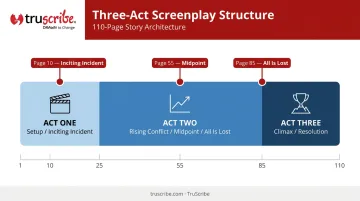
These page ranges, based on Syd Field's paradigm, are planning targets—not rigid laws. But understanding them gives you a structural language that every professional in the industry speaks.
Other Structural Frameworks
Other widely used frameworks include:
- Save the Cat (Blake Snyder, 2005): A 15-beat sheet mapping the story across 110 pages, with specific named beats from Opening Image to Final Image
- The Hero's Journey (Joseph Campbell): A monomyth commonly adapted by Christopher Vogler into a 12-step model covering Departure, Initiation, and Return
- Dan Harmon's Story Circle: A simplified 8-step loop built on the same underlying logic
All of these are variations of one principle: a character with a want faces obstacles that force internal change. Study the framework that resonates with you—understanding one deeply is more valuable than dabbling in all of them.
Why Character Arc Is the Real Backbone
External conflict drives plot. Internal conflict drives story. The protagonist should be a fundamentally different person—or have made an irreversible choice—by the end of the script compared to who they were at the beginning.
Weak character arcs are a primary reason otherwise well-formatted, structurally sound scripts fail to sell. A script can have a clever premise and clean formatting — but if readers don't feel the protagonist has changed, they'll pass.
Common Mistakes New Screenwriters Make
Directing on the Page
Including camera angles throughout a script—CLOSE UP ON, LOW ANGLE, RACK FOCUS—signals inexperience and frustrates directors, who consider shot selection their creative territory. As David Trottier notes, visual intent can almost always be conveyed through well-chosen action and reveals. Reserve camera directions for moments where the intended image genuinely cannot be communicated any other way.
Writing Unfilmable Descriptions
Action lines must describe what is visible or audible. These don't pass the test:
- "She thinks about her dead father."
- "He knows something is wrong but doesn't show it."
Neither can be filmed. Ask yourself: how would an audience see or hear this? If the answer is "they can't," rewrite it into observable action or dialogue.
Skipping the Outline
Writing without an outline reliably produces the same result: a strong first act, a meandering second act, and a rushed or incoherent third act.
First drafts written this way typically require near-complete structural rewrites—meaning the time "saved" by skipping the outline gets paid back with interest. An outline doesn't constrain creativity; it frees you to focus on scene-level craft once the draft actually begins.
Frequently Asked Questions
What are the 5 basic elements of a screenplay?
The five core elements are scene headings (slug lines), action lines, character introductions, dialogue, and transitions. Mastering the formatting conventions for each element makes a script readable and industry-ready.
What is the rule of three in screenwriting?
The rule of three is a storytelling principle where ideas or events presented in groups of three feel more complete and satisfying. Common applications include setups requiring three attempts before success, the three-act structure, and recurring motifs that pay off on the third occurrence.
What is The Black List for scripts?
The Black List, founded in 2005, is an annual survey of Hollywood film development executives listing their favorite unproduced screenplays of that year. Appearing on the list signals strong industry interest and has led to major productions—listed films include Argo, Spotlight, and The King's Speech.
How long should a movie script be?
Most feature-length screenplays fall between 90 and 120 pages, with Final Draft's 2025 guidance suggesting 90–110 pages as the current industry target. Standard formatting makes one page equal approximately one minute of screen time.
What is the difference between a spec script and a shooting script?
A spec script is written speculatively—without a commission—to showcase the writer's voice and sell on the open market. A shooting script is a production-ready version with numbered scenes and technical details added by the director and production team after the project is greenlit.
Do I need screenwriting software to write a movie script?
Technically you can format a screenplay manually, but dedicated software like Final Draft, Celtx, WriterDuet, or Fade In auto-formats scene headings, dialogue blocks, and transitions to industry standard. That saves significant time and eliminates the formatting errors that make a script look unprofessional before anyone reads a single line.