Now picture a different leader — same room, same audience — who opens with a single story about a product launch that nearly collapsed and what it taught them about trust. That story gets repeated in the hallway, at lunch, and in team meetings for the next year.
The difference isn't charisma. It's structure.
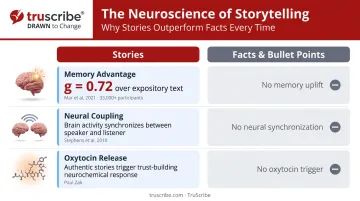
Research using narrative versus expository text found a meaningful memory advantage for narrative (g = 0.72) over plain information delivery — and yet most leaders still default to bullet points and data reports when they need people to actually move.
This guide covers what leadership storytelling actually is, the brain science behind why it works, a practical framework you can use immediately, and the mistakes that undermine even well-intentioned stories.
Key Takeaways
- Leadership storytelling is the strategic sequencing of facts and emotions — not simply recounting events
- Stories engage sensory, motor, and emotional brain regions simultaneously; bullet points don't
- The core formula: Context + Characters + Conflict + Moral
- Authenticity outperforms polish — vulnerability builds credibility faster than perfection
- Scalable visual formats extend a leader's story to distributed teams — no live delivery required
What Is Leadership Storytelling?
Leadership storytelling isn't the same as telling anecdotes or recapping what happened in a meeting. It's the deliberate, strategic use of narrative to communicate vision, build trust, motivate teams, and drive action.
Esther Choy, founder of the Leadership Story Lab, defines it precisely: leadership storytelling is "the strategic sequencing of facts and emotions." The emphasis is on sequencing. The goal is choosing which facts and feelings to present, in what order, to move a specific audience toward a specific outcome.
That distinction matters. A leader who simply reports events is informing. One who strategically sequences those events, controlling what the audience feels and when, is storytelling.
What Leadership Storytelling Actually Does
Across leadership contexts, storytelling serves a surprisingly wide range of functions:
- Communicating organizational vision — making abstract direction feel real and urgent
- Leading through change — giving employees a cognitive map for transitions they didn't choose
- Building trust and psychological safety — creating emotional connection that data cannot
- Transferring knowledge — embedding lessons in narrative form so they stick
- Acknowledging team contributions — honoring effort in a way that recognition emails rarely do
- Addressing conflict — reframing difficult situations through a shared lens
That range explains why storytelling is worth developing deliberately. Whether a leader is navigating a reorg, onboarding a new team, or making a case to the board, the same narrative skill applies.
Why Leadership Storytelling Works: The Neuroscience Behind It
Stories outperform slide decks for a biological reason, not a stylistic one.
What Happens in the Brain During a Story
Speer, Reynolds, Swallow, and Zaks' 2009 fMRI research at Washington University showed that when people read narratives, the brain activates visual, motor, and social processing regions alongside language areas. Reading about a character picking up a coffee cup activates motor regions. Reading about a landscape activates visual cortex. The story creates a partial simulation of the experience.
Plain information delivery doesn't do that. The brain processes a bullet point. It inhabits a story.
Neural Coupling: Brain-to-Brain Connection
Princeton researchers Stephens, Silbert, and Hasson (2010) took this further. Using fMRI on a speaker and listeners simultaneously, they found that listener brain activity synchronized with the speaker's — a phenomenon called neural coupling. Greater coupling correlated with better comprehension.
For leaders, this is significant. Effective storytelling doesn't just transmit information — it creates a shared cognitive state. That's the mechanism behind why a well-told story can align a room around a vision in a way that a PowerPoint deck never quite manages.
The Memory and Trust Effects
Stories also have documented advantages for what happens after the communication ends:
- Produces a narrative memory advantage of g = 0.72 over expository text, per the 2021 Mar et al. meta-analysis across 150 effect sizes and 33,000+ participants — a substantial gap, not a marginal one
- Triggers oxytocin release through emotionally engaging content, according to Paul Zak's research; when leaders share authentic stories — including failures — that neurochemical response accelerates trust formation in ways data-only presentations cannot
How TruScribe's Scribology Method Extends These Principles
TruScribe's Scribology methodology applies these brain science principles to scalable visual communication. Sequential drawing directs viewer attention with precision — the brain follows motion and anticipates the next reveal, maintaining engagement throughout. Minimalist design keeps cognitive load low. Hand-drawn visuals activate deeper memory encoding than polished digital graphics tend to.
The practical result, per TruScribe's internal data: 2.3x higher retention than traditional video formats. For organizations that can't rely on a leader to deliver the same story live to every audience, that's a significant advantage.
A Practical Framework for Leadership Storytelling
Most storytelling frameworks, however differently labeled, share the same architecture. Here's the one that works consistently across leadership scenarios:
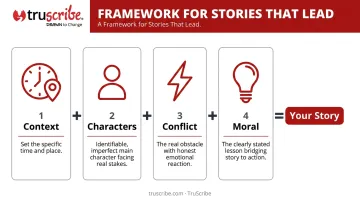
Context + Characters + Conflict + Moral = Your Story
This mirrors how the brain naturally processes and remembers narrative. Stray from it, and the story loses its grip — not because the audience can identify the flaw, but because something feels off and attention drifts.
Setting the Context
Stories need a sense of place and time. Not a vague setup — a specific one.
Compare these two openers:
- Vague: "I called a staff meeting to discuss the situation."
- Immersive: "I'm at the head of the conference table, watching people check their phones, and the silence feels heavier than I expected."
The second version anchors the audience inside the moment. Their brain starts simulating the scene, which means they're already invested before the conflict arrives.
Characters and Problem
The main character — ideally the leader themselves — needs to be identifiable and imperfect. Polished characters don't create connection. Characters facing real challenges do.
The problem is what makes a story worth hearing. Leaders who resist showing difficulty — preferring to appear composed throughout — give up the one thing that actually builds credibility. Showing the struggle is what persuades people, not the polished outcome.
A strong character-and-problem setup typically includes:
- A specific person in a specific situation (not a composite or generic "team")
- A real obstacle with meaningful stakes
- An honest reaction — uncertainty, frustration, or doubt — before any resolution
The Lesson Learned
Every leadership story must contain a moment of transformation or realization, along with a clearly stated moral. Don't assume the audience will extract it. State it directly.
The moral is the bridge between the story and the action you want your audience to take. Without it, even a compelling narrative can feel like entertainment rather than leadership communication.
Best Practices for Effective Leadership Storytelling
Prioritize Authenticity Over Polish
Employees detect corporate scripting immediately. David Grossman of The Grossman Group advises that leaders "demonstrate authenticity" by being real rather than relying on "corporate speak" — showing that "we're human, too."
Personal stories of real professional experiences — including mistakes, doubts, and hard-won lessons — build trust faster than inspirational language. The story about the time a strategy failed teaches more than the story about the time everything worked.
Keep It Concise and Answer "So What?"
Every leadership story must connect to something that matters to the audience — a behavior, a change, a value, or an outcome. If it doesn't, the story will feel self-indulgent.
Brevity matters more than most leaders realize. Microsoft's 2025 Work Trend Index found that employees using Microsoft 365 were interrupted by a meeting, email, or notification every two minutes during core work hours. Attention is genuinely scarce. A story that earns its place wins. A story that meanders loses the room — and the message.
Rehearse Without Memorizing
Effective storytelling requires practice. Before high-stakes moments, rehearse to refine the scene-setting, tighten the pacing, and ensure the moral lands clearly. The goal is well-rehearsed, not scripted. Word-for-word memorization produces exactly the kind of stilted delivery that undermines authenticity.
Build a Personal Story Library
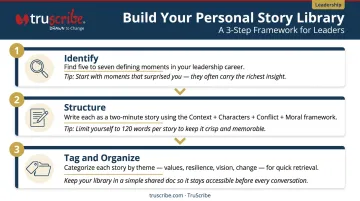
Grossman recommends that leaders develop a library of brief stories organized around key themes — values, lessons learned, vision, resilience, change. Having the right story ready for the right moment is a real advantage. Without a library, leaders default to whatever comes to mind, which is rarely the most effective choice.
A practical starting point:
- Identify five to seven defining moments in your leadership career
- Write each as a two-minute story using the Context + Characters + Conflict + Moral structure
- Tag each story by theme so you can pull the right one when the moment calls for it
Invite Teams to Tell Stories Too
Leadership storytelling isn't a one-way broadcast. Leaders who invite employees to share stories — before meetings, during onboarding, in retrospectives — build psychological safety and surface the culture that already exists inside the organization. When people contribute their own experiences, connection happens before the task work even begins.
Common Mistakes to Avoid
Mistake 1: Positioning Yourself as the Unambiguous Hero
A story where the leader arrives, assesses the situation, and solves everything without real struggle fails to create connection. The narrative power comes from the obstacle and what it cost to overcome — not the triumph itself. Show the difficulty. That's what people trust.
Mistake 2: Too Much Detail, Too Little Point
Leaders often confuse thoroughness with storytelling. Every detail in a leadership story should serve the moral — if it doesn't, cut it. Over-detailed recounting buries the message and signals a lack of editorial judgment. The audience doesn't need the full context. They need the right context.
Mistake 3: Using Second-Hand Stories Without Disclosure
If a leader presents someone else's story as their own — or embellishes facts for effect — trust collapses the moment the audience notices the gap. Shawn Callahan's ethics of business storytelling offer a clear standard:
- Tell stories as you believe they happened
- Disclose when a story is borrowed or paraphrased
- Acknowledge the source when using historical or third-party examples
Borrowed stories still land well. They just need to be labeled honestly.
Leadership Storytelling in Action: Key Business Scenarios
Change Management
Stories are among the most effective tools for guiding people through uncertainty. McKinsey research found that transformations are nearly six times more likely to succeed when senior leadership teams align on and communicate a shared change story.
The structural frame that works: current challenge → what the journey requires → the better future. This gives employees a cognitive map for the transition rather than leaving them to fill the uncertainty with their own interpretations.
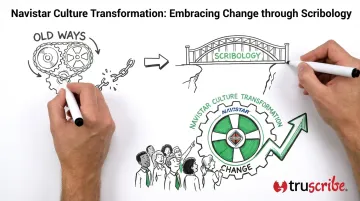
TruScribe produced a Culture Transformation video for Navistar that exemplifies this — taking the abstract concept of cultural change and translating it into a clear, sequential visual narrative that employees could follow and internalize.
Training, Onboarding, and Knowledge Transfer
Stories outperform procedural instructions for transferring tacit knowledge — the lessons that aren't in any manual. For large or distributed workforces, that creates a delivery problem: the leader can't personally tell the story to every new hire or every regional team.
Scalable visual storytelling formats address this directly. The right format can:
- Translate leadership narratives into repeatable content that holds up without live delivery
- Maintain emotional resonance across every viewing, not just the first
- Reach employees across time zones, regions, and roles simultaneously
- Build the same forward momentum as a well-told story through sequential reveal
TruScribe's whiteboard animation format does this for organizations like Amedisys and Walmart. The Scribology method's sequential visual structure mirrors effective storytelling — each frame builds on the last, keeping attention in a way static slides rarely do.
Vision Communication and Employee Engagement
When leaders need to inspire alignment around a long-term direction, data and strategic frameworks inform people — but rarely move them. A well-crafted story connecting organizational purpose to real human impact — a customer story, a founding story, a team achievement — generates the buy-in that makes people want to be part of what's being built.
TruScribe's Strategy Alignment service helps organizations communicate the why behind a direction, the relationships between components, and the dynamics needed for success. The format works whether the audience is 15 people in a conference room or 15,000 employees spread across time zones.
Frequently Asked Questions
What are the C's of storytelling?
Common storytelling frameworks built around "C" elements include Character, Conflict, Context, Consequence, and Conclusion. These five elements appear consistently across professional storytelling frameworks used in leadership and business settings.
What are the C's of leadership?
Commonly cited leadership C's include Communication, Courage, Competence, Credibility, and Consistency. Storytelling directly strengthens communication and credibility in particular — a well-told story demonstrates both in a single moment.
Why is storytelling important in leadership?
Storytelling helps leaders build trust, communicate vision memorably, and move people to action in ways data alone cannot. Narrative activates both emotional and memory processing in the brain at once, which is why story-driven messages stick longer and drive more action than facts delivered alone.
What makes a good leadership story?
A strong leadership story is authentic, purposeful, clearly structured (context, character, conflict, lesson), and concise. It ends with a moral that connects directly to the audience's situation or the behavior you want them to take — stated explicitly.
How do you start a leadership story?
Open with a specific scene, moment, or question that creates immediate curiosity or relatability. Anchor the audience in a time and place before introducing the central tension. Avoid generic openers — the more specific the opening image, the faster the audience becomes invested.
What is the difference between storytelling and just sharing facts?
Facts inform. Stories persuade and motivate. Leadership storytelling strategically sequences facts alongside emotions, giving the audience not just information but a reason to care, remember, and act. Without that structure, even accurate data rarely changes behavior.