Introduction
Sales reps today are reaching informed buyers — prospects who have already researched competitors, read reviews, and formed opinions before a first conversation. Yet despite the volume of content created to support those reps, much of it never gets used. According to SiriusDecisions, 60–70% of content produced by B2B marketing organizations sits unused on sales portals and websites.
The gap isn't volume — it's relevance. Most content gets built without a clear picture of what buyers actually need at each stage, so reps default to workarounds or skip the materials entirely.
Sales enablement content closes that gap. It gives reps the right resource at the right moment: a leave-behind after a demo, or a one-pager for a stakeholder who missed the first meeting.
A 2019 CSO Insights study found that organizations with sales enablement reported a 49% forecast-deal win rate versus 42.5% for those without it.
This article covers the 10 most impactful types — split into internal and external categories — with practical guidance on how to create each one.
Key Takeaways
- Sales enablement content falls into two categories: internal (for reps) and external (for buyers)
- The 10 types range from battle cards and playbooks to case studies and explainer videos
- Effective content must be mapped to the buyer journey — different stages need different assets
- Most content goes unused when reps aren't involved in creating it — involving them early changes that outcome
- Short video content and on-demand webinars offer strong behavioral evidence for engagement
What Is Sales Enablement Content?
Sales enablement content is any material created to help reps engage leads, handle objections, and move deals forward. It's not content marketing — which is built to attract an audience. It's built to support a conversation.
The distinction matters. A blog post can warm up a prospect. A battle card helps a rep respond when that prospect asks "How do you compare to your competitor?" Both serve the buyer journey, but in very different ways.
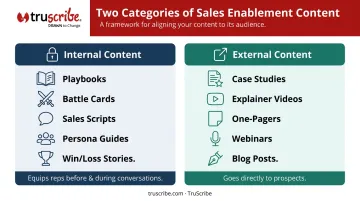
Two categories define the space:
- Internal content (playbooks, battle cards, scripts, persona guides) equips reps before and during the conversation
- External content (case studies, explainer videos, one-pagers) goes directly to the prospect to build understanding and trust
Both serve the same ultimate goal: closing more deals. But a library full of content that reps can't find, don't understand, or don't know when to use is essentially wasted. That's the lens for evaluating each of the 10 types covered below — not just what the content is, but how reps actually put it to work.
Internal Sales Enablement Content: 5 Types to Equip Your Team
Internal content is for the sales team only. Its job is to make reps more knowledgeable, consistent, and confident before they ever open a conversation with a prospect.
Sales Scripts and Playbooks
Sales scripts are structured talk tracks for calls, demos, and follow-ups. Playbooks are the broader strategic guide — how to approach different buyer types, navigate sales stages, and handle objection scenarios.
Scripts keep messaging consistent across the team, which matters more than most sales leaders realize. Gartner's 2025 survey of 632 B2B buyers found that 69% encountered inconsistencies between what sellers said and what the company's website said — and 73% actively avoided irrelevant outreach as a result.
Scripts solve the consistency problem. Playbooks solve the strategic one. Use both — especially when onboarding new hires or entering a new vertical.
Email Templates
Email templates are pre-written, customizable messages for recurring scenarios: initial outreach, post-demo follow-ups, re-engagement of cold leads. They save reps hours while keeping tone and messaging on-brand.
The key creation principle: templates should be skeletons, not scripts. Give reps a structure and starting point, with enough flexibility to personalize the key lines — the prospect's specific challenge, their industry, a callback to a previous conversation. A rep sending identical emails to 50 prospects will get the same response rate as a form letter.
Battle Cards
Battle cards are concise quick-reference guides that give reps instant access to competitive differentiators, common objections from prospects evaluating rival products, and approved response talking points.
They're most useful in the moment — pulled up when a prospect asks "How do you compare to [Competitor X]?" right before or during a live call.
What makes a battle card work:
- One page maximum (or a simple digital card)
- Objections listed as the prospect would actually say them
- Responses that are honest and specific, not defensive
- Updated every time a competitor makes a significant product change
Stale battle cards are worse than none. Outdated competitive intel gives reps false confidence heading into a live deal.
Buyer Persona Overviews
Buyer persona overviews are structured profiles of each target customer type: their typical role, pain points, decision-making authority, and key messaging angles. They give reps a head start on understanding a new prospect before the first call.
That said, personas are a starting point, not a substitute for discovery. A rep who assumes they know a CFO's priorities because the persona says "cost-focused" will miss the nuances that decide a competitive deal. Use personas to ask better questions — not to skip them.
Win/Loss Stories
Win/loss stories are internal case narratives — ideally captured in short video format — where reps walk through how a deal was won or lost, sharing competitive intel, objection-handling approaches, and what they'd do differently.
A new rep watching a veteran explain why a particular deal fell apart learns something no playbook can fully capture. Capture these stories in short videos so institutional knowledge doesn't walk out the door when a rep moves on.
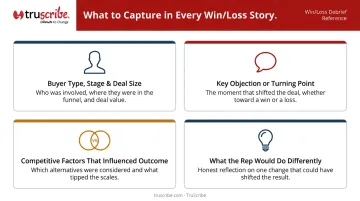
What to capture in each win/loss story:
- The buyer type, stage, and deal size
- The key objection or turning point
- Competitive factors that influenced the outcome
- What the rep would do differently next time
External Sales Enablement Content: 5 Types to Engage Buyers
External content is what prospects actually see. It must go beyond surface-level product information — today's B2B buyers arrive well-researched, often having already compared you against competitors before the first conversation.
Blog Posts and Thought Leadership
Blog posts and long-form thought leadership pieces are top-of-funnel assets that build brand authority, improve search discoverability, and warm up leads before a sales conversation begins. Reps can share these to add value without a direct pitch — useful for prospects who aren't quite ready to engage but are open to relevant content.
The most effective posts address a real challenge the target buyer faces, not product features. To find those topics:
- Research what competitors are writing about and identify the gaps
- Prioritize questions your sales team hears repeatedly on calls
- Own underserved topics early, before competitors do
Product Demo and Explainer Videos
Explainer videos walk a prospect through what a product does and why it matters. Demo videos offer a deeper walkthrough of specific features or use cases. Both allow prospects to evaluate at their own pace — which matters increasingly as buyers prefer self-directed research.
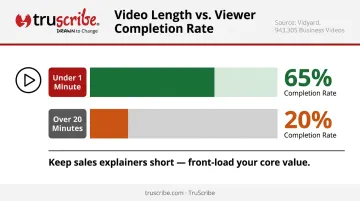
Format significantly affects retention. Vidyard's analysis of 943,305 business videos found that 65% of viewers completed videos under one minute, compared to just 20% for videos over 20 minutes. Keep sales explainers short and front-load the core value.
For B2B products with complex value propositions, whiteboard animation offers a distinct advantage. TruScribe's neuroscience-backed Scribology methodology uses sequential drawing to guide viewer attention step by step — revealing information in a logical progression that mirrors how buyers actually process new concepts, rather than hitting them with a dense feature list all at once. Microsoft, Siemens, and HPE have used this approach to communicate technically complex solutions to diverse buyer audiences.
Case Studies and Customer Testimonials
Case studies are structured proof documents: customer situation, challenge, solution, measurable results. They're most effective in the consideration and decision stages, when a prospect needs evidence that the product delivers real ROI — not just marketing claims.
What separates a compelling case study from a forgettable one is specificity. Vague success stories ("our client saw significant improvement") don't move buyers. Quantified outcomes do:
- Percentage improvements in key metrics
- Cost savings expressed in dollar terms
- Time saved per week or per cycle
The more specific the numbers, the more credible the story.
Customer testimonials work similarly, but in shorter form. A one-paragraph quote from a recognizable company can do significant work when a prospect is weighing their final decision.
One-Pagers and FAQ Sheets
One-pagers are single-page summaries of a product or solution — designed for sharing with additional stakeholders who weren't in the original meeting and need a quick overview without scheduling another call. They respect the reader's time.
FAQ sheets serve a different purpose: pre-emptive objection handling. They give prospects answers to the questions they'd typically email the rep about after a demo, reducing friction and keeping deals moving without requiring rep involvement at every step.
Both formats share one creation rule: write them for someone who has never heard of your product. Assume nothing.
Webinars and On-Demand Content
Webinars let reps engage multiple prospects simultaneously while showcasing internal expertise — more efficient than one-to-one outreach and more credible than a cold pitch. ON24's 2025 benchmark data reports an average of 216 attendees per webinar with 51 minutes of average engagement — a meaningful attention window.
Don't overlook the on-demand side: 45% of webinar audiences watch recordings, not live sessions. A well-structured webinar becomes an evergreen asset that reps can share throughout the sales cycle for middle-of-funnel nurturing.
How to Create Effective Sales Enablement Content
Creating content is the easier part. Creating content reps actually use requires a deliberate process.
Follow these four steps to build a content library reps will actually reach for:
Start with rep input. The most common reason sales content goes unused is that marketing built it without asking what reps need. Ask reps what objections they hear most, what questions prospects ask after demos, and what they're currently improvising because no asset exists. That gap list is your content roadmap.
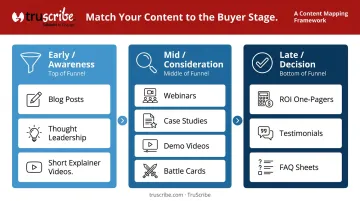
Map assets to the buyer journey. Different content works at different stages:
| Buyer Stage | Content Types That Work |
|---|---|
| Early (awareness) | Blog posts, thought leadership, short explainer videos |
| Mid (consideration) | Webinars, case studies, demo videos, battle cards |
| Late (decision) | ROI-focused one-pagers, testimonials, FAQ sheets |
Audit before you create. Review what already exists — identify what's current, what's outdated, and what's genuinely missing. This prevents duplication and ensures effort goes toward high-impact gaps, not more blog posts when reps actually need a competitive battle card.
Train reps to deploy content strategically. Creating assets is only half the job. Show reps when and how each piece should be used. Video especially benefits from precise timing — a two-minute explainer sent in a post-demo follow-up lands very differently than the same video buried in an untargeted content blast.
Frequently Asked Questions
What are the topics of sales enablement?
Sales enablement spans content creation, rep training and coaching, technology and tools, sales-marketing alignment, performance measurement, and onboarding. All of it aims at one outcome: helping reps engage buyers more effectively and close more deals.
What is the difference between sales enablement content and content marketing?
Content marketing attracts and educates a broad audience — blogs, SEO articles, social posts. Sales enablement content is built specifically to support sales conversations. It's tailored to close deals, not generate awareness, and it's often never seen by anyone outside a specific deal.
What is the 3-3-3 rule in sales?
The 3-3-3 rule holds that a sales message should capture attention in 3 seconds, communicate value in 3 minutes, and motivate a decision within 3 days. It's a useful lens for evaluating sales enablement content — if an asset can't pass the 3-second attention test, it won't get read.
How do you measure the effectiveness of sales enablement content?
Track three metrics: content usage rate (are reps using it?), prospect engagement (opens, views, time spent), and sales outcomes (deal velocity, win rates, conversion). High usage with flat outcomes points to a content problem; strong outcomes with low usage points to a distribution or training gap.
What is the most effective type of sales enablement content?
It depends on buyer stage and product complexity. Short video consistently shows strong completion rates, and case studies carry the most weight at the decision stage where proof matters. The best asset is whichever one directly addresses what's blocking the deal.