Introduction
Producing video content in English and calling it a global strategy is a common mistake — and an expensive one. The moment a viewer encounters content in a language they don't fully understand, engagement drops, retention suffers, and the action you wanted them to take rarely happens.
CSA Research's survey of 8,709 consumers across 29 countries found that 76% prefer product information in their own language, and 40% will not buy from websites in other languages. For B2B organizations managing multinational training, sales, or compliance programs, those numbers represent a measurable opportunity gap.
This guide covers what video localization actually means, why it matters for B2B teams specifically, the four main methods available, and how to build a practical strategy. By the end, you'll have a concrete framework — not just a concept.
Key Takeaways
- Video localization adapts language, visuals, tone, and cultural references — not just words
- 76% of global consumers prefer content in their native language; ignoring this costs real engagement
- The four main methods are subtitles, voiceover/dubbing, reversioning, and transcreation
- Animation-based videos (like whiteboard explainers) localize faster and at lower cost than live-action
- Effective localization starts before production, so design source content with adaptation in mind
What Is Video Localization?
Video localization is the process of adapting video content so it resonates naturally with a specific regional audience. That goes well beyond swapping out words — translation changes the language; localization changes the meaning.
Take a common English business phrase like "move the needle" as an example. Translated literally into many languages, it becomes meaningless. A skilled localization team wouldn't translate that phrase at all — they'd replace it with an expression that carries the same intent in the target culture.
What Localization Actually Touches
A fully localized video typically involves adapting:
- Spoken dialogue and voiceover narration, re-recorded in the target language
- On-screen text and graphics, including titles, labels, and callouts reformatted for the new language
- Cultural references and humor, with idioms and metaphors replaced by locally relevant equivalents
- Music and sound design, adjusted where cultural associations diverge
- Supporting metadata, including captions, subtitles, and accessibility fields updated throughout
Humor and cultural references are where localization gets genuinely difficult. Getting them right requires expertise in both the source and target cultures — not just fluency in the language.
Why Video Localization Matters for B2B Organizations
The business case for localization isn't abstract. For organizations with global workforces, international sales pipelines, or multinational compliance obligations, untranslated video content creates direct operational and legal exposure.
The Engagement and Reach Gap
The preference data is consistent: audiences engage more deeply with content delivered in their native language. When training, sales, or onboarding content is only available in English, non-native speakers disengage — or miss critical information entirely.
For B2B teams, this shows up in:
- Lower training completion rates across non-English-speaking employee populations
- Weaker sales conversations where reps can't share on-message content with local prospects
- Compliance gaps when employees don't fully understand regulatory training delivered in a second language
Where B2B Localization Is Most Critical
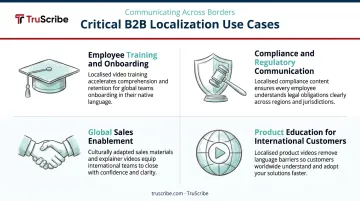
Four use cases drive localization demand across enterprise organizations:
- Employee training and onboarding — multinational companies need consistent messaging delivered in the languages their people actually use
- Compliance and regulatory communication — OSHA requires covered training to be delivered in a language and vocabulary employees understand; EU regulations impose similar requirements in pharma and financial services
- Global sales enablement — regional sales teams need content that speaks to local buyers, not translated versions of US-market messaging
- Product education for international customers — complex products require clear explanation, and clarity drops sharply across language barriers
The Compliance Dimension
For regulated industries, localization carries legal weight. Three frameworks make this concrete:
- OSHA mandates workplace training in a language employees actually understand
- EU PRIIPs regulation requires key information documents in officially accepted local languages
- EMA's centralized procedure requires translated product information for medicinal products
Organizations in healthcare, life sciences, and financial services — sectors TruScribe serves extensively, including clients like Merck, Baxter, Catalent, and Fidelity — face real regulatory exposure when multilingual communication falls short.
Source Content Quality Determines Localization Success
Before localization can work, the source video has to be clean. Ambiguous narration, embedded on-screen text, heavy cultural references, and dense live-action production all compound during localization — errors and confusion multiply across every market you enter.
This is why production format matters from the start. Whiteboard and animation-based videos — like those TruScribe produces using its Scribology methodology — use structured sequential narration, concept-driven visuals, and minimal on-screen text. These characteristics make the source content much easier and less expensive to adapt for new languages and markets.
The Main Methods of Video Localization
No single approach works for every situation. The right method depends on the content type, target audience, budget, and how immersive the experience needs to be. Four options cover most use cases.
Subtitles and Captions
Subtitles overlay translated text on the original video while preserving the source audio. Captions go a step further, also capturing non-speech audio cues for viewers with hearing impairments.
According to MultiLingual, subtitling is the fastest and most cost-effective localization option — though viewers must divide attention between reading and watching.
Best for: Social media content, webinars, short-form training clips, and initial market testing before committing to full dubbing.
Dubbing and Voiceovers
Voiceover layers a new-language narrator track over the original audio — no lip-sync required. Dubbing replaces the original audio entirely, ideally synchronized to on-screen speakers for maximum immersion.
Dubbing delivers higher engagement but traditionally carries more production complexity and cost. AI tools are narrowing that gap, though specific savings figures vary widely by vendor — verify claims against your actual production scope before budgeting.
Animation-based source content eliminates lip-sync complexity entirely. With no on-screen speakers to match, dubbing a whiteboard video takes significantly less production effort than dubbing live-action — a concrete cost advantage when building a localization-ready asset from the start.
Best for: Corporate training, product explainers, and any content where comprehension depends on the audience fully following narration without reading text overlays.
Reversioning and Transcreation
When language isn't the only barrier, the approach shifts from translation to reconstruction. Reversioning reworks the visual and structural elements of a video — swapping backgrounds, scenes, or culturally specific imagery — to reflect local context beyond language alone.
Transcreation goes further: the creative concept is reimagined for the target market while preserving the original intent. Tone, humor, and emotional resonance are rebuilt from scratch.
| Method | When to Use |
|---|---|
| Reversioning | Brand campaigns requiring visual cultural fit |
| Transcreation | High-value creative work where humor or emotional tone must be rebuilt for a specific culture |
The HSBC "Assume Nothing" campaign — which the Financial Times reported was replaced after it rendered as "Do Nothing" in some markets — is a well-documented example of what happens when localization stops at translation and misses cultural meaning entirely.
How to Build a Video Localization Strategy Step by Step
Effective localization starts with prioritization, not a blanket effort across every piece of content. A phased approach keeps budgets manageable and results measurable.
Step 1: Identify and Prioritize Target Markets
Use existing data to find where localized content will have the most immediate impact:
- Website traffic and engagement by region
- Video completion rates by country
- Sales pipeline and revenue by geography
- Support ticket volume from non-English-speaking regions
Focus on one or two high-potential markets first. Attempting to localize everything at once dilutes resources and makes it nearly impossible to measure what's working.
Step 2: Select and Audit Your Source Content
Not all content is equally localization-ready. Prioritize:
- High-performing, evergreen content — videos with strong completion rates that will remain relevant for 12–24 months
- Clean narration — structured, jargon-light scripts that translate without ambiguity
- Minimal embedded on-screen text — graphics with text baked into the footage increase cost significantly
Avoid starting with complex live-action productions that have heavy cultural references, rapid scene cuts, or text embedded in footage. These increase cost and difficulty at every stage.
Step 3: Choose the Right Method for Each Use Case
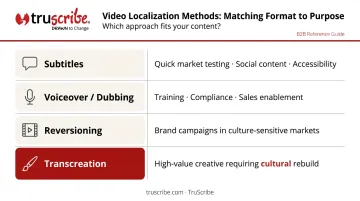
Match the localization method to the content goal:
- Subtitles → quick market testing, social content, initial accessibility
- Voiceover/dubbing → high-engagement training, compliance content, sales enablement
- Reversioning → brand campaigns in visually culture-sensitive markets
- Transcreation → high-value creative work where cultural resonance must be rebuilt
Pilot one method on three to five top-performing pieces before committing to a full rollout. This gives you real engagement data to justify the investment.
Step 4: Build Quality Assurance Into the Process
AI translation tools can accelerate the work, but they're not a quality gate.
Native-speaker review is non-negotiable, and the reviewer must be a speaker of the correct regional variant. "Spanish" is not one language for localization purposes — Castilian and Latin American Spanish differ in vocabulary, grammar, and usage.
The American Translators Association recommends professional translators work into their native language and that the target market's regional variant be specified before production begins.
In-market review of culturally sensitive scripts is a fixed production requirement, not an optional expense. Skipping it risks the kind of brand damage that no localization budget can absorb after the fact.
Best Practices to Set Your Localization Up for Success
A few decisions made before production begins have an outsized impact on localization cost and quality downstream.
Design for Localization Before You Produce
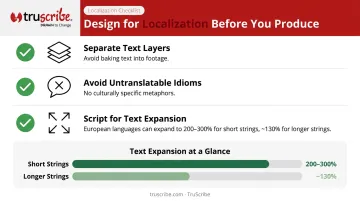
Source videos built with localization in mind cost less to adapt. Before you record a single frame, consider:
- Using separate text layers for on-screen graphics (not baking text into footage)
- Avoiding idioms, culturally specific metaphors, and humor that won't translate
- Writing scripts that account for text expansion — W3C data shows European language translations of short English strings can expand to 200–300% of the original length, with longer strings typically averaging around 130%
Maintain Brand Consistency Across Versions
Localized content should feel native to the target audience without drifting from your core brand. Terminology, visual style, and messaging hierarchy should stay consistent across all language versions. Inconsistency across markets erodes trust faster than a mistranslation.
Track, Measure, and Iterate
Localization is not a one-time project. Establish a feedback loop that tells you what's working by market:
- Watch time and completion rates by region for localized content
- Conversion and action rates compared to the original version
- Assessment scores for training content by language cohort
Use those insights to refine both your localization approach and your source content strategy. Teams that build this loop into their workflow consistently outperform those that localize once and move on.
Frequently Asked Questions
What does video localization mean?
Video localization is the process of adapting video content — including language, cultural references, visuals, and tone — so it resonates authentically with audiences in a specific region. Unlike simple translation, it reshapes the full viewing experience so the content feels native to that market.
How much does video localization cost?
Cost varies by method: subtitles are the most affordable, dubbing and voiceover fall in the middle, and reversioning or transcreation are the most resource-intensive. Animation-based videos — such as whiteboard explainers — generally cost less to localize than live-action productions because they eliminate lip-sync complexity.
What is the difference between video translation and video localization?
Translation converts spoken or written words into another language. Localization adapts the full viewing experience — cultural references, humor, visuals, tone, and pacing — so the content feels like it was created specifically for that audience rather than imported from somewhere else.
What types of videos are easiest to localize?
Animation-based and voiceover-driven videos — such as whiteboard explainers — are the simplest to localize. No on-screen speakers means no lip-sync challenges, visuals are concept-driven and easy to modify, and narration scripts are structurally clean. Live-action productions with on-camera speakers and embedded text cost significantly more to adapt.
How long does video localization take?
Timelines vary by method and video length. Subtitle-based localization can be completed in days; dubbing or reversioning a multi-minute video may take several weeks depending on the number of languages and review cycles required. AI tools have compressed timelines across all methods, though human review remains an essential step.