Introduction
Most organizations have HR software. Far fewer have a coherent employee experience. The difference shows up in turnover reports, engagement scores, and the quiet exit of your best people.
The problem isn't a lack of tools — it's fragmentation. Employees interact with dozens of touchpoints daily: onboarding portals, manager conversations, learning platforms, policy documents, recognition programs. When those experiences are disconnected, employees notice. Leadership usually doesn't, until attrition accelerates.
McKinsey's research found that employees with positive experiences reported 16x the engagement and were 8x more likely to stay than their counterparts — numbers that reframe EX from a wellness initiative into a business priority.
This guide walks through the key pillars, platform types, evaluation criteria, and implementation steps you need to build an employee experience that actually holds together.
Key Takeaways
- Employee experience spans every interaction across the full employment journey, from hiring through exit
- Replacement costs range from 40% of salary for frontline roles to 200% for leaders, making EX investment an ROI calculation
- The average desk worker now uses 11 applications daily — integration is non-negotiable
- Recognition paired with weekly feedback correlates with 61% engagement versus 38% without it
- Nearly 1 in 4 HR technology implementations fall short on adoption, making change management as critical as platform selection
What Are Employee Experience Solutions?
Employee experience solutions refer to the full ecosystem of platforms, tools, strategies, and communication approaches that shape every stage of the employee journey — from recruitment and onboarding through development, transitions, and eventual departure.
"Employee experience platform" gets conflated with pulse surveys, recognition software, or performance management tools. In reality, it includes all of those — and the connective tissue between them.
Gartner defines employee experience as the sum of all interactions an employee has with an employer, including the work environment, culture, technology, and support systems.
By that definition, a confusing benefits enrollment process is an EX problem. So is a manager who never gives feedback — or a new-hire orientation that drowns people in policy documents.
Why This Definition Matters for Buying Decisions
When organizations treat EX as synonymous with a single software category, they tend to:
- Purchase engagement survey tools without addressing the underlying issues surveys reveal
- Implement recognition platforms without connecting them to performance conversations
- Roll out learning management systems employees never log into
The organizations that get EX right think in systems. They identify where the employee journey breaks down and choose solutions that address those specific friction points — while building toward an integrated whole.
Why Employee Experience Solutions Are a Business Priority
The Numbers That Change the Conversation
The business case for EX investment isn't soft. Gallup's research on employee turnover puts replacement costs at approximately:
- 40% of annual salary for frontline roles
- 80% of annual salary for technical professionals
- 200% of annual salary for leaders and managers
At those figures, replacing ten mid-level employees at $80,000 each costs $640,000 — before accounting for lost institutional knowledge, team disruption, and the productivity dip during ramp-up. That's not an HR cost. That's a business loss.
What's Making Fragmented EX Unsustainable
Three forces have raised the stakes considerably:
- Digital tool sprawl: The average desk worker used 11 applications to complete tasks in 2023, up from six in 2019, according to Gartner research reported by CIO Dive. More tools without better integration creates friction — and rarely solves the underlying problem.
- Hybrid and distributed work: When employees aren't in the same room, the informal cultural reinforcement — hallway conversations, visible recognition, spontaneous feedback — disappears. EX solutions have to replace what proximity used to provide.
- Rising expectations: Employees now expect workplace technology to function as intuitively as consumer apps. Clunky HR portals, broken search in knowledge bases, and one-way communication channels erode trust.
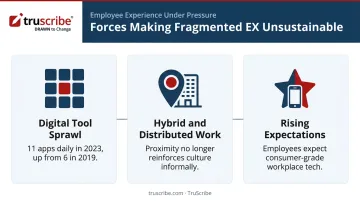
These three forces compound each other. Organizations that treat EX as discretionary rarely identify that dynamic until turnover spikes, engagement scores drop, or a change initiative stalls — and by then, the cost of inaction is already visible on the balance sheet.
The Key Pillars of Employee Experience Solutions
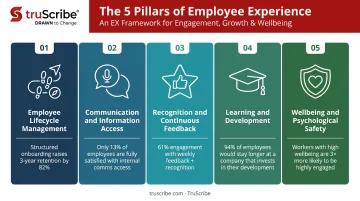
Pillar 1 — Employee Lifecycle Management
EX solutions address the full employee journey, but impact concentrates at transitions: onboarding, manager changes, role changes, and exits. These moments carry outsized weight — employees are actively forming or revising their assessment of the organization.
Poor onboarding alone can undermine months of recruiting investment. Effective EX solutions map these critical moments deliberately and intervene with structured support — before employees quietly disengage.
Pillar 2 — Communication and Information Access
Employees can't engage with policies, programs, or changes they don't understand. Information fragmentation is one of the most consistent sources of employee frustration. When the answer to a basic question requires three platforms and a Slack message, trust erodes fast.
Knowledge management tools, internal comms platforms, and digital communication systems create the organizational transparency that directly shapes trust and productivity.
Pillar 3 — Recognition and Continuous Feedback
Annual reviews are too infrequent to influence behavior or sustain motivation. The data is clear: weekly feedback paired with recognition correlates with 61% engagement, versus 38% for weekly feedback without recognition. Employees who feel well-recognized are also 45% less likely to have changed organizations two years later.
Recognition and feedback loops work when they're ongoing, specific, and tied to actual work. That's what makes employees feel genuinely valued, not just managed.
Pillar 4 — Learning and Development
Access to growth is a retention factor, not just a training metric. Key findings bear this out:
- Employees with access to a learning platform were 46% more likely to have received a promotion, per Degreed's research across 2,500 workers
- People stay where they feel they are advancing; they leave when growth stalls
- L&D investment signals organizational commitment to the individual — not just to the role
Learning access correlates with engagement and loyalty beyond any single skill acquired.
Pillar 5 — Wellbeing and Psychological Safety
Modern EX increasingly addresses mental health, workload balance, and environments where employees feel safe contributing authentically. Among large employers, 45% provided or planned manager mental-health training as of Mercer's 2025 survey.
For hybrid and distributed teams, this pillar is especially critical. Without informal social reinforcement, feelings of isolation go undetected longer. By the time they surface, they've usually already become a resignation.
Types of Employee Experience Solutions
Employee Engagement Platforms
Platforms like Culture Amp, 15Five, and Officevibe centralize recognition programs, pulse surveys, and real-time sentiment monitoring. They give HR teams a continuous signal on employee morale and equip managers to act on feedback before disengagement escalates.
Culture Amp leads with diagnostic surveys and manager coaching tools. Officevibe emphasizes pulse surveys with anonymous feedback and recommended manager actions. These platforms are most valuable when managers actually use the data — not just HR reviewing quarterly dashboards.
Performance Management Systems
Lattice and Betterworks replace annual review cycles with continuous goal-setting, OKR tracking, regular check-ins, and structured feedback conversations.
The key differentiation from engagement platforms: performance management tools connect individual goals to company strategy. Employees who can trace their work to organizational objectives report both higher accountability and a clearer sense of purpose — two drivers that engagement surveys alone can't create.
Learning, Development, and Training Tools
LMS platforms and training content solutions support onboarding, skills building, compliance, and career development. The format of training content matters as much as the platform delivering it.
Video-based formats — particularly whiteboard animation — are widely used to break down complex onboarding, compliance, and change management content into formats that improve comprehension and retention.
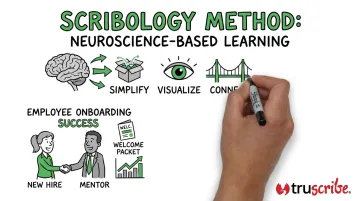
TruScribe's Scribology method applies neuroscience principles to hand-drawn whiteboard videos, achieving 2.3x higher retention than traditional video formats. Walmart and Medtronic have used this approach to deliver consistent training across large, distributed employee populations.
Internal Communications and Knowledge Management Platforms
Microsoft Viva, Confluence, and Staffbase ensure employees have centralized, searchable access to company information, policies, announcements, and resources.
Each platform serves a distinct need:
- Microsoft Viva — broadest scope, covering communications, learning, insights, and connection within the Microsoft 365 ecosystem
- Confluence — knowledge-centric, built for documentation and internal search
- Staffbase — multichannel employee communications across app, email, and intranet, suited for frontline or distributed workforces
Organizations already in Microsoft 365 typically find Viva the lowest-friction starting point. Confluence fits documentation-heavy teams. Staffbase works best when reaching non-desk employees is the primary challenge.
People Analytics Platforms
Qualtrics EmployeeXM aggregates employee data across multiple touchpoints to surface patterns in engagement trends, retention risk, and culture health. With this data, HR leaders can prioritize interventions by department, tenure, or role — rather than applying one-size-fits-all programs based on aggregate scores.
Behavioral listening — tracking signals like recognition frequency, feedback patterns, and goal progress — is growing: adoption rose from 28% in 2024 to 36% in 2025, according to Perceptyx's State of Employee Listening report. These signals complement survey data, which can be subject to response bias.
Key Features to Look for in an EX Solution
Recognition and Rewards Capabilities
Look for platforms where recognition is:
- Social and visible across the organization, not just private manager messages
- Peer-to-peer, not only top-down
- Tied to company values so it reinforces specific behaviors
- Flexible in rewards — a catalog that feels meaningful to a geographically and demographically diverse workforce
Continuous Listening and Feedback Tools
Evaluate whether the platform supports multiple formats: pulse surveys, lifecycle surveys, onboarding and exit surveys, and always-on channels. Then ask what happens with that data.
The most useful listening tools surface results in ways managers can act on — not just HR dashboards reviewed quarterly. Check for anonymity safeguards, response benchmarking, and whether the platform identifies what's driving engagement or disengagement, not just the aggregate score.
Performance Management and Development
Continuous feedback mechanisms matter more than annual review sophistication. Prioritize platforms that support:
- Regular check-ins and OKR tracking
- Individual development plans
- Connections between performance data, recognition, and analytics
That integration gives managers a unified, real-time picture of team health.
Integration With Existing Systems
EX platforms create value only when they connect to systems employees and HR already live in:
- HRIS: Workday, SAP, Oracle, ADP
- Collaboration tools: Slack, Microsoft Teams
- LMS and payroll systems
Platforms that require a separate login or create data silos increase friction and reduce adoption. Treat integration as a core selection criterion from the start.
Analytics and Reporting Depth
Look for real-time dashboards with the ability to segment data by team, tenure, role, and location. The strongest platforms draw on behavioral signals alongside survey responses, producing a more continuous and reliable picture of culture health than self-reported data alone.
How to Choose and Implement the Right EX Solution
Start With a Clear Diagnosis
Before evaluating vendors, identify your most urgent EX challenge:
- High attrition in the first 90 days → onboarding and lifecycle management
- Disengaged remote employees → recognition, communication, and listening tools
- Low feedback adoption → performance management and manager enablement
- Information overload → knowledge management and internal comms
The right solution category varies dramatically depending on the problem. Skipping this diagnosis leads to purchasing platforms that address the wrong need.
Match Platform Strengths to Your Priority
Most EX platforms lead with one of three orientations:
| Priority | Platform Focus | Examples |
|---|---|---|
| Recognition-first | Engagement and culture | Culture Amp, Officevibe |
| Performance-first | Goals, feedback, reviews | Lattice, Betterworks |
| Listening-first | Analytics and people data | Qualtrics EmployeeXM |
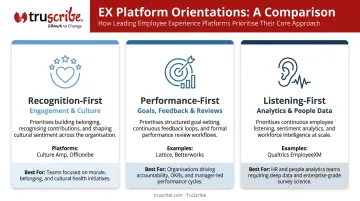
Understand which dimension is most critical before treating all features as equal.
Evaluate Total Cost — Then Run a Real Pilot
Per-seat pricing can double or triple with implementation, training, and premium feature add-ons. Calculate what it costs to achieve a specific outcome — a measurable improvement in 90-day retention, for example — rather than comparing license fees in isolation.
Run a 60-90 day structured pilot with a representative employee group before committing to organization-wide deployment. Observe actual usage patterns, not just survey feedback about the platform.
Build Phased Rollout With Manager-First Workflows
EX solution rollouts fail most often when they lack internal ownership, defined milestones, and visible leadership commitment. Gallup estimates managers account for at least 70% of variance in employee engagement scores — which means manager-facing workflows should be prioritized first.
If recognition, feedback, and check-in tools work for managers, employee adoption follows. The reverse is rarely true.
Communicate the "Why" in Language Employees Understand
Prosci's change management research found that projects with effective sponsors met objectives 79% of the time, versus 27% with ineffective sponsors. Adoption suffers when employees don't understand the purpose or value of a new tool.
Visually engaging communication formats close this gap. Short explainer videos — particularly hand-drawn whiteboard formats built around how people process new information — help employees quickly grasp the purpose of a new platform before they ever log in. TruScribe produces this type of change communication content specifically for EX rollouts, using the neuroscience-based Scribology methodology to improve comprehension and retention across distributed workforces.
Measure, Iterate, and Close the Feedback Loop
Set baseline metrics before rollout: survey participation rate, eNPS score, manager check-in frequency. Review them at 30-60-90 day intervals. Use that data to refine adoption approaches, identify feature gaps, and demonstrate ROI to leadership.
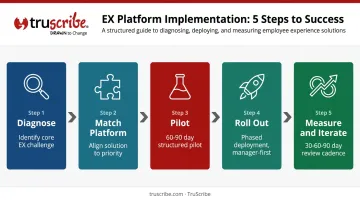
EX implementation doesn't end at launch. The 30-60-90 day review cadence is where most of the real adoption work happens — adjusting messaging, closing feature gaps, and building the case for continued investment.
Frequently Asked Questions
What is the difference between employee experience and employee engagement?
Employee engagement is an outcome — how emotionally committed and motivated employees feel. Employee experience is the sum of all interactions, environments, and conditions that produce that outcome. EX solutions address root causes; engagement metrics measure the results.
What are the main components of an employee experience platform?
Core components include recognition and rewards, continuous feedback and employee listening, performance management and goal-setting, learning and development tools, and people analytics. Platforms vary significantly in how deeply they handle each component, and most lead strongly with one or two.
How long does it typically take to implement an employee experience solution?
Pilots typically run 60-90 days. Full organizational rollouts generally take 3-6 months, depending on company size, HRIS integration complexity, and the effectiveness of the internal change management and communication plan.
How do you measure the ROI of employee experience investments?
Track retention rate improvements, changes in eNPS or engagement survey scores, productivity indicators, and reduction in HR administrative time. Establish baseline measurements before implementation — without a baseline, impact can't be clearly attributed.
What role does communication play in employee experience?
Communication is foundational to employee experience. Employees can't engage with policies or changes they don't understand, and how organizations communicate — clarity, format, accessibility — directly shapes perception and trust.
Can small and mid-sized organizations benefit from employee experience solutions?
Yes — EX solutions aren't exclusive to large enterprises. Many platforms offer tiered pricing, and even lightweight implementations of recognition, feedback, or training tools can drive meaningful retention and engagement gains for teams of any size.