The challenge isn't just the number. It's understanding why the number changes. Crew size, shoot duration, post-production scope, and event complexity all pull the price in different directions. Misread any one of them, and you're either underprepared with a vendor who can't execute, or overspending on production values that don't match the event's purpose.
This guide breaks down real pricing ranges by event type and tier, explains the specific factors that move costs up or down, and gives you a framework for building a smarter budget before you ever request a quote.
Key Takeaways
- Event videography typically costs $1,500–$10,000+, depending on crew size, event scale, and deliverables
- The biggest cost drivers are crew size, shoot duration, and post-production editing scope
- Freelancers average $10–$53/hour; US video production agencies typically bill $100–$149/hour
- Post-production editing often costs as much as — or more than — the shoot day itself
- Multi-day events, live streaming, and breakout sessions can push costs into five-figure territory
How Much Does Event Videography Cost?
Event videography has no fixed price. What you pay depends on the event type, the deliverables you need, and how much crew it takes to capture everything properly.
Two events with identical run-of-show documents can land in completely different price brackets. One needs three concurrent camera crews for breakout sessions; another needs a same-day highlight reel for social. Knowing where you fall on that spectrum prevents underbudgeting (and unusable footage) or overspecifying for a simple internal event.
Here's how the tiers break down.
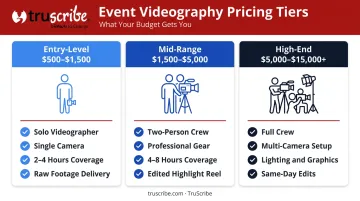
Entry-Level Coverage: $500–$1,500
Typically includes:
- Solo videographer with a single camera
- 2–4 hours of on-site coverage
- Minimal or no editing; often raw footage delivery
Best for: Small internal meetings, team events, simple interviews, or organizations with in-house editing capabilities.
Mid-Range Professional Coverage: $1,500–$5,000
Typically includes:
- One to two videographers with professional camera and audio gear
- 4–8 hours of coverage
- Edited highlight reel or full-length final video
- Basic color correction and audio mixing
Best for: Full-day corporate events, product launches, single-stage conferences, and branded content meant for external distribution. Think Branded Media places small corporate event packages in the $3,000–$5,000 range for this tier.
High-End and Multi-Camera Production: $5,000–$15,000+
This tier is built for events where video becomes a primary marketing, training, or investor asset. Expect a full production footprint:
- Multi-person crew with multiple camera setups
- Professional lighting and audio
- Comprehensive post-production: graphics, motion titles, licensed music
- Same-day edits or multi-day shoot coverage
Large conferences, trade shows, and multi-session corporate events typically land here.
D-MAK Productions notes that multi-day schedules, simultaneous rooms, live streaming, hybrid production, and rush edits drive budgets into the five-figure range; complex multi-day productions can reach $50,000 or more.
Key Factors That Affect Event Videography Pricing
Two events with identical agendas can land in very different price ranges. Pricing depends on a combination of technical, operational, and creative variables — not just hours on-site.
Experience Level of the Videographer
The experience gap matters more at live events than in almost any other video context. A seasoned videographer anticipates room transitions, adjusts exposure for changing light conditions, and knows when to reposition without being told. That judgment is invisible in the quote. It's only visible in the final footage.
The provider type also affects pricing structure:
- Freelancers (via platforms like Upwork): Directional rates of $10–$53/hour — lower overhead, less redundancy, more price flexibility
- US video production agencies: Clutch data from verified client reviews shows typical rates of $100–$149/hour, reflecting organizational capacity, backup systems, and project management
These aren't equivalent services. An agency rate buys infrastructure; a freelancer rate buys a person. Neither is inherently better — it depends on the event's scale and complexity.
Crew Size and Number of Cameras
A solo videographer can handle a single-stage event using two cameras. Add simultaneous sessions, separate rooms, or dynamic outdoor segments, and you need additional operators — which changes the budget significantly.
A practical example: a three-room conference with breakout sessions could require three to five videographers running separate production setups for each room. That's not one extra camera — it's effectively three separate productions happening at the same time, each with its own operator, audio setup, and capture plan.
Each additional crew member adds a full day rate to the quote.
Shoot Duration and Post-Production Scope
More hours on-site produce more footage — and more footage directly increases editing time. This is the most underestimated cost multiplier in event videography budgeting.
Live interviews, panel transitions, audience reaction shots, and outdoor segments all add to the volume and complexity of material that needs to be reviewed and assembled in post. That editorial burden compounds quickly.
Post-Production and Editing
Editing is often where the largest cost lives — and it's the line item most clients underestimate when they focus only on the shoot day rate.
Vidico estimates that a mid-range corporate project typically requires 20–40 hours of editing, with professional editor rates running $75–$150/hour. The deliverable type drives that range significantly:
| Deliverable | Editing Complexity |
|---|---|
| Raw footage handoff | None — deliver and done |
| Simple cut / basic assembly | Low |
| Polished highlight reel | Medium |
| Full-length edit with graphics, titles, and licensed music | High |
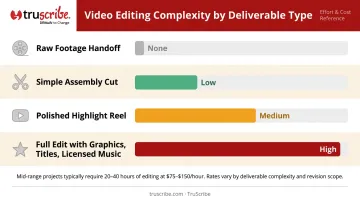
A two-hour event can easily require 10–20 hours of editing to produce a polished final video. That's a cost line worth confirming before the shoot day, not after.
Location and Travel
Local shoots are generally priced into base rates. Events outside the videographer's home market typically add travel costs — transportation, accommodation, and meals. Always confirm whether travel is included or billed separately before signing a contract. It's one of the most common sources of invoice surprises.
Full Cost Breakdown: What You're Actually Paying For
The rate quoted upfront usually reflects the shoot day only. The total project cost includes additional line items that can significantly change the final number.
Pre-Production
A one-time cost covering planning calls, shot list creation, location scouting, equipment prep, and timeline coordination. Freelancers often bundle this into their day rate; production companies typically itemize it separately.
Production (Shoot Day)
The most visible line item — and the one clients focus on most. Covers videographer time on-site, all camera and audio equipment, lighting setup, crew coordination, and breakdown. It's the largest single-day cost but rarely represents the full project investment.
Post-Production and Editing
Often billed separately. Covers footage review, editing, color grading, audio mixing, music licensing, motion graphics, and revision rounds.
Editing can take 3–5x longer than the shoot itself. Vendor estimates on post-production's share of total project cost range from 20–25% (Think Branded, D-MAK) to 25–40% (Vidico) — the variance largely reflects different deliverable loads.
Beyond these core phases, most projects carry at least one or two add-ons that push the final number higher than the initial quote suggests.
Add-Ons and Additional Services
Common add-ons and their approximate ranges (based on current vendor examples, not national survey data):
| Add-On | Approximate Range |
|---|---|
| FAA-licensed drone operator | $300–$1,500 (local market example) |
| Same-day or rush edit | $300–$1,500 |
| Livestream setup and technician | $800–$3,000 setup; $150–$300/day technician |
| Extra revision rounds | $50–$100/hour after standard 2–3 rounds |
Note: Ranges above are drawn from vendor examples, primarily from the San Francisco market via Argus HD. Your local market may differ.
Budget vs. Premium Event Videographers: What Really Changes?
Choosing between a budget and premium videographer isn't just about price — it affects how much hand-holding you'll need to do, and what happens when something goes wrong on the day.
| Dimension | Budget Tier | Premium Tier |
|---|---|---|
| Equipment | Single-camera setup, basic audio | Redundant cameras, backup audio, professional lighting |
| Live unpredictability | Limited backup plans | Escalation protocols, dedicated backup workflows |
| Editing sophistication | Basic assembly cut | Color grading, licensed music, graphics, multiple cuts |
| Turnaround | Standard delivery | Rush/same-day available at additional cost |
| Project management | Self-managed | Technical direction, dedicated coordinator |
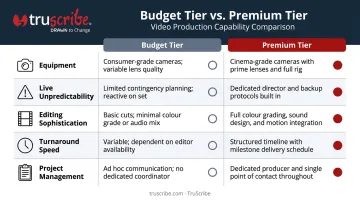
According to AVIXA's guidance on hybrid event production, professional event coverage requires redundant AV equipment, backup power, secondary feeds, and replacement microphones. Premium quotes often reflect this failure-prevention infrastructure — beyond camera quality alone.
A well-produced event video functions as a marketing asset, internal training resource, and brand content long after the event ends. Footage that's too dark, poorly mixed, or missing key sessions has limited usability — making upfront savings a poor trade-off for high-visibility events.
How to Estimate the Right Budget for Your Event Video
The right budget matches your event's scale, the intended use of the footage, and the quality level your audience will judge you by.
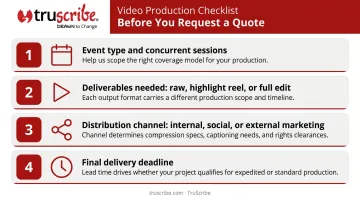
Before requesting a quote, answer these questions:
- What type of event is it, and how many simultaneous sessions need coverage?
- What deliverables do you actually need? Raw footage, highlight reel, or full-length edited video?
- Where will the video be distributed? Internal use only, social media, or external marketing?
- What's your deadline for final delivery?
What Most People Miss When Budgeting
- Focusing only on the day rate while ignoring editing costs
- Not accounting for travel fees or overtime
- Over-specifying production for a simple internal event
- Choosing the cheapest option without reviewing their portfolio for similar event types
- Forgetting to budget for revision rounds
- Assuming live videography is the right format — if the actual goal is recurring corporate content like training programs, onboarding videos, or product explainers, on-site production may be the wrong starting point entirely. Illustrated or animated formats often deliver stronger comprehension and retention for that type of structured content, without the scheduling and logistics overhead of a film crew.
Frequently Asked Questions
How much should a videographer charge per day?
Full-day rates for a professional videographer with equipment typically range from $1,500 to $5,000+, depending on experience level and market. Day rates generally include the videographer's time and gear but not editing. Major markets like San Francisco or New York tend to run higher than regional averages.
How much does a 2-minute video cost?
Vidico estimates a professionally shot and edited 2-minute corporate video typically falls in the $2,000–$20,000 range, depending on production style and complexity. Post-production is the largest cost component; the shoot itself is often a fraction of the total.
What is typically included in an event videography package?
Most packages include shoot day coverage, standard equipment, and a basic edit or highlight reel. Add-ons like raw footage delivery, drone footage, same-day edits, additional edited cuts, and extra revision rounds are almost always priced separately.
How much does editing add to the total event videography cost?
Editing typically accounts for 20–40% of the total project cost, depending on deliverable complexity. Professional editors generally bill $75–$150/hour, and more complex outputs — graphics, licensed music, multiple cuts — add proportionally to that total.
Should I hire a freelance videographer or a production company for my event?
Freelancers cost less and offer more flexibility; production companies bring redundant equipment, backup workflows, and dedicated project management. For small single-stage events, a freelancer delivers excellent value — but for multi-room conferences or high-visibility events, a production company's infrastructure is usually worth the premium.
What is the cheapest way to get professional video coverage for a corporate event?
Hire a single experienced freelancer, limit deliverables to a basic cut, and schedule during weekdays or off-peak periods. Scope coverage to your most critical sessions only — every deliverable you add increases editing costs, so defining needs before the shoot is your most effective cost control.