Introduction
Most teams know they need video. Few know which format to choose. HR wants an onboarding video. Marketing needs a brand story. Sales is asking for a demo. L&D has a compliance deadline. The result? Either decision paralysis or a mismatched format that doesn't deliver.
According to Wyzowl's 2026 survey, 91% of businesses now use video as a marketing tool — but corporate video spans far beyond marketing alone. It covers everything from investor communications to employee orientation to FAQ content that deflates objections before a sales call.
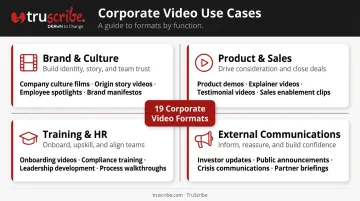
This article breaks down 19 categorized corporate video examples and ideas across four major use cases: brand and culture, product and sales, training and HR, and external communications. For each format, you'll find what makes it work and when to use it.
Key Takeaways:
- Corporate video serves internal and external audiences across four distinct functional areas
- Format choice determines effectiveness — the wrong format fails regardless of production quality
- Animation excels where complexity is highest: training, compliance, and technical explainers
- A single clear objective per video consistently outperforms multi-purpose content
- Whiteboard animation delivers 2.3x higher retention than traditional video formats
What Is a Corporate Video?
A corporate video is any non-advertising video a company produces for internal or external audiences — employees, customers, prospects, investors, or the public. It's distinct from a commercial, which has a direct paid-media sales objective.
Corporate video serves a wide range of purposes:
- Building brand trust and communicating company values
- Training and developing workforces at scale
- Explaining products, services, or processes to buyers
- Communicating with stakeholders and investors
- Driving measurable behavior change across the employee lifecycle
These videos live across websites, email campaigns, employee intranets, LinkedIn, and event screens. LinkedIn is the primary video channel for 80% of B2B teams, according to Wistia's 2026 report.
That reach also means format and audience alignment determine results: a training video built for an intranet will land very differently than a brand film built for LinkedIn.
Brand & Company Culture Corporate Video Examples
Brand and culture videos communicate who a company is, what it stands for, and why it matters — to customers, recruits, and employees alike. These six formats cover the most effective approaches in this space.
Brand Story Video
A brand story video communicates why the company was founded, the problem it solves, and where it's going. It builds emotional connection with prospects and works well on homepages, LinkedIn, and in sales sequences.
What separates a strong brand story from a generic one:
- A clear narrative arc: origin → challenge → solution → vision
- An authentic spokesperson or voiceover rather than a scripted announcer
- An emotional call to purpose, not a product pitch
LinkedIn Creative Labs research found that cinematic brand films produced a 129% engagement lift in B2B contexts, and that emotionally rich stories generated 36% more engagement than function-first content. Storytelling features also accounted for 73% of video completions in the same study.
Brand Vision / Mission Statement Video
A mission or vision video goes beyond products to articulate core values and long-term purpose. It's effective for attracting values-aligned customers, employees, and partners.
The best versions lead with a bold, specific statement of belief — not generic corporate language — and use cinematic visuals or motion graphics to amplify the message. TruScribe's work illustrates what this looks like in practice: culture and values videos for Walmart ("100 Pennies"), Navistar (Culture Transformation), and Amedisys (Core Values Onboarding) each translate organizational identity into hand-drawn visual stories that employees actually remember.
Company Culture & Meet the Team Video
This format humanizes the brand by introducing the people behind the work. It's ideal for recruiting pages, LinkedIn, and partner onboarding.
What makes it compelling:
- Unscripted or lightly scripted employee moments
- Lower-third name tags that add context without interrupting the flow
- A mix of individual personality with team energy
Behind-the-Scenes Video
A BTS video pulls back the curtain on how a company operates — from product creation to event prep — showing how work actually gets done. It performs well on LinkedIn, Instagram, and TikTok, and demonstrates operational expertise without a hard sell.
Day-in-the-Life Employee Video
This format follows one employee through a real workday, showcasing responsibilities, team dynamics, and culture cues. It functions as a hybrid between a culture video and a recruitment asset. Done well, it reduces drop-off during the hiring process by setting honest expectations before an applicant ever submits a resume.
Work-Life Balance / Employee Benefits Video
Popularized by companies like Dropbox, this format highlights wellness benefits, flexible schedules, and employee wellbeing initiatives as competitive differentiators. It works best when led by actual employees sharing genuine experiences rather than HR scripting, and pairs naturally with job postings and career pages.
TruScribe's employee benefits video work helps organizations turn dense Summary Plan Descriptions and compensation packages into formats employees can actually follow and use.
Product, Explainer & Sales Corporate Video Examples
These five formats move prospects through awareness, consideration, and decision stages by educating audiences on what a product does, how it works, and why it matters.
Product Demo Video
A product demo shows the product in action, guided by an expert or narrator, with emphasis on how key features address real customer pain points. Sales teams deploy them in decks, landing pages, and email sequences.
TrustRadius's 2024 B2B Buying Disconnect report found that 54% of buyers — and 67% of enterprise buyers — consulted product demos during purchasing. The key differentiator between a strong demo and a weak one: lead with the customer's problem before introducing the product, and use real use-case scenarios rather than feature checklists.
Product Explainer Video
A product explainer is a short, concept-driven video designed to clarify a new, complex, or unfamiliar offering for audiences who have never encountered it. Animation is the dominant format here — it avoids production complexity and visualizes abstract concepts quickly.
Whiteboard, 2D, and motion graphics each work well. TruScribe's Scribology-based explainers are particularly effective when audiences need to build a mental model before they can evaluate an offering. Financial services tools, medical devices, enterprise software, and industrial systems are common applications.
"How It Works" Animated Explainer
A "How It Works" video zooms in on a specific mechanism, process, or system. It establishes thought leadership and helps audiences understand the logic behind a product or service decision.
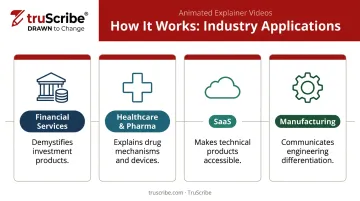
This format reduces sales cycle friction across industries where complexity is a barrier to purchase:
- Demystifies investment products and benefits structures for financial services buyers
- Explains drug mechanisms and device functionality for healthcare and pharma audiences
- Makes technical SaaS products approachable for non-technical decision-makers
- Communicates engineering differentiation in manufacturing and industrial sales
TruScribe has produced this format for clients including HPE, Siemens, Pegasystems, and Danfoss.
"How It's Made" Process Video
This format uses behind-the-scenes footage and narration to walk audiences through a product's creation journey — from raw materials or concept through finished output. It builds appreciation for quality and craftsmanship, and works particularly well for manufacturing, food and beverage, and professional services firms where the process itself is a differentiator.
FAQ / Product Education Video
A FAQ video addresses the most common objections and questions in the consideration stage, reducing friction before the sales conversation begins.
Best practices:
- Display each question as an on-screen text overlay
- Keep answers under 60 seconds each
- Use a consistent presenter or voiceover to build familiarity across the series
87% of video marketers report that video increased sales, and 57% say it reduced support queries, according to Wyzowl. A three-to-five-video FAQ series placed on product pages typically contributes to both results simultaneously.
Training, Onboarding & HR Corporate Video Examples
This category represents one of the highest-ROI applications of corporate video. Internal audiences consume these videos repeatedly, which compounds the value of every production investment. Each of the four formats below serves a different stage of the employee lifecycle.
Employee Onboarding Video
Onboarding videos welcome new hires by walking them through company culture, values, role expectations, and key processes — before or during their first week. The format delivers consistent information to every new hire regardless of location or manager, and is available on demand for rewatching.
TruScribe has produced onboarding content for Walmart, Amedisys, 4Wall Entertainment, Raising Cane's, and Navistar, among others. Each of these projects was designed to accelerate organizational alignment and reduce new-hire disengagement by replacing overwhelming training manuals with sequential visual storytelling.
Corporate Training & L&D Video
Training videos serve ongoing learning and development needs — from compliance and safety to skills development and software adoption — at each employee's own pace, without scheduling constraints.
For complex B2B training content — regulatory processes, multi-step procedures, abstract systems — whiteboard animation is particularly effective. A peer-reviewed study published in PMC found that progressive drawing (the mechanism at the heart of whiteboard animation) significantly improved retention (F = 25.72, p < .001) and knowledge transfer (F = 13.56, p < .001) while reducing cognitive load (F = 28.21, p < .001) compared to static presentation.
TruScribe's Scribology methodology applies these principles in every production:
- Sequential drawing directs viewer attention to what matters next
- Minimalist design keeps cognitive load low
- Hand-drawn visuals activate deeper memory pathways than polished digital graphics
Across more than 5,000 projects and 100 million views, TruScribe's Scribology videos have achieved 2.3x higher retention than traditional video formats.
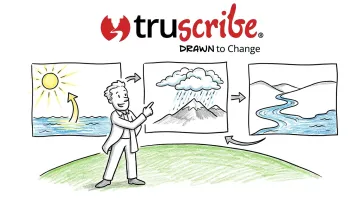
The methodology has earned external recognition: a collaboration with MediaPRO and Eli Lilly on an information security training video earned a Summit Award for creativity in the training space, with MediaPRO's former Chief Learning Officer noting the video generated significant attention across the information security industry.
Campus Tour / Virtual Orientation Video
A virtual campus tour walks remote or pre-start employees through company facilities, helping them feel oriented and welcome before their first day. For organizations with compelling physical environments — labs, production facilities, headquarters campuses — this format also serves as a recruitment tool and employer brand asset.
People & Culture / HR Update Video
HR and people-team leaders use this format to communicate policy changes, benefits updates, DEI initiatives, or company news in a consistent, accessible format employees can watch on their own schedule. Video improves comprehension and retention of complex HR policies, and gives leadership a more human, credible presence in company-wide communication — without the friction of scheduling all-hands meetings or burying updates in email threads.
Event, Testimonial & Communications Corporate Video Examples
These four formats serve external credibility-building and stakeholder communication goals — from building buyer trust to keeping investors informed and communities engaged.
Client Testimonial Video
A client testimonial features a real customer describing their challenge, the solution provided, and the results achieved. No brand-produced content replicates the credibility of an independent endorsement.
The most effective testimonials share three traits:
- Specific — name the problem, name the result
- Short — 90 seconds or under
- Customer-led — the customer's words drive the narrative, not a scripted brand frame
The share of companies planning testimonial videos grew from 17% in 2023 to 47% in 2026, per Wistia's 2026 State of Video report — reflecting accelerating investment in social proof at scale.
Event Highlight & Conference Reel
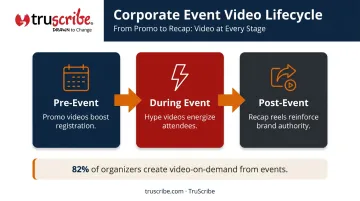
Event highlight videos extend the reach of live moments — capturing key speaker insights, audience energy, and product reveals for audiences who couldn't attend. The format's reach compounds across the event lifecycle:
- Pre-event: Promo videos boost registration
- During event: Hype videos energize attendees
- Post-event: Recap reels reinforce brand authority for digital audiences
82% of event organizers create video-on-demand content from events, and 53% gate at least some of it, according to Bizzabo's 2026 event marketing data. TruScribe supports this full lifecycle — from general session videos and tradeshow booth content to breakout session recaps — so the value of a live event extends well beyond the room.
Investor Relations / Year in Review Video
Where event videos speak to broad audiences, investor relations videos target a narrower, high-stakes one: shareholders and financial stakeholders. These use an annual highlight format to communicate financial milestones, leadership updates, and strategic direction with a tone that inspires confidence. Clear data visualization and a composed, credible presenter are essential. This video typically lives on investor pages, earnings emails, and shareholder reports.
CSR Impact / Charity Video
CSR impact videos document volunteer programs, philanthropic partnerships, or community initiatives — reinforcing that the company's values extend beyond profit. These videos work best when grounded in specifics: named beneficiaries, measurable outcomes, and employees visibly involved — not generic statements about company values.
What Makes a Corporate Video Effective?
Beyond format selection, the most effective corporate videos share three production principles:
- One objective per video — A single, clear purpose prevents cognitive overload and gives the creative team a sharp target
- Audience-specific framing — Internal vs. external, awareness vs. decision stage require different tone, depth, and call to action
- A matched call to action — The viewer's next logical step should be obvious and friction-free
Recommended Length by Video Type
Video length should align with purpose and distribution channel. Shorter is not always better — the video should be exactly as long as it needs to achieve its goal.
| Video Type | Recommended Length |
|---|---|
| Social / brand video | Under 2 minutes |
| Explainer video | 60–90 seconds |
| Product demo | 2–4 minutes |
| Employee onboarding | 3–10 minutes per module |
| Compliance / L&D training | 3–10 minutes per topic |
| On-demand webinar | 31–45 minutes for highest engagement |
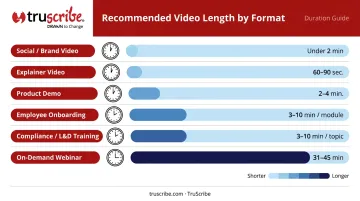
Vidyard's 2024 Business Video Benchmark Report found that 65% of viewers completed videos under one minute, compared to just 20% for videos longer than 20 minutes — a completion gap that reinforces the importance of matching length to viewer intent and context.
Clarity Over Cinematic
Production quality matters, but clarity matters more. A well-scripted, clearly narrated video with purposeful visuals will outperform a cinematic but confusing one every time. Cognitive science explains why: audiences retain information better when visuals and audio reinforce each other rather than compete for attention.
When visual complexity exceeds what the message actually needs, viewers spend mental energy processing the presentation itself instead of absorbing the content. Removing what doesn't serve the message is a deliberate communication decision — and research consistently backs it.
Frequently Asked Questions
What is a corporate video?
A corporate video is any non-advertising video produced by a company for internal or external audiences. The category covers formats from brand films and training videos to investor communications and employee onboarding — any video where the goal is communication rather than direct paid-media sales.
What is the difference between corporate and commercial video?
Commercial video is a paid advertisement with a direct sales objective. Corporate video serves broader communication purposes — training employees, explaining products, building brand trust, or engaging stakeholders — without necessarily carrying a direct sales call to action.
What should be in a corporate video?
Every corporate video needs a clear objective, audience-specific messaging, a compelling opening hook, a structured narrative, and a call to action aligned with the viewer's next step. The objective should drive every other production decision.
How much does a corporate video cost per minute?
Costs vary widely based on format, production complexity, and vendor. Live-action, 2D animation, and whiteboard animation each carry different cost structures. Budget for scripting, production, revisions, and post-production — not just the raw animation or filming time.
How long should a corporate video be?
It depends on purpose: social and brand videos typically perform best under 2 minutes, explainer videos in the 60–90 second range, and training videos can run 3–10 minutes depending on content depth. Match length to viewer intent, not to convention.
What is the most effective corporate video format for employee training?
Animation-based training videos — particularly whiteboard animation — work well for complex or process-heavy content. The sequential drawing mechanism directs viewer attention, reduces cognitive load, and improves knowledge retention compared to static documents or slide decks. TruScribe's Scribology method applies these neuroscience principles to every production, achieving 2.3x higher retention than traditional video formats.