Introduction
Most organizational change initiatives don't fail because the strategy was wrong. They fail because the people side gets mismanaged. According to McKinsey, employee resistance and management behavior were identified as the primary barriers in 72% of failed transformations — making people and execution the dominant risk factors, not flawed planning.
Change management practitioners are the professionals responsible for bridging that gap. They plan, implement, and sustain organizational transitions — ensuring that changes in processes, systems, or goals actually stick at the individual level.
The role demands more than one specialty. Practitioners who succeed aren't just organized project managers or thoughtful communicators — they're both, applied at the right moment across the change lifecycle. Here are the 10 skills that make that possible.
Key Takeaways
- Communication is the single highest-leverage skill — it underpins every other capability on this list
- Empathy, active listening, and stakeholder engagement address the emotional side of change that strategy misses
- Strategic thinking, project management, and analytical thinking keep the operational side on track
- Visual communication tools like whiteboard animation videos help practitioners reach distributed workforces with consistent messaging
- All 10 skills can be developed through certifications, mentorship, and real-world practice
Why Change Management Skills Matter for Practitioners
Change management is a structured discipline covering the planning, implementation, and sustaining of transitions in goals, processes, or technology. Practitioners don't just execute plans — they're accountable for whether people actually adopt the change.
Skill gaps create measurable damage. McKinsey's transformation research found that 20% of total value loss occurs after implementation — meaning organizations that technically "complete" a change initiative still bleed value because adoption wasn't sustained. Separate Prosci benchmarking research found that initiatives with excellent change management are approximately 7 times more likely to meet objectives than those with poor change management.
The consequences of poor change management show up differently depending on the industry:
- Healthcare: Clinical adoption failures create direct patient safety risks
- Technology: Productivity drops sharply during system migrations when users aren't prepared
- Manufacturing: Skipped process training leads to safety gaps and efficiency losses
The 10 skills below address both the human and operational dimensions of change — the ones that separate practitioners who hit their objectives from those who don't.
10 Essential Change Management Skills for Practitioners
Communication
Communication is the foundation. Without it, every other skill in this list operates in a vacuum. Practitioners must convey the what, why, and how of change clearly — and they must do it consistently, across all stakeholder levels, throughout every phase of the initiative.
McKinsey's transformation research found that open senior-manager communication was associated with 8x greater likelihood of success — rising to 12.4x for enterprise-wide changes with continual communication. A single launch announcement is not a communication strategy.
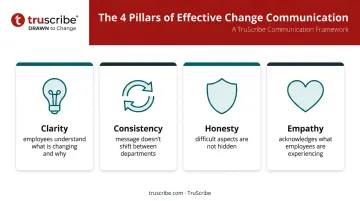
Effective change communication rests on four pillars:
- Clarity — employees understand exactly what is changing and why
- Consistency — the message doesn't shift between departments or managers
- Honesty — difficult aspects of the change are not minimized or hidden
- Empathy — the communication acknowledges what employees are experiencing
For large or distributed workforces, visual formats matter. TruScribe's whiteboard animation videos — built on their Scribology methodology, which uses neuroscience principles to direct attention and sequence information — help practitioners translate complex change narratives into clear, sequential visual stories. That approach delivers a documented 2.3x higher retention rate than traditional video. When the same message needs to reach 5,000 employees across 40 locations, a well-crafted visual explainer eliminates the interpretation gaps that cascading briefings introduce.
Active Listening
Communication only works in both directions. Practitioners who only broadcast information miss the resistance forming underneath the surface — often until it's too late to address it cleanly.
Active listening means creating structured opportunities to hear employee concerns — not just fielding questions at the end of a town hall. Stakeholder check-ins, anonymous feedback channels, and facilitated listening sessions give employees a real voice and give practitioners early intelligence on where resistance is forming.
A 2022 systematic review of 79 organizational change studies identified participation, communication, perceived support, trust, and procedural fairness as the primary drivers of positive employee reactions to change. Active listening directly activates all five. When employees feel heard — and see their input reflected in decisions — psychological safety increases and honest engagement follows.
The key word is visible response. Collecting feedback without acting on it, or acting on it without communicating back, can actually deepen distrust. Feedback channels are only as effective as the follow-through they produce.
Empathy
Organizational change is disorienting. Employees experience fear, uncertainty, and loss of familiarity — even when the change is objectively positive. Practitioners who treat these reactions as obstacles to push through will fail. Practitioners who treat them as data will succeed.
Empathy in this context means recognizing the emotional journey employees are on and using that understanding to inform how change is designed and communicated. It means involving team members in planning where possible, tailoring support structures for different groups, and adjusting the pace when resistance signals deeper concern.
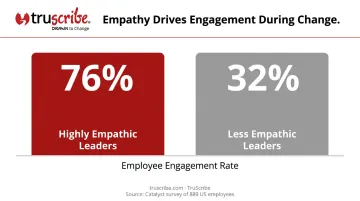
The business case is clear. Catalyst's survey of 889 US employees found that 76% of people with highly empathic senior leaders reported engagement, compared to just 32% under less empathic leaders. Engagement doesn't fall off a cliff overnight during change initiatives — it erodes when people feel the organization isn't seeing them. Empathic practitioners slow that erosion.
Leadership
Change management leadership isn't about positional authority. It's about setting a clear vision, modeling the behaviors the change requires, and motivating people to commit to outcomes they may not have chosen.
Employees take cues from leaders during uncertainty. If a senior practitioner appears hesitant, inconsistent, or disengaged from the change they're championing, those signals travel fast through an organization. Strong change leaders:
- Articulate the vision in terms that connect to employee experience
- Demonstrate the new behaviors before asking others to adopt them
- Address individual and team concerns proactively — not reactively
- Maintain visible presence and communication throughout the transition
Leadership in this context directly impacts morale, engagement, and productivity during transformation — which means it's not a soft skill. It's an operational one.
Adaptability
No change plan survives first contact with implementation intact. Timelines slip. Stakeholders shift priorities. Technology behaves unexpectedly. A practitioner who can only execute the plan as written is a liability.
Adaptability means adjusting approach, messaging, and tactics when circumstances shift — without losing the thread of the overall initiative. It's also a skill practitioners must actively build in the employees they lead, helping teams see change as ongoing rather than exceptional.
Practical strategies for developing adaptability:
- Cultivate self-awareness about your own default reactions to disruption
- Build peer networks with other practitioners who normalize mid-course corrections
- Review what changed after each initiative phase, and document what you'd do differently
- Practice separating the goal (the outcome) from the method (how you get there)
Adaptability isn't a personality trait. It's a practiced discipline — and the practitioners who build it intentionally outperform those who treat every deviation as a crisis.
Problem-Solving
Change management is a problem-solving discipline by nature. Obstacles are not exceptional occurrences; they're scheduled. Practitioners who wait for problems to escalate before addressing them create crises. Those who identify and address obstacles early keep the initiative moving.
Effective problem-solving in this context requires two things working together:
- Analytical rigor — examining root causes, assessing risk, and interpreting data before acting
- Creative flexibility — generating solutions that work for diverse stakeholder groups, not just the technically correct solution
The most common trap is solving for the symptom rather than the cause. An employee group resisting a new system may appear to be a training problem when the actual issue is a fear that the system will eliminate their role. Analytical thinking surfaces the root cause; creative thinking finds a solution that addresses it without undermining the initiative.
Stakeholder Engagement
Stakeholder engagement is not a launch-week activity. It's a discipline that begins in the earliest stages of planning and continues through adoption.
The key principle: involve all affected parties — employees, managers, sponsors, and external partners — early enough that they can actually shape the approach, not just approve it. McKinsey's transformation research found that only 3% of transformations succeeded when line managers and frontline employees were not engaged in the process.
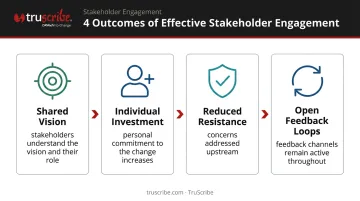
Strong engagement produces four outcomes:
- Stakeholders understand the shared vision and their role in it
- Individual investment in the change increases
- Resistance decreases because concerns were heard and addressed upstream
- Feedback loops remain open throughout the initiative
One important caveat from research: symbolic engagement — inviting participation without genuinely incorporating input — can backfire. A 2024 qualitative study found that attempts to empower employees sometimes left line managers feeling bypassed or ambushed. Meaningful engagement requires giving stakeholders enough lead time and genuine influence to actually affect decisions — not just the appearance of participation.
Strategic Thinking
Strategic thinkers understand the organization's broader goals and design change plans that align with them. That means building timelines that account for what else is happening across the business, sequencing stakeholders deliberately, and anticipating what could derail adoption three months after launch — before those threats materialize.
This skill separates reactive change management from proactive change management. Reactive practitioners respond to problems as they emerge. Strategic practitioners anticipate second-order effects — the downstream consequences of the change that weren't obvious at planning — and build those considerations in from the start.
Practically, strategic thinking in change management means:
- Defining realistic milestones tied to organizational context, not just project convention
- Assigning clear responsibilities and decision rights at each phase
- Building contingency plans before they're needed
- Aligning change milestones to business performance cycles and leadership priorities
Project Management and Organization
The most empathetic, visionary change practitioner will still fail without operational discipline. Change plans need documentation. Resources need allocation. Timelines need tracking. Accountability needs to be visible and enforced.
Project management skills ensure that the human side of change is supported by a reliable operational infrastructure. Practitioners who are skilled here can coordinate cross-functional teams, manage dependencies across workstreams, and quickly identify when the initiative is drifting off course.
Familiarity with change management software and planning frameworks helps — not because tools replace judgment, but because they create structure that makes judgment easier to apply consistently. Without that structure, important tasks fall through gaps, and those gaps compound.
Analytical Thinking
Data tells you whether the change is working — and gives you enough lead time to course-correct before a fixable problem becomes an irreversible one. Analytical thinking is the ability to interpret workforce metrics, adoption rates, performance trends, and feedback survey results — and use that interpretation to guide strategy.
Deloitte describes adoption analytics as converting behavior data into insight about what's working and where to pivot. This is especially critical in two scenarios:
- Justifying continued investment to leadership — when the change is mid-implementation and results aren't yet visible
- Identifying when a course correction is needed — before a fixable problem becomes an irreversible one
The trap to avoid: measuring activity instead of adoption. Training completion rates look good on a dashboard. Whether employees are actually applying what they learned looks different. Analytical thinkers know the difference and track accordingly.
How to Build and Strengthen These Skills
Skill development in change management happens through three primary pathways:
1. Formal Certifications
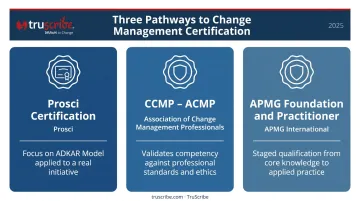
Three widely recognized credentials build different capabilities:
| Credential | Issuing Body | Focus |
|---|---|---|
| Change Management Certification Program | Prosci | Applies the ADKAR Model to a real change initiative |
| Certified Change Management Professional (CCMP) | ACMP | Validates competency against professional standards and a code of ethics |
| Change Management Foundation & Practitioner | APMG International | Staged qualification from core knowledge to applied practice |
2. Mentorship and Peer Learning
Working alongside experienced practitioners — even informally — accelerates skill development in ways that coursework alone doesn't. Many of the judgment calls in change management are learned through exposure to real situations, not frameworks.
3. Real-World Application
Even limited-scope roles on change projects build the muscle memory that transfers to larger initiatives. Volunteer for a support role on an active change project, or document lessons from a recent initiative and identify what you'd do differently.
A practical starting point for practitioners: audit your skill profile across all 10 areas, identify your two or three most significant gaps, and prioritize development there rather than spreading effort evenly.
L&D and HR leaders can reinforce this by creating structured pathways — access to frameworks, cross-functional exposure, and coaching — that make skill-building intentional rather than accidental.
Conclusion
The 10 skills covered here span both dimensions that change management demands: the human side — communication, empathy, active listening, and stakeholder engagement — and the operational side — strategic thinking, project management, and analytical thinking. Practitioners who develop both are equipped to drive change that actually sticks.
Of all 10, communication carries the most leverage. It underpins every other skill and directly determines whether employees understand, accept, and act on the change. That's where visual communication tools earn their place. TruScribe's whiteboard animation videos help change practitioners communicate the what, why, and how of organizational transitions in a format that is consistent across large, distributed workforces, reduces cognitive overload, and improves retention.
Organizations like Navistar have used TruScribe for culture transformation work, and Walmart has used it to communicate organizational values to one of the world's largest and most distributed workforces — proof that the format scales when the message has to reach everyone.
That same principle applies to your own development. If you're building or refining your change management capabilities, start by assessing where you stand across this list. Identify your priority gaps, pick a development pathway, and take the first step — whether that's pursuing a certification, finding a mentor, or rethinking how change messages reach your employees. How you communicate the change is often what determines whether it holds.
Frequently Asked Questions
Frequently Asked Questions
What are the 5 key elements of change management?
The five most commonly cited elements are leadership alignment, stakeholder engagement, clear communication, training and support, and measurement and sustainment. These work together as an integrated system — each one reinforces the others, and gaps in any single area tend to surface as resistance or failed adoption.
What is the most important skill in change management?
Communication. It's the mechanism through which every other skill delivers value: empathy without clear expression doesn't reach employees, and strategic thinking without clear articulation doesn't drive action. Practitioners who communicate well consistently see lower resistance and faster adoption.
How do change management skills differ from project management skills?
Project management focuses on tasks, timelines, and deliverables — ensuring a solution is built and deployed on schedule. Change management focuses on whether people are ready, willing, and able to adopt that solution. Both matter; a technically successful project can still fail if employees don't use what was delivered.
How do you develop change management skills?
Through formal certifications (Prosci, CCMP, APMG), mentorship from experienced practitioners, and hands-on application in real change projects. Peer communities and industry case studies reinforce what structured programs can't always cover.
Can change management skills be learned, or are they innate?
They can be learned. Some people have natural aptitude in areas like empathy or communication, but all 10 skills covered here are deliberately developable through training, practice, and honest reflection on what worked and what didn't.
What role does communication play in reducing resistance to change?
Uncertainty is the primary driver of resistance — and clear, honest, consistent communication directly reduces it. Visual formats improve comprehension and retention, particularly for organization-wide changes where interpretation gaps across locations and departments create real risk.