But what does a video producer actually do? The role is often misunderstood — confused with videographers, directors, or editors — when in reality it's one of the most demanding hybrid roles in creative industries.
This guide covers exactly what a video producer does across all three production phases, the skills that separate good producers from great ones, what the job pays, and how to build a career in this field.
Key Takeaways
- A video producer oversees every stage of a project, from concept and scripting to final delivery, serving as both creative lead and project manager
- Core skills include storytelling, client communication, leadership, budget management, and technical literacy
- The BLS reports a $83,480 median annual wage for producers and directors, with 5% projected job growth through 2034
- Career paths typically move from production assistant → coordinator → staff producer → senior or executive producer
What Is a Video Producer?
A video producer is an audiovisual professional who oversees all stages of a video project — pre-production, production, and post-production — ensuring the finished product meets both creative and business objectives.
The role is broader than most people assume. A video producer doesn't just manage logistics; they own the outcome — accountable for whether the final video actually works.
What Video Producers Work On
The range of projects is wide:
- Corporate brand and marketing videos
- Training, onboarding, and instructional content
- Commercials and sales enablement videos
- Documentaries and long-form storytelling
- Social media content and event coverage
- Internal communications and change management videos
How the Role Differs From a Director
On major film or TV productions, producers and directors are distinct roles — the director manages creative execution on set while the producer handles the business and logistical side. On smaller productions and most corporate video projects, those responsibilities collapse into one person. A producer on a corporate video project often makes every creative call as well.
The key distinction from a videographer: a video producer manages the big picture, not the camera. Where a videographer focuses on capturing footage, a producer is responsible for every decision that shapes what that footage communicates.
What Does a Video Producer Do?
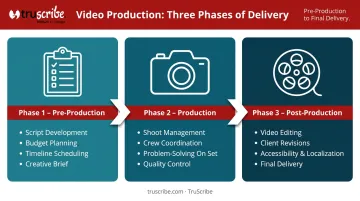
Every video project moves through three phases: pre-production, production, and post-production. The producer is responsible across all three — not just one slice.
Pre-Production: Planning and Vision
This is where the project is defined. A producer in pre-production:
- Meets with stakeholders to clarify objectives ("What do you want viewers to remember? What action should they take?")
- Writes or reviews scripts and develops the narrative strategy
- Identifies key messages and target audience
- Scouts locations and assesses production requirements
- Builds the timeline and estimates the budget
The client-facing work here is critical. A producer who asks the wrong questions in pre-production ends up managing expensive corrections in post. Getting alignment on goals before a single camera fires is what separates well-run productions from chaotic ones.
Once that groundwork is laid, everything depends on executing it well on set.
Production: Managing the Shoot
On set, the producer assembles and coordinates the crew — camera operators, lighting and sound technicians, editors, and talent — while ensuring the footage being captured reflects what was planned.
Production is also where problem-solving happens in real time:
- Equipment fails
- Locations fall through
- Talent is unavailable
- Weather doesn't cooperate
It falls on the producer to resolve these issues quickly without blowing the budget or schedule. That means making fast calls with incomplete information — and keeping the crew moving while doing it.
Post-Production: Delivering the Final Product
Wrapping the shoot doesn't mean the producer's job is done. The post-production phase carries its own deadlines, revision cycles, and budget risks — and the producer owns all of them:
- Collaborates with editors on pacing and story structure
- Approves music, motion graphics, and color grading
- Manages revision rounds with clients
- Tracks budget and deadlines through the final delivery
- Ensures the finished video is delivered in the right formats for each distribution channel
Post-production is where many projects quietly go over budget — scope creep in revision rounds, delayed approvals, last-minute format changes. A producer who manages this phase tightly is what keeps a finished video from becoming an expensive stall.
Key Skills Every Video Producer Needs
Producing requires two distinct competency sets working at the same time: creative instincts and operational discipline. Producers who excel at one but not the other tend to hit a ceiling.
Creative and Storytelling Skills
The ability to craft a compelling narrative is the core skill. A producer must identify the core message, structure it clearly, and ensure every visual and audio element serves that story — not just decorates it.
This matters especially in corporate and instructional contexts, where dense, technical subject matter has to be made accessible without losing accuracy. The question isn't "what do we want to say?" but "what does the audience need to understand, and in what order?"
Communication and Client Management
Producers coordinate between clients, writers, crew, editors, and executives — often simultaneously. The skill isn't just speaking clearly; it's translating between different stakeholders who use completely different vocabularies.
A producer working with an L&D director at a pharmaceutical company needs to understand what the video is trying to change in learner behavior, then communicate that to a scriptwriter and an illustrator in creative terms they can act on. That translation is where many productions break down.
Effective producers ask probing questions early, such as:
- Why does this video need to exist?
- Who is the audience?
- What does success look like in six months?
Leadership and Team Coordination
Producers lead without micromanaging. They assemble the right team, delegate with clarity, maintain morale under deadline pressure, and make final calls when creative disagreements arise.
Strong producers create environments where specialists do their best work — which means knowing when to set direction and then get out of the way.
Budget and Timeline Management
Budget management is a technical skill, not just an administrative one. Producers must:
- Allocate resources across talent, equipment, locations, and post-production
- Track spend continuously against a baseline
- Make trade-off decisions when something costs more than planned
- Keep overlapping production phases from cannibalizing each other
Budget discipline and schedule discipline are inseparable. Pre-production, production, and post often overlap on large projects — a producer managing one without the other will eventually lose control of both.
Technical Literacy
Producers don't need to operate every piece of equipment themselves, but they must understand what cameras, audio gear, lighting setups, and editing software can and can't do — well enough to evaluate quality and guide their team.
O*NET's technology data for producers and directors lists Adobe Premiere Pro, Adobe After Effects, Apple Final Cut Pro, and Avid Media Composer as occupational requirements.
A producer who has never touched editing software struggles to have credible conversations with their editor about what's achievable.
Video Producer vs. Videographer: What's the Real Difference?
This distinction comes up constantly — and hiring the wrong one is an expensive mistake.
A videographer is primarily technical and execution-focused. They operate the camera, manage lighting and audio on set, and capture footage — usually working alone or with a small crew on projects where the creative direction is already defined. Their deliverable is footage.
A video producer is strategic and managerial. They shape the concept, manage the project end to end, coordinate the team, and are ultimately accountable for whether the final video meets its intended objective. Their deliverable is an outcome.
A Simple Decision Framework
| Situation | What You Need |
|---|---|
| You have a clear concept and just need footage captured | Videographer |
| You need help developing the concept and managing the full project | Video Producer |
| You need someone to translate business goals into a finished video | Video Producer |
| You have a defined script and just need it filmed | Videographer |
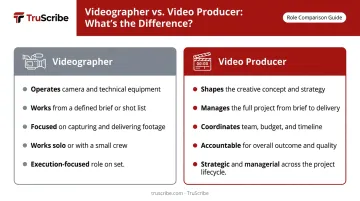
The confusion often arises because on small productions, one person does both. On any project where the brief is still fuzzy, the goals need defining, or multiple stakeholders need to align, you need a producer — not just someone behind a camera.
Video Producer Salary and Career Outlook
What Producers Earn
According to the Bureau of Labor Statistics, the median annual wage for producers and directors is $83,480 (May 2024 data). The mean wage sits higher — the BLS reported a $107,170 mean annual wage in May 2023 — reflecting that high earners pull the average up considerably.
Payscale data breaks the range down by experience:
- Entry-level (under 1 year): ~$45,000 average total compensation
- Early-career (1–4 years): ~$57,700 average total compensation
- All experience levels combined: ~$67,000 average base salary
- Executive Producer: ~$113,500 average base salary, ranging up to $185,000+
Geography and Employer Type Matter Significantly
| Geography / Employer | Annual Mean Wage |
|---|---|
| National median | $83,480 |
| California | $132,990 |
| New York | $139,060 |
| Radio and television broadcasting | $71,710 |
| Advertising and PR agencies | $111,790 |
| Motion picture and video industries | $130,620 |
Source: BLS OEWS May 2023 data.
Job Growth Outlook
Employment for producers and directors is projected to grow 5% from 2024 to 2034, adding roughly 8,300 jobs with approximately 12,800 annual openings. The BLS cites growth in streaming platforms and expansion of video across corporate communications as primary demand drivers.
Corporate demand backs that projection up: 52% of large organizations now use video as their primary training modality, creating sustained demand for producers who understand organizational learning and internal communications — not just entertainment production.
How to Become a Video Producer
Education
Most video producer job postings request a bachelor's degree in film/video production, communications, journalism, or media arts. O*NET data shows 57% of producers and directors in the workforce hold a bachelor's degree. That said, hands-on experience producing videos in collaborative environments can substitute for or supplement formal credentials — particularly in corporate and digital video contexts.
Career Progression
The path is fairly consistent across the industry:
- Production assistant or coordinator — learning the workflow, supporting shoots, handling logistics
- Junior producer or associate producer — managing smaller projects independently, building client relationships
- Staff or mid-level producer — leading projects end to end, growing a portfolio
- Senior producer — managing larger, more complex productions or multiple simultaneous projects
- Executive producer — overseeing entire production departments, major campaigns, or studio operations
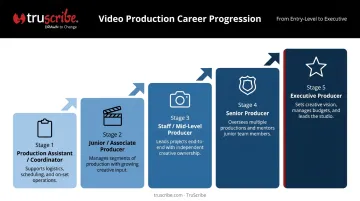
Senior and executive producer roles typically require 7–10+ years of experience.
The Case for Specialization
Climbing that ladder gets easier with a clear niche. Generalist producers face more competition at every level; producers who develop deep expertise in a specific sector — corporate/B2B, medical and life sciences, learning and development, or financial services — tend to command stronger positioning and higher rates.
TruScribe is a concrete example of what niche specialization looks like in practice. The Fitchburg, WI-based whiteboard video studio has delivered over 5,000 projects for more than 1,000 B2B clients — including Microsoft, Merck, Fidelity, and NASA — by focusing entirely on a format built for complex corporate communication. Every production decision, from scripting through final delivery, is guided by the Scribology methodology, which draws on neuroscience and cognitive science to shape how information is sequenced and presented.
The producers and project leads working on those projects don't just manage schedules. They translate pharmaceutical mechanisms, enterprise software architecture, and financial planning concepts into visual stories with measurable outcomes. If you're building a career in B2B video production, that cross-industry content fluency — paired with production craft — is what separates a specialist from a generalist.
Frequently Asked Questions
What is a video producer?
A video producer is an audiovisual professional who manages all stages of a video project: from planning and scripting through filming and post-production, ensuring the final video meets its creative and business objectives. They act as both the creative lead and the project manager.
What skills do you need to be a video producer?
The core skills are storytelling, client communication, leadership, budget management, and project coordination. Producers also need technical familiarity with production tools and editing software like Adobe Premiere Pro, Final Cut Pro, and After Effects.
How much does a video producer make?
The BLS reports a median annual wage of $83,480 for producers and directors. Entry-level producers typically earn $45,000–$57,000, while executive producers can earn $113,000 or more — with California and New York paying well above the national median.
What is the difference between a video producer and a videographer?
A videographer focuses on operating the camera and capturing footage, usually with a defined creative brief already in place. A video producer manages the entire project lifecycle — developing the concept, coordinating the crew, managing the budget, and ensuring the final product meets the original strategic goals.
How do you become a video producer?
Most producers earn a degree in film, communications, or media arts, then build experience through entry-level roles like production assistant or coordinator. The path progresses through larger projects and client relationships until reaching senior or executive producer level.